Tables of Soyga: the first cellular automaton? Anders Sandberg

Source: http://www.aleph.se/andart/archives/2014/04/tables_of_soyga_the_first_cellular_automaton.html

April 17, 2014

Tables of Soyga: the first cellular automaton?

Was the first cellular automaton intended to do encryption and/or summon angels?

Normally the history of cellular automata begins with von Neumann’s classical study of self-replicating systems in the 1950s. While clearly influenced by Turing’s discrete automata, this was the first paper using a grid of cells in different states where each cell changed each clock tick according to a fixed, universal rule. Even Stephen Wolfram seems to think so: “Despite their very simple construction, nothing like general cellular automata appear to have been considered before about the 1950s.”

But maybe von Neumann was scooped by a few centuries.

Liber Soyga

Liber Soyga is a early modern book. It was owned by Dr John Dee, the Elizabethan scholar, magician and government adviser (check out Leslie A. Rutledge’s entertaining “John Dee: Consultant to Queen Elizabeth I“). He mentioned it in a few locations, but the identity of the work was lost for many years. In 1994 Deborah Harkness managed some nice scholarly sleuthing and found copies at the Oxford Bodleian Library and the British Library (filed under an alternative, non-obvious title).The work contains various pieces of astrology, cabalism, lists of supernatural names and summoning formulas. At the end there are 36 36×36 squares of apparently random letters, labelled by the constellations (twice), planets, elements and the word “magistri”.

An example is the first square of Aries:

ndizbdizbdizbdizbdizbdizbdizbdizbdiz
isrlytrlytrlytrlytrlytrlytrlytrlytrl
scucbxibaxibaxibaxibaxibaxibaxibaxib
roernmhggdokqsrnplfdfzlyqsrnplfdfzly
aqbtxdnxytybscuefnutohqtauiducisohqt
mppimcqsgbadzelbhsekfkhaczlaysrfqegb
mozlirdziqxthkceykubhpxqzbnpmreuhkyr
aqucmqablnmsqgitgqrnygdxppcsuiteybat
rdbectiqhsukhmhaigzpmffzrcfumhageqxl
smagikasqpkbkdnpyypeciupgiumlepuuhco
icdmhpoctzmamcqmxozgizygnzydqbrhbksy
nrpbkgusdecdroaofquyabaidensadyzdphd
nhurxymrpslatyqlctenpporpsxkqaabfrtm
iymqsgsbrfnpingrodkefrbtzunasipptbxd
sgsauykreueflkyiessnuiqqummzuarcyris
rscdbamqbyuxcnnzgauelfsaydrlrmqzatrf
ausmacpfddbzedshmzyuciipmcucudxpodyx
mtcpolmesmabgkkzohdbezlmlzysesfrbfaz
mslmnbonicdgnamyfktkupaothdzgahyrrmy
aucpceedolaidfogmikbygguleshmzkobtuo
rhhusntmnbcmciexdoskopumkukzohpdgbyf
sqelpcydsksusrqsmniaqmtubybbqeffiqto
iglhusgkkbumregaoxactulrnnqyhkxxasdt
nxclrfiamaydyuyqlsirgcobpctgosfzcxtd
nmbnhlfcpogkoengrflopqlygikyfuxpqsdi
icednbhhufiaqbpuiucrcttgnzmxxmugyktr
slbfppxzyxactkgcmtlolqqdshrimlrsgqqo
ryrrcsfbazcfxbirzxcryhxtclorznhzigyf
aatbeiurmysofdobbzehdnmslhtbbpxpyyoo
mzxrqfyicbufhieqypsqapbuclqyrcarkoyf
mynhxxorokmeyagyozuhfrnlzngehhftsyoo
aapxnmnhtsuuoixoypkzhyebbpuuzkxlpmne
rmofpbpxlpkmnzzqtzmyzaghgxmthplhudsn
sufhurcanfmlkpngbbogfckzimlqefnymcxe
ilclrermmecoszpurnexxsshouctnuencfzg
nbebtnhrzgieiozyidknmrfkfysdsetxsohm

This is similar to many other early modern magical books: John Dee is himself famous among hermeticists for his “Enochian squares“. Exactly how the Soyga squares were to be used is apparently unclear; Dee himself tried asking the archangel Uriel if the book was any good but got told that it was above his clearance.

The next step of the story is that the Soyga squares were reverse engineered by Jim Reeds. He found the rule to generate them: a keyword is used to seed the left edge (the word is written downwards, followed by itself in reverse, in the right order, reverse, and so on – in the above example the word is “nisram”). Each cell depends on the cell to the left and above itself: the letter to the left determines how many steps forward in the alphabet to move from the letter above.

L(i,j)= [L(i-1,j)+f(L(i,j-1))] mod 23, if L(i,j) is the letter in row i and column j. f() is an apparently arbitrary list of values. The top row is generated by L(1,j)= [L(1,j-1)+f(L(1,j-1))] mod 23, taking the left letter as the top letter too.

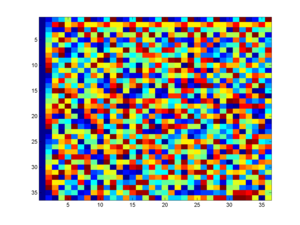
Plotting the result as color rather than letters gives the following pattern:
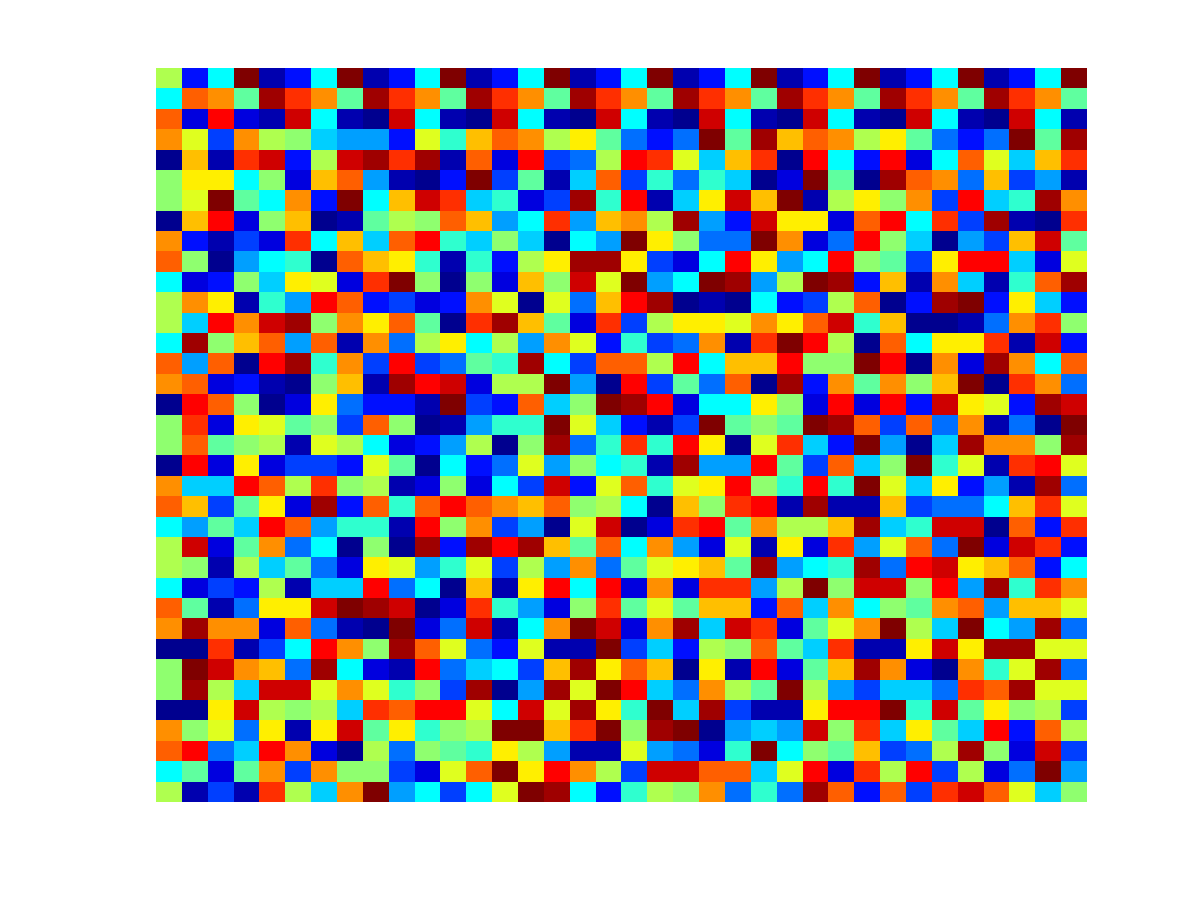
nisramim.png

The Soyga Automaton

The cool thing is that this is essentially a 23 state 1D cellular automaton, where the time is running from the left to the right.The dynamics is strongly chaotic (class 3), producing an apparently random distribution of letters. There is a slight bias because of the top boundary condition: there are two attractor states along the top, one consisting of repetitions of ”dizb” and one of repetitions of “oy”. The oy attractor tends to produce a triangle of repeated “oy”. But even if the keyword is just “a” the pattern is chaotic (as demonstrated in the image at the top).

Using this kind of rule generically produces pseudorandom behavior: nearly any transition table f() will work. Some have triangle slices along the top of repeating patterns, but most seem to approach an even distribution of letter frequency.
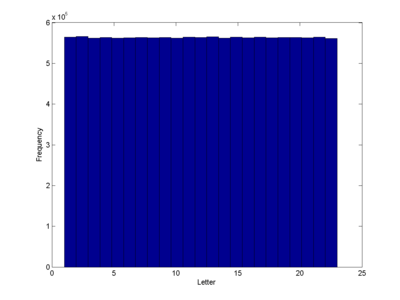
That the dynamics is generically random for many-state automata is well known.
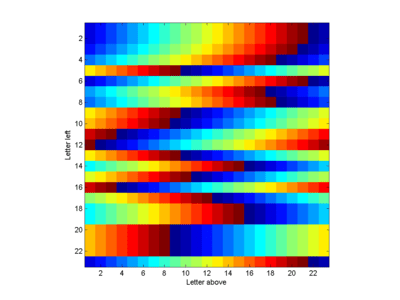
It is less obvious that it would also generate an even distribution of states. However, if one looks at the transition table T(i,j) denoting what letter one gets from having letters i and j to the left and above the uniformity becomes more obvious: each row is a circular shift of the alphabet, so the total number of instances of each resulting letter is the same. A random transition matrix would have produced some letters more often than others. There is still the issue that some matrices like these might have subsets of letters permuted to each other (imagine one where even letters are turned into even letters and odd ones into odd), so some keywords would induce an uneven distribution. But presumably ergodicity is generic for this class of automata.

What was it good for?

Why did the originator invent this rule? Reeds compares it to other letter tables from the same era, and it is pretty clear that Soyga is indeed far more advanced than the other tables. Most have very simple repeating or zigzagging patterns. Rutledge notes that some of Dee’s tables had crudely random patterns reminiscent of a person filling them in by hand in an arbitrary way.Most of these tables were intended for magical use: to make talismans or find sacred names in order to perform magical invocations of angels.

However, I wonder if the purpose was cryptographic: the medieval and early modern ciphers made use of tables of rectification. Trithemius Steganographia is mentioned in Soyga, and is itself an apparent treatise on magic that actually does contain cryptographic work.

Hiding a cipher key in the form of a magical table would seem fairly rational as a cover today, but given how much more sensitive magic was back then (it landed both Trithemius and Dee in trouble) it is a bit like using illegal pornography as a way of hiding encryption keys: not exactly a discreet method if somebody pries.

Soyga might have been a method of generating new tables that were far more random than the Trithemius table. It produces an uniform distribution of letters with nearly no pattern. Take the first 23 rows and columns as a tabula recta and you have something that would be far more resistant to cryptoanalysis.

But given that the Vigenère cipher was viewed as uncrackable, was there a perceived need for anything else? I suspect that the urge to invent new encryption methods has always been strong: if you have a cool idea based on your own field of expertise, you will suggest it (after all, if you cannot break it, it must be unbreakable!).

In fact, the use of a transformation of the previous column seems to be like an autokey cipher. The first real autokey cipher was suggested ion 1556 by Cardano in De Subtilitate, but the first useful on was invented in 1564 by Giovan Battista Bellaso. Vigenère published one in 1586. Liber Soyga was mentioned by Dee in 1583. Could the Soyga automaton be the result of somebody working on an autokey method, perhaps getting the bright idea of applying it again and again to itself? It would seem to fit into the time.

Of course, the border between cryptography and angelic communication might have been blurry. Maybe the tables were seen as both: sufficiently advanced cryptography is indistinguishable from magic.

Posted by Anders3 at April 17, 2014 12:06 PM

http://www.aleph.se/andart/archives/2014/04/tables_of_soyga_the_first_cellular_automaton.html

Going Critical — Melting Asphalt – Kevin Simler


Systems Dynamics may have some limits, according to spruikers of complexity theory as superior to systems thinking – still interesting, though 🙂


Source: Going Critical — Melting Asphalt


Going Critical

by Kevin Simler
If you’ve spent any time thinking about complex systems, you surely understand the importance of networks.
Networks rule our world. From the chemical reaction pathways inside a cell, to the web of relationships in an ecosystem, to the trade and political networks that shape the course of history.
Or consider this very post you’re reading. You probably found it on a social network, downloaded it from a computer network, and are currently deciphering it with your neural network.
But as much as I’ve thought about networks over the years, I didn’t appreciate (until very recently) the importance of simple diffusion.
This is our topic for today: the way things move and spread, somewhat chaotically, across a network. Some examples to whet the appetite:
  • Infectious diseases jumping from host to host within a population
  • Memes spreading across a follower graph on social media
  • A wildfire breaking out across a landscape
  • Ideas and practices diffusing through a culture
  • Neutrons cascading through a hunk of enriched uranium
A quick note about form.
Unlike all my previous work, this essay is interactive. There will be sliders to pull, buttons to push, and things that dance around on the screen. I’m pretty excited about this, and I hope you are too.
So let’s get to it. Our first order of business is to develop a visual vocabulary for diffusion across networks.

A simple model

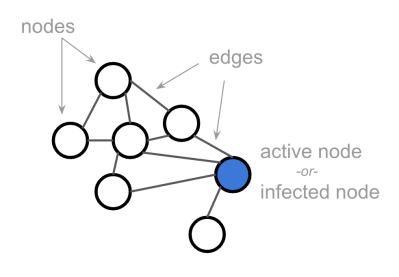
I’m sure you all know the basics of a network, i.e., nodes + edges.
To study diffusion, the only thing we need to add is labeling certain nodes as active. Or, as the epidemiologists like to say, infected:
This activation or infection is what will be diffusing across the network. It spreads from node to node according to rules we’ll develop below.
Now, real-world networks are typically far bigger than this simple 7-node network. They’re also far messier. But in order to simplify — we’re building a toy model here — we’re going to look at grid or lattice networks throughout this post.
(What a grid lacks in realism, it makes up for in being easy to draw 😉
Except where otherwise specified, the nodes in our grid will have 4 neighbors, like so:
And we should imagine that these grids extend out infinitely in all directions. In other words, we’re not interested in behavior that happens only at the edges of the network, or as a result of small populations.
Given that grid networks are so regular, we can simplify by drawing them as pixel grids. These two images represent the same network, for example:
Alright, let’s get interactive.
The network below has playback controls at the bottom. Press the ▷ button to watch the activation spread, or step through one moment at a time:
Reset️▷Step
In this simulation, an active node always transmits its infection to its (uninfected) neighbors.
But this is dull. Far more interesting things happen when transmission is probabilistic.

Continues in source: Going Critical — Melting Asphalt


Redesigning Health Care with Insights from the Science of Complex Adaptive Systems – Crossing the Quality Chasm – Paul Plsek, 2001 – NCBI Bookshelf

A classic of its kind
via SystemsInnovation.io
 

Source: Redesigning Health Care with Insights from the Science of Complex Adaptive Systems – Crossing the Quality Chasm – NCBI Bookshelf


Crossing the Quality Chasm: A New Health System for the 21st Century.

Show details

Institute of Medicine (US) Committee on Quality of Health Care in America.
Washington (DC): National Academies Press (US); 2001.

Appendix B

Redesigning Health Care with Insights from the Science of Complex Adaptive Systems

Paul Plsek

The task of building the 21st-century health care system is large and complex. In this appendix, we will lay a theoretical framework for approaching the design of complex systems and discuss the practical implications.

SYSTEMS THINKING

A “system” can be defined by the coming together of parts, interconnections, and purpose (see, for example, definitions proposed by von Bertalanffy [1968] and Capra [1996]). While systems can be broken down into parts which are interesting in and of themselves, the real power lies in the way the parts come together and are interconnected to fulfill some purpose.

The health care system of the United States consists of various parts (e.g., clinics, hospitals, pharmacies, laboratories) that are interconnected (via flows of patients and information) to fulfill a purpose (e.g., maintaining and improving health). Similarly, a thermostat and fan are a “system.” Both parts can be understood independently, but when they are interconnected, they fulfill the purpose of maintaining a comfortable temperature in a given space.

The intuitive notion of various system “levels,” such as the microsystem and macrosystem, has to do with the number and strength of interconnections between the elements of the systems. For example, a doctor’s office or clinic can be described as a microsystem. It is small and self-contained, with relatively few interconnections. Patients, physicians, nurses, and office staff interact to produce diagnoses, treatments, and information. In contrast, the health care system in a community is a macrosystem. It consists of numerous microsystems (doctor’s offices, hospitals, long-term care facilities, pharmacies, Internet websites, and so on) that are linked to provide continuity and comprehensiveness of care. Similarly, a thermostat and fan comprise a relatively simple microsystem. Combine many of these, along with various boiler, refrigerant, and computer-control microsystems, and one has a macrosystem that can maintain an office building environment.

A distinction can also be made between systems that are largely mechanical in nature and those that are naturally adaptive (see Table B-1). The distinctions between mechanical and naturally adaptive systems are fundamental and key to the task of system design. In mechanical systems, we can know and predict in great detail what each of the parts will do in response to a given stimulus. Thus, it is possible to study and predict in great detail what the system will do in a variety of circumstances. Complex mechanical systems rarely exhibit surprising, emergent behavior. When they do—for example, an airplane explosion or computer network crash—experts study the phenomenon in detail to design surprise out of future systems.

TABLE B-1. Mechanical Versus Naturally Adaptive Systems.

TABLE B-1

Mechanical Versus Naturally Adaptive Systems.

In complex adaptive systems, on the other hand, the “parts” (in the case of the U.S. health care system, this includes human beings) have the freedom and ability to respond to stimuli in many different and fundamentally unpredictable ways. For this reason, emergent, surprising, creative behavior is a real possibility. Such behavior can be for better or for worse; that is, it can manifest itself as either innovation or error. Further, such emergent behavior can occur at both the microsystem and macrosystem levels. The evolving relationship of trust between a patient and clinician is an example of emergence at the microsystem level. The AIDS epidemic is an example of emergence that affects the macrosystem of care.

The distinction between mechanical and naturally adaptive systems is obvious when given some thought. However, many system designers do not seem to take this distinction into account. Rather, they design complex human systems as if the parts and interconnections were predictable in their behavior, although fundamentally, they are not. When the human parts do not act as expected or hoped for, we say that people are being “unreasonable” or “resistant to change,” their behavior is “wrong” or “inappropriate.” The system designer’s reaction typically is to specify behavior in even more detail via laws, regulations, structures, rules, guidelines, and so on. The unstated goal seems to be to make the human parts act more mechanical.

Continues in source: Redesigning Health Care with Insights from the Science of Complex Adaptive Systems – Crossing the Quality Chasm – NCBI Bookshelf

Spreading and scaling up innovation and improvement – Trisha Greenhalgh and Chrysanthi Papoutsi, 2019 | The BMJ


Source: Spreading and scaling up innovation and improvement | The BMJ

Spreading and scaling up innovation and improvement

BMJ 2019; 365 doi: https://doi.org/10.1136/bmj.l2068 (Published 10 May 2019)Cite this as: BMJ 2019;365:l2068

  1. Trisha Greenhalgh, professor,
  2. Chrysanthi Papoutsi, postdoctoral researcher

Author affiliations

  1. Correspondence to T Greenhalgh trish.greenhalgh@phc.ox.ac.uk

Disseminating innovation across the healthcare system is challenging but potentially achievable through different logics: mechanistic, ecological, and social, say

Key messages

  • Spread (replicating an intervention) and scale-up (building infrastructure to support full scale implementation) are difficult

  • Implementation science takes a structured and phased approach to developing, replicating, and evaluating an intervention in multiple sites

  • Complexity science encourages a flexible and adaptive approach to change in a dynamic, self organising system

  • Social science approaches consider why people act in the way they do, especially the organisational and wider social forces that shape and constrain people’s actions

  • These approaches may be used in combination to tackle the challenges of spread and scale-up

The general practitioner in the surgery, the nurse manager on the ward, and the policy maker in the boardroom would be forgiven for losing track of all the new technologies, care pathways, and service models that could potentially improve the quality, safety, or efficiency of care. Yet we know that innovations rarely achieve widespread uptake even when there is robust evidence of their benefits (and especially when such evidence is absent or contested).1 The NHS Long Term Plan points out that every approach prioritised in the plan is already happening somewhere in the NHS but has not yet been widely adopted.2

There are common sense reasons why spreading an innovation across an entire health system is hard. Achieving any change takes work, and it usually also involves—in various combinations—spending money, diverting staff from their daily work, shifting deeply held cultural or professional norms, and taking risks. Simplistic metaphors (“blueprint,” “pipeline,” “multiplier”) aside, there is no simple or universally replicable way of implementing change at scale in a complex system. A technology or pathway that works smoothly in setting A will operate awkwardly (or not at all) in setting B.

Given these realities, what insights does the rapidly growing research literature on spread and scale-up offer the busy clinician, manager, commissioner, or policy maker? How—if at all—does this literature speak to the patient?

“Spread” generally means replicating an initiative somewhere else and “scale-up” means tackling the infrastructural problems (across an organisation, locality, or health system) that arise during full scale implementation,3 though in practice the one blurs into the other.

In this rapid review (the methods of which are described in box 1) we found that scholars of spread and scale-up had used many different theoretical lenses. We have chosen to discuss three—implementation science, complexity science, and social science, each of which is based on a different logic of change (mechanical, ecological, and social, respectively; table 1). Many successful spread and scale-up programmes draw predominantly on one of these lenses but include elements of the other two.

Continues in source: Spreading and scaling up innovation and improvement | The BMJ


Annual Conference – The OR Society – 3-5 September 2019, University of Kent – with Systems Thinking stream

following the success of the systems thinking stream at last year’s OR conference (the largest ever stream in the history of the OR Society!), this year there is a full named stream, not capped as last year at three parallel sessions. Gerald Midgley is quite inspiring in his enthusiasm for this! Abstract submissions deadline is 31 May.

And Canterbury, with its beautiful cathedral, is a notable international draw.

Info on the systems thinking at bottom and this and other relevant streams in the link.


key dates: https://www.theorsociety.com/what-we-do/events-conferences/annual-conference/or61-key-dates/


Source: Annual Conference – The OR Society


OR61: Annual Conference

3-5 September 2019

University of Kent
Sibson Building, Park Wood Rd, Canterbury CT2 7FS

SUBMIT ABSTRACTS

Now in its 61st year, the conference picks up momentum from the 2018 diamond anniversary which saw a record number of delegates in attendance. Whether you work as a practitioner or an academic, OR61 is the place to come and learn about how OR and analytics are transforming the workplace through delivering productivity improvements.

This must-attend conference also promotes debate and future thinking to focus the OR profession on how it needs to evolve to deliver benefits to business, the economy and wider society. OR61 is co-chaired by Professor Said Salhi and Dr Kathy Kotiadis from the University of Kent and will feature three prominent plenary speakers:

  • Professor Erhan Erkut, Vice Rector, MEF University, Istanbul, Turkey
  • Professor Grazia Speranza, IFORS President and former EURO president. Professor of OR, University of Brescia, Italy
  • Professor Panos Pardalos, Distinguished Professor of Industrial and Systems Engineering, University of Florida, USA

The University of Kent is one of the country’s leading academic institutions producing world-class research, rated internationally excellent and leading the way in many fields of study. It is a forward-thinking research institution, committed to the transformative power of education and research and to the development and support of our students and staff.


Systems Thinking stream

Many OR and Systems practitioners share a common interest in systemic intervention to address highly complex organizational, social and environmental problems. This stream provides a fantastic opportunity to bring people from both the OR and Systems communities together to learn from one another, so both can be enriched. We welcome the widest possible diversity of practitioners and academics, whichever tradition of systems thinking or systemic OR you come from. We encourage the submission of abstracts discussing applications of systems thinking; methodological innovations; theoretical contributions; thoughts on the diversity, impacts and ethics of systemic OR practice; and reflections on the past, present and future of the relationship between Systems Thinking and OR.

Organisers

Gerald Midgley  – G.R.Midgley@hull.ac.uk
Giles Hindle  – giles.hindle@hull.ac.uk
Angela Espinosa   – A.Espinosa@hull.ac.uk

Four quadrants of systems thinking threats revisited (and complexity)

Some time ago I published here (https://stream.syscoi.com/2018/06/20/four-quadrants-of-systems-thinking-threats/) a four quadrant model of how we might ‘go wrong’ with systems thinking – with each corner creating problems for the field – but contributing something too – and corrective to bring them back to the middle. It is, of course, all dependent on perspective and boundaries and views.

Anyway, in light of the various recent ‘systems thinking is old and bad and complexity is new and good’ discussions, I am sharing a newer version which I’ve renamed the systems thinking and complexity minefield.

Left side errs towards ‘power to’ change the world and idealism, right side ‘power over’ and money, intellectual property etc.

Top errs towards the many and populism, but is likely to lose interest and move on / bottom to the personal, the few.

So top says ‘our tools are right’ (often not knowing there are other approaches), bottom is focused on ‘your tools are wrong’.

https://www.dropbox.com/s/q8rq14u4j91uipu/2019-04-15%20four%20quadrants%20of%20systems%20thinking%20threats%20v2.1BT.pdf?dl=0

Thus we find in the top left the naive enthusiast who thinks whatever they’ve found will change the world. Their path to learning might be to realise the limits of their knowledge and see the bigger, tougher challenge ahead.

Top right is the populariser, who is buying a following at the cost of nuance. They can be confronted with ‘the robust old stuff’, the unsexy 20th Century approaches which are incredibly valuable, and have trodden the same ground before, to better effect.

Bottom right is the gooroo – they can be dragged into the swampy lowlands of actual practice.

And bottom left is the Systems Curmudgeon (TM), who needs to be led into application and acceptance of adopting practices that fit the actual context.

Which are you? Which am I? 😉

None of this is perfect and nobody really wants to be in the game of correcting stuff. I don’t like to be called a ‘gatekeeper’ on twitter (as when someone defined organisational development as ‘the practice of service design applied to organisations’), nor accused of having ad hominem attacks as my go-to along with straw man attacks (especially when they might be right). There’s a case for just making the case you believe to be intellectually honest (‘bearing witness’, I suppose) and ignoring those who seem off or just wrong… But it does muddy the waters awfully, some of the things people say in this field!

Soft systems methodology revisited

csl4d's avatarCSL4D

Combining Checkland and Churchman for systems learning

Systems concepts baffling    Over the past years I have been trying to get a better understanding of the workings of a systems approach described in a workbook that I am co-writer of. Wicked Solutions, as it is called, uses three operable systems concepts to explain systems thinking in a nutshell and get learners to apply them directly on a ‘wicked’ problem of their own so as to gain a direct, hands-on experience of their usefulness. The three concepts are: inter-relationships, perspectives, and boundaries (as in ‘boundary critique’), see also here. It may seem silly that I don’t understand the workings of a systems approach that I have used and written about myself, but I may well be in very good company.

John Poulter      …., in his talk about a closely related systems approach, explains that “what I realized was that I…

View original post 1,100 more words

Systems Innovation London – conference, 7-8 September 2019


Source: Systems Innovation London – Systems Innovation


Systems Innovation London

Overview

Systems Innovation is a conference on applying systems and complexity thinking towards innovating new solutions to complex challenges. This will be the second in this series of events and will take place in London on the weekend of the 7-8th of September. This is an open forum for those organizations and individuals applying complexity and systems thinking in various areas of economy, society, technology or environment towards enabling systems innovation and whole systems change; it is for anyone who feels that complexity theory or systems thinking is central to what they do – or wishes to learn how to apply these new ideas – and is interested in engaging with peer organizations and individuals in open discussion and ideas exchange.

The event will bring together up to 10-15 organizations and some 100-200 individual participants, for an active two days of presentations, workshops and brainstorming sessions on applying the ideas of complexity and systems thinking. The forum will be an opportunity to meet and exchange ideas and perspectives with others in an open space, to foster collaboration and awareness across the community, to hear from our speakers and brainstorm on specific issues of interest to participants. Whether you are a seasoned complexity thinker or new to the area this is a place to connect, learn and see what is happening when it comes to the application of these exciting new ideas to tackling some of today’s most complex challenges across many domains.

Basic Info

What

This will be a weekend conference of presentations, brainstorming and open discussion sessions

When

The dates are set for a two full-day event on the weekend of the 7 – 8th of September

Who

This is for those interested in applying complexity thinking to tackling real-world issues and enabling systems change.

Where

Location is yet to be confirmed but the event will take place in the center of London UK

Activities

Keynotes

Keynote speakers that will present a broad overview to the topics of systems/complexity thinking and systems change/innovation

Presentations

This format is for sharing real-world experience and applied knowledge, presentations are focused on specific domains, eg health, finance, energy etc.

Workshops

This event will include educational presentations, workshops and training seasons, both in the theory of systems and its applications

Panel Discussions

Panel discussions focused on specific themes with 3-4 guests and open to audience engagement

Open Spaces

Participant-driven “open spaces” for focusing on specific, important questions and challenges

Networking

This event will be optimized for networking; for you to find the right people and make the right connections

SI London will be the second in our series of SI events, see the first one in Barcelona

Confirmed Speakers So Far

We are currently confirming speakers and will update this list of participants over the coming weeks.

Nabeel Goheer

Assistant Secretary-General at the Commonwealth Secretariat

Nabeel will talk on his experiences in transforming large bureaucratic systems in the Pakistani Government and the United Nations

Katie Boswell

Systems Change Lead
at NPC

Katie will present on NPC’s insightful research on “Thinking big: How to use theory of change for systems change”

Martin Sandbrook

Leads Systems Learning at
Schumacher Institute

As an overview to his Schumacher Institute’s course, Martin takes us deep into systems thinking as a “world view”

Sanne Pelgröm

Senior service systems designer at Livework Studio

Designer by heart, systems thinker by head, Sanne will take us into the world of designing integrated service systems

Benjamin Taylor

Chief Executive Public Service Transformation Academy

Benjamin will present on the Viable Systems Model and how it relates to his work in public sector transformation

Francesco Filia

CEO Fasanara Capital alternative asset management company

An expert in systemic risk Francesco will illustrate how complexity theory applies to understand nonlinearity in capital markets

Cassie Robinson

Strategic Design Director at Doteveryone

Cassie will present on the theme of “Beyond human-centred design” talking about the emergence of a new kind of system-level design approach

James Greyson

Founder and CEO of BlindSpot
Think Tank

James will be talking on global system change and methods to map & expand the imaginative space for solutions through “blindspotting” and leverage points

Deon Cloete

Research Associate CST, Principal Consultant Transformability

Based upon his PhD research Deon will run a workshop on change agents; how different actors take different roles in trying to change a system

Plus 9 more
speakers to be
confirmed soon

Why Attend

SI events are more than just a gathering, we are working to co-create the agenda when it comes to applying systems thinking, guiding the development of the global systems innovation movements and work to set future visions and directions for this burgeoning area.

The applied systems and complexity community is hugely dispersed consisting of many small organizations spread around the world, we design the SI events as physical connectors, as places to get offline and make those lasting face to face connections.

We know that not everyone is an expert in these ideas so we work to bring in not just great thinkers but also great educators making this a place to learn about systems and complexity thinking, both the abstract ideas but also how they apply within specific context.

This is a place to join the discussion on how to move forward with the application of systems thinking and systems change, both generally and within specific areas of interest; it is a place to get diverse and fresh perspectives that challenge your narrative.

More than just a platform for networking and learning this is a unique place to synthesize different perspectives, spark new ideas and get re-energized. You are sure to come away with new insights and motivation.

One more time – is #systemsthinking meaningfully distinct from #complexitytheory

It’s my opinion that some old canards about a distinction between systems thinking and complexity theory do the rounds – and they are deeply troubling and motivated by some ‘complexity theorists’ intentionally misinterpreting the roots of systems thinking in order to privilege their own work. A recent exchange on twitter – linked below – exemplifies this.

I agree that some ‘systems practice’ is done in a deeply mechanistic way (Nora Bateson has a great line in ‘small arcs of larger circles’ about the dominant mechanistic mindset and ‘no wonder that new thinking is interpreted through the dominant paradigm’). And there are some useful tools and approaches and complexity science is a serious and meaningful endeavour. But the idea that ‘this does this’ and ‘that does that’ is unworthy of us (and as soon as I try to address the distinction, it being a distinction, I inevitably fall foul of it as well), and I think we can do better by addressing the fact that there’s a range of theory, a range of practice, and a range of people – all drawing (whatever the complexity ‘map’ says) on the same roots and all seeking for comparable things – and we need to appreciate them as theory and seek to think about how to use them in positive and constructive ways – and that’s it!

Anyway, have a look at the discussion on twitter below.

Become a system change agent | Forum for the Future

Source: Become a system change agent | Forum for the Future

Join the School of System Change

Applications are now open for Basecamp #7 UK.

You can also express your interest for other upcoming programmes in Europe, the Americas and Asia through this form here.

FAQs

Is this for me?

For each programme we are looking for inspired and intrepid individuals from business, not-for-profits, public sector organisations and other enablers of change to form a strong cohort of twenty participants.

 The network you plug into (participants, workshop facilitators and the organizers) is incredible!  Gina LaMotte, Ecorise

What will I learn?

Basecamp will help you navigate five core capabilities for system change, introducing you to a variety of tools and methods to lead ambitious initiatives and engage others. You will learn with a dozen high-level system change thinkers and practitioners pioneering this field across the world.

Many of the tools introduced have been great organizing tools even if we take them out of the framework of “systems change” so I have been able to apply my learnings to my work in many ways.  Eddie Junsay, Power Shift Network

This is an applied learning programme, where you will first have the opportunity to try out new skills on a complex Fieldwork project we source with our partners, and then embed new practices in your own work.

 It was really unique to acquire skills to enable change and build consensus, not technical sustainability knowledge which goes out of date.  Elizabeth Howarth, Transport for London

What is the structure of the course?

  • A six month learning journey
  • Two in-person sessions at the beginning and in the middle
  • A collaborative team Fieldwork project after the first in-person session, lasting six weeks
  • Online learning with peer coaching and support from the School of System Change team

The School provided a constant prompt to put theory into practice and learn from it.  Rachel Jetel, We Mean Business

How much does it cost?

  • Corporate: £7,500 or $9000
  • NGO / social enterprise / public sector: £5,250 or $6300
  • Small organisation / freelance / individual: £3,750 or $4500

30% discount for members and partners of Forum for the Future.

VAT does not apply

Find out more about Basecamp #7 UK

Social alliances improve rank and fitness in convention-based societies

cxdig's avatarComplexity Digest

What forces produce and maintain social inequality, and why do society members tolerate this inequality? The “One Percent” clearly benefit from having high status, but low-status individuals have strong incentive to challenge the established pecking order and try to improve their position. This conundrum is particularly striking in the societies of many primates and spotted hyenas, where females who are born to low-status mothers rarely manage to improve their position. Here we find that females who are strongly allied with their group-mates are more likely to improve their status, and that upward social mobility is often achieved with support from their closest allies. This suggests that, much like some animals compete physically for status, these species compete through social alliances.


Social alliances improve rank and fitness in convention-based societies

Eli D. Strauss and Kay E. Holekamp
PNAS April 30, 2019 116 (18) 8919-8924

Source: www.pnas.org

View original post

Origins Of Life – Complexity Explorer course from the Santa Fe Institute, starts 14 June 2019 (free)

Source: Complexity Explorer

THIS COURSE STARTS ON 14 JUN 2019 8AM UTC

Origins Of Life

Lead instructor: 

About the Course: 

This course aims to push the field of Origins of Life research forward by bringing new and synthetic thinking to the question of how life emerged from an abiotic world.

This course begins by examining the chemical, geological, physical, and biological principles that give us insight into origins of life research. We look at the chemical and geological environment of early Earth from the perspective of likely environments for life to originate.

Taking a look at modern life we ask what it can tell us about the origin of life by winding the clock backwards. We explore what elements of modern life are absolutely essential for life, and ask what is arbitrary? We ponder how life arose from the huge chemical space and what this early ‘living chemistry’may have looked like.

We examine phenomena, that may seem particularly life like, but are in fact likely to arise given physical dynamics alone. We analyze what physical concepts and laws bound the possibilities for life and its formation.

Insights gained from modern evolutionary theory will be applied to proto-life. Once life emerges, we consider how living systems impact the geosphere and evolve complexity.

The study of Origins of Life is highly interdisciplinary – touching on concepts and principles from earth science, biology, chemistry, and physics.  With this we hope that the course can bring students interested in a broad range of fields to explore how life originated.

The course will make use of basic algebra, chemistry, and biology but potentially difficult topics will be reviewed, and help is available in the course discussion forum and instructor email. There will be pointers to additional resources for those who want to dig deeper.

This course is Complexity Explorer’s first Frontiers Course.  A Frontiers Course gives students a tour of an active interdisciplinary research area.The goals of a Frontiers Course are to share the excitement and uncertainty of a scientific area, inspire curiosity, and possibly draw new people into the research community who can help this research area take shape!

About the Instructor(s): 

Dr. Sarah Maurer

Dr. Maurer is interested in the abiogenesis from both the origins-of-life and artificial life perspectives. She builds model cells from amphiphiles, and examines possible life-like properties, such as metabolism or growth and division. Her current projects include: the ability of cells to survive in the absence of reproduction, artificial photosynthesis under prebiotic conditions, and studying the behavior of biomolecules and their analogues in less polar solvents to inform our search for life in the solar system and beyond.


Dr. Chris Kempes

Dr. Kempes works at the intersection of physics, biology, and ecology. Using mathematical and computational techniques, he studies how simple theoretical principles inform a variety of phenomena ranging from major evolutionary transitions, to the biogeography of plant traits, to the organization of bacterial communities. He is particularly interested in biological architecture as a mediator between physiology and the local environment, and in developing general perspectives of life that can be applied in astrobiological contexts.


This course is funded through Research Coordination Network (RCN) funded by a National Science Foundation grant  (NSF Grant No. 1745355) on which Chris Kempes (SFI Faculty) and SFI President David Krakauer are co-principal investigators.

Disclaimer. The grantee is responsible for assuring that every publication of material (including web pages) based on or developed under an NSF award, except scientific articles or papers appearing in scientific, technical or professional journals, contains a disclaimer that specifies that the opinions, findings, and conclusions or recommendations expressed are those of the author(s) and do not necessarily reflect the views of the National Science Foundation.

Class Introduction:Class Introduction
How to use Complexity Explorer:How to use Complexity Explorer
Participant map: View Participant Map
Course dates:14 Jun 2019 8am UTC to
02 Sep 2019 7am UTC

Prerequisites:None (useful to have Algebra, Introductory Chemistry and Biology)

Like this course?


Syllabus

  1. Introduction
  2. Chemical Origins
  3. Chemical Comminalities
  4. Early Life
  5. Evolution
  6. Astrobiology & General Outlook

How to stop climate change: six ways to make the world a better place (with systems change) – the Conversation

Source: How to stop climate change: six ways to make the world a better place

How to stop climate change: six ways to make the world a better place

Nobel Peace Prize nominee Greta Thunberg claims we need system change to save the planet, and the majority of experts, from the IPCC, through to our own research, would certainly agree with this.

But for most people, it often isn’t clear what changes actually need to be made to address environmental problems. And ideas that are presented can be seem as extreme to some. This is despite the fact that many experts agree that to really tackle climate change, the focus needs to be on changing the capitalist system to make it more environment-friendly.

System change can sound scary, but as the current system drives social injustice and environmental destruction, a new approach to address bothi s called for. These are some suggestions to help build that new system which also aim to improve people’s lives in the process.

Continues in source How to stop climate change: six ways to make the world a better place

LINKAGE PROPOSITIONS BETWEEN FIFTY PRINCIPAL SYSTEMS CONCEPTS L. Raphael Troncale (1978)

Institute for Advanced Systems Studies
California State Polytechnic University
Pomona, California, U.S.A.

1.0 INTRODUCTION: THE NEED FOR LINKAGES BETWEEN GENERAL SYSTEMS

CONCEPTS
Ackoff states that “the concepts and terms comonly used to
talk about systems have not themselves been organized into a system [1].” Margaret Mead can be heard meeting after meeting criticizing the field she helped popularize for not applying the
“systems approach” to itself. The comparatively slow development
of a paradigm in general systems theory [compare with fields described in (2) and especially (3)] is characterized by endless redefining of the same few terms followed by the rediscovery, and
often rewording of the most comon of these terms in each new
discipline as it “popularizes” the systems level for itself. The
result has been confusion in terminology, a highly fractured and
“fuzzy” paradigm, and a set of introductory texts [4, 5, 6, 7]
none of which can be expected to cover more than a part of the
whole set of concepts available. The fragmentation of concepts
between disciplines and approaches has stifled the widespread
awareness of the consistent set of linkages that potentially exist
among the concepts.

(pdf)

Click to access Original-SoSPT-Paper-NATO-1978.pdf

Designing Freedom: Stafford Beer – full book free (and more) on archive.org


Source: Designing Freedom : Stafford Beer : Free Download, Borrow, and Streaming : Internet Archive


Also – for example:
On The Design Of Stable Systems
by gerald weinberg, daniela weinberg

An Approach To Cybernetics
by gordon pask

Engineeringn Cybernetics
by robert glorioso

The Structure Of Awareness
by vladimir lefebvre

#cybernetics, #cybersyn, #dankaudiostash

s
search
c
compose new post
r
reply
e
edit
t
go to top
j
go to the next post or comment
k
go to the previous post or comment
o
toggle comment visibility
esc
cancel edit post or comment