
Click on link to see full twitter chain: https://twitter.com/Meaningness/status/1010283825333784576
Recent Updates Page 356
Methods for Measuring Viability and Evaluating Viability Indicators

Life and other dissipative structures involve nonlinear dynamics that are not amenable to conventional analysis. Advances are being made in theory, modeling, and simulation techniques, but we do not have general principles for designing, controlling, stabilizing, or eliminating these systems. There is thus a need for tools that can transform high-level descriptions of these systems into useful guidance for their modification and design. In this article we introduce new methods for quantifying the viability of dissipative structures. We then present an information-theoretical approach for evaluating the quality of viability indicators, measurable quantities that covary with, and thus can be used to predict or influence, a system’s viability.
Methods for Measuring Viability and Evaluating Viability Indicators
Matthew D. Egbert and Juan Pérez-Mercader
Artificial Life
Volume 24 | Issue 2 | Spring 2018
p.106-118
Source: www.mitpressjournals.org
Human Nature: our (four) Human Social Instincts

It is often said that “human’s are social animals” without really thinking what that implies. Many creatures are social, in the sense that they live in groups, but there are wide differences in what ‘social’ means – from the simple semi-chaos of herding for cattle or deer through to the elaborate, regimented, division-of-labour society of the termite or the honey bee.
View original post 1,346 more words
Twenty years of network science
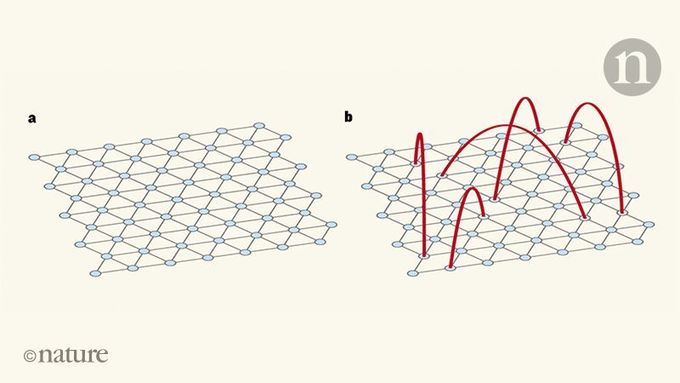
The idea that everyone in the world is connected to everyone else by just six degrees of separation was explained by the ‘small-world’ network model 20 years ago. What seemed to be a niche finding turned out to have huge consequences.
Source: www.nature.com
Predicting perturbation patterns from the topology of biological networks
High-throughput technologies, offering unprecedented wealth of quantitative data underlying the makeup of living systems, are changing biology. Notably, the systematic mapping of the relationships between biochemical entities has fueled the rapid development of network biology, offering a suitable framework to describe disease phenotypes and predict potential drug targets. Yet, our ability to develop accurate dynamical models remains limited, due in part to the limited knowledge of the kinetic parameters underlying these interactions. Here, we explore the degree to which we can make reasonably accurate predictions in the absence of the kinetic parameters. We find that simple dynamically agnostic models are sufficient to recover the strength and sign of the biochemical perturbation patterns observed in 87 biological models for which the underlying kinetics is known. Surprisingly, a simple distance-based model achieves 65% accuracy. We show that this predictive power is robust to topological and kinetic parameters perturbations, and we identify key…
View original post 103 more words
‘four quadrants of systems thinking threats’
A lighthearted and conceptual piece intended to communicate something important, was developed at a SCiO board meeting but I take responsibility for any offence or error…
‘four quadrants of systems thinking threats’ https://www.dropbox.com/s/y36i3t9tu9kcgia/four%20quadrants%20of%20systems%20thinking%20threats.jpg?dl=0
The Systems Approach and its Enemies Helps Us Find the Morality of a Revised Democracy | van Gigch | 2006

In a book series celebrating C. West Churchman, John P. van Gigch digests (and portends to extend) The Systems Approach and its Enemies.
On enemies …
4.1 A MATTER OF DEFINITIONS: ADVERSARIES VERSUS ENEMIES
I note the similarity/difference between the words ‘enemy’ and ‘adversary.’ Other authors use the word adversary (ies) to denote all the forces that impede the progress of his/her own discipline.In the Oxford dictionary (1976), the concepts of adversaries and enemies are considered synonyms. However other sources show a distinction between these two concepts.
An enemy is seen as a hated opponent and is usually considered a person who hates another and eagerly seeks his/her defeat. Words used in lieu of ‘enemy’ include: opponent; hostile army or nation, an alien.
An adversary is an opponent who is not hated; an adversary is someone who is ‘in front of, opposed, coming from another direction, averse…
View original post 936 more words
Managing in complexity – an interview with Prof. Dave Snowden – Richard Atherton
[This should be interesting – I haven’t had time to watch yet but I bet it is good and entertaining, and as one who might have used the ‘curmudgeon’ (and other) tags for Snowden, it will be interesting to see his response. He also looks increasingly like Mandy Patinkin playing Saul Berenson in Homeland]
By Richard Atherton on 17 June 2018
In this interview, FirstHuman Partner Richard Atherton takes a walk and a tea with Professor Dave Snowden.

Dave Snowden is the creator of the Cynefin complexity framework. His Harvard Business Review paper on this topic is one of the most downloaded HBR papers of all time. Dave has forged a career through is early non-profit work to becoming a leading thinker in knowledge management at IBM. He went on to found the company Cognitive Edge, a pioneering firm in the field of ‘sense making’ within organisations and in applying complexity science to organisational challenges.
In this in-depth interview, Dave shares the philosophy underpinning his work. He talks through how people can apply his insights to leading and managing organisations. He also responses to claims that he can sometime to be seen as something of a curmudgeon!
Source: Managing in complexity – an interview with Prof. Dave Snowden – First Human
Living systems – Wikipedia
[I’ve always been suspicious of ‘living systems theory’ as I’ve experienced it as (ironically) highly mechanistic and somewhat simplistic – but there’s a 1,000+ page book so I can’t say I know. The nesting described here sounds good, the fundamental input-process-output dynamic seems potentially limiting]
Living systems are open self-organizing life forms that interact with their environment. These systems are maintained by flows of information, energy and matter.
Some scientists have proposed in the last few decades that a general living systems theory is required to explain the nature of life.[1] Such a general theory, arising out of the ecological and biological sciences, attempts to map general principles for how all living systems work. Instead of examining phenomena by attempting to break things down into components, a general living systems theory explores phenomena in terms of dynamic patterns of the relationships of organisms with their environment.[2]
Theory
Living systems theory is a general theory about the existence of all living systems, their structure, interaction, behavior and development. This work is created by James Grier Miller, which was intended to formalize the concept of life. According to Miller’s original conception as spelled out in his magnum opus Living Systems, a “living system” must contain each of twenty “critical subsystems”, which are defined by their functions and visible in numerous systems, from simple cells to organisms, countries, and societies. In Living Systems Miller provides a detailed look at a number of systems in order of increasing size, and identifies his subsystems in each. Miller considers living systems as a subset of all systems. Below the level of living systems, he defines space and time, matter and energy, information and entropy, levels of organization, and physical and conceptual factors, and above living systems ecological, planetary and solar systems, galaxies, etc.[3]
Living systems according to Parent (1996) are by definition “open self-organizing systems that have the special characteristics of life and interact with their environment. This takes place by means of information and material-energy exchanges. Living systems can be as simple as a single cell or as complex as a supranational organization such as the European Union. Regardless of their complexity, they each depend upon the same essential twenty subsystems (or processes) in order to survive and to continue the propagation of their species or types beyond a single generation”.[4]
Miller said that systems exist at eight “nested” hierarchical levels: cell, organ, organism, group, organization, community, society, and supranational system. At each level, a system invariably comprises twenty critical subsystems, which process matter–energy or information except for the first two, which process both matter–energy and information: reproducer and boundary.
The processors of matter–energy are:
- ingestor, distributor, converter, producer, storage, extruder, motor, supporter
The processors of information are:
- input transducer, internal transducer, channel and net, timer (added later), decoder, associator, memory, decider, encoder, output transducer.
Miller’s living systems theory[edit]
James Grier Miller in 1978 wrote a 1,102-page volume to present his living systems theory. He constructed a general theory of living systems by focusing on concrete systems—nonrandom accumulations of matter–energy in physical space–time organized into interacting, interrelated subsystems or components. Slightly revising the original model a dozen years later, he distinguished eight “nested” hierarchical levels in such complex structures. Each level is “nested” in the sense that each higher level contains the next lower level in a nested fashion.
His central thesis is that the systems in existence at all eight levels are open systems composed of twenty critical subsystems that process inputs, throughputs, and outputs of various forms of matter–energy and information. Two of these subsystems—reproducer and boundary—process both matter–energy and information. Eight of them process only matter–energy. The other ten process information only.
All nature is a continuum. The endless complexity of life is organized into patterns which repeat themselves—theme and variations—at each level of system. These similarities and differences are proper concerns for science. From the ceaseless streaming of protoplasm to the many-vectored activities of supranational systems, there are continuous flows through living systems as they maintain their highly organized steady states.[5]
Seppänen (1998) says that Miller applied general systems theory on a broad scale to describe all aspects of living systems.[6]
Continues in source: Living systems – Wikipedia
what are the key things to learn about Pattern Languages? What’s a good way in
I’m at a retreat on ‘building the field of systems change’ and was asked about pattern language – what’s a good way to see an overview and grasp core concepts? Probably mentioning the medicine wheel, Nietzsche and ayurveda wasn’t the best way in – though I referenced a bunch of the below. And we connected to Lakoff’s ideas on metaphor and framing.
Any advance on this?
David Ing :
http://coevolving.com/commons/20161028-pattern-manual-for-service-systems-thinking
(includes slides and video)
and much more, for example
https://www.linkedin.com/pulse/alexandrian-pattern-language-wicked-problems-david-ing/
Click to access Ing_Slides_2014.pdf
(and his recent book)
David is the person to speak to for current state of the craft, and controversies, and history
From Christopher Alexander (modern ‘original’ pattern language)
https://en.wikipedia.org/wiki/A_Pattern_Language
https://www.patternlanguage.com/
full pdf http://library.uniteddiversity.coop/Ecological_Building/A_Pattern_Language.pdf
Decent paper:
http://zeta.math.utsa.edu/~yxk833/StructurePattern.html
“The Structure of Pattern Languages”, by Nikos A. Salingaros
This builds on Christopher Alexander but the point in David Ing’s PUARL 2016 paper is that ideas that are based in physical space don’t necessarily apply in social spaces. In particular, service systems are social, not physical – and therefore interactive (see below).
This is probably more useful for complex, human systems: https://ingbrief.wordpress.com/2017/10/29/20171025-0930-michael-mehaffy-horizons-of-pattern-languages-software-cities-planet-plop/
conferences:
PLoP – pattern languages of programmes
https://en.wikipedia.org/wiki/Pattern_Languages_of_Programs
most relevant
PLAST – Pattern Languages for Systemic Transformation
https://www.facebook.com/groups/125513674232534/?ref=nf_target&fref=nf
https://model.report/s/iq7pfa/a_pattern_language_for_systemic_transformation
One of the main things that continues the Alexandrian work is PUARL – http://puarl.uoregon.edu/
The person leading PUARL is Hajo Neis, who is a coauthor with Christopher Alexander https://archenvironment.uoregon.edu/architecture/hajo-neis and http://pages.uoregon.edu/hajoneis/
Helene Finidori is also an interesting and active person to speak to:
https://www.linkedin.com/in/helenefinidori/
And she is closer to, I think, all the group dynamic/facilitation pattern languages
https://groupworksdeck.org/
MG Taylor method : http://www.matttaylor.com/public/public/papers_06/mgt_modeling_language_2.htm
http://www.mgtaylor.com/mgtaylor/gg_description.html
(and of course pattern ‘recognition’ goes much deeper, certainly to cognition and metacognition, see Bongard Games references)
see also https://model.report/s/wr7kjl/a_connection_language_dialogue_methods_collaboration_from_cynthia_kurtz
and the collection of large scale group facilitation techniques:
https://model.report/s/np0uvr/a_collection_of_collective_systems_facilitation_and_delivery_techniques
David says:
‘The conventional description is that “a pattern is a solution to a problem in context”. The challenge, as I’m writing up in the yet-to-be-released workshop proposal for PUARL …
‘In 1966, hierarchical structure (graphically drawn as a root with trees) was criticized in “A City Is Not A Tree” in favour of a semi-lattice (Alexander 1966/1967). Also in 1967, at the formation for Center for Environmental Structure, Pattern Manual then chartered:
‘The environmental pattern language will contain hundreds of subsystems and tens of thousands of individual patterns. Every conceivable kind of building, every part of every kind of building, and every piece of the larger environment will be specified by one or more subsystems of the environmental pattern language.
‘In summary: An environmental pattern language is a coordinated body of design solutions capable of generating the complete physical structure of a city. The language is designed to grow and improve continuously as a result of criticism and feedback from the field (Alexander 1967).
‘So, patterns are less than subsystems, which are less than systems.
‘And the problem is that traditional Alexandrian pattern language is static (as in a built environment) and not interactive (as in a personal computer).’
…’pattern language’ is often used quite loosely for generally useful pattern recognition too.

Social Enterprise Systems Engineering | James Mason | 2015 | Conf on Systems Engineering Research
Theory-building on Social-Enterprise Systems-Engineering “as an applied discipline and as an addition to the development intervention field”. Written by James Mason when he was a Ph.D. candidate at Stevens Institute of Technology, he’s now a professor at Lesley University (Cambridge, MA)
Social Enterprise Systems Engineering (SESE) is defined as that body of knowledge and practice whereby engineering discipline is applied to plan, analyze, design, implement and operate a coordinated network of enterprises processes and stakeholders – in order to create sustainable social value for marginalized populations. Engineering discipline brings the rigor of lifecycle process, verification, validation, non-functional requirements modeling and simulation to assure that the design and performance of solutions are driven by and are traceable to the requirements of stakeholder populations – and that opportunity selection and operational practices align with the social mission and values of the enterprise.
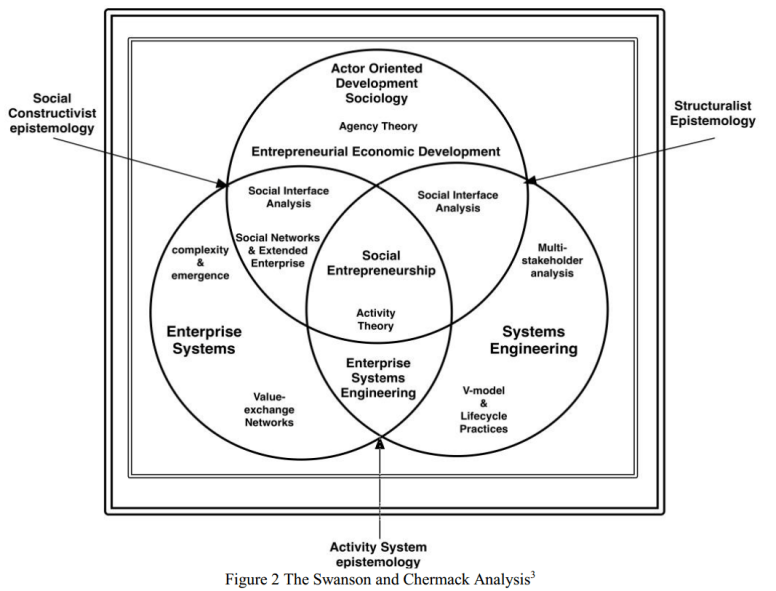
James Mason | “Social Enterprise Systems Engineering” | 2015 | Procedia Computer Science, 2015 Conference on Systems Engineering Research (open access) | doi:10.1016/j.procs.2015.03.067
The big bang of equity + systems change — the outside – Tuesday Ryan-Hart
The big bang of equity + systems change
By bringing fresh air to persistent challenges, we can transcend overwhelm to make a better world together. That’s what we do at THE OUTSIDE: we help collaborators get unstuck with unforgettably pivotal events, capacity-building, and strategy that sparks significant change. Today, we explore the critical ingredient to change that makes a difference: equity. —Tuesday

A conscious practice of equitable systems change often begins with a bang—an abrupt coming-to, a sad realization, a peak of failure or outcry or injustice. Something urgent enough to make us realize the effectiveness and relevance of our systems is diminishing exponentially. From higher up than we have before, we examine the way we live and realize we have more questions than answers.
It dawns on us: the systems governing much of our world are suddenly not as successful as some of us had presumed they should be. Today, this awareness is rapidly shifting:
- Our concept of capitalism
- How we instinctively build cities, products, or democracies
- How we administer education, poverty relief, natural resources, or human rights
- How we control, design, and deliver the modern world through our bureaucracies, organizations, and institutions
As society’s peripheral vision expands to acknowledge the innate value, presence, and contributions of more people, those with a legacy of privilege can see what marginalized communities have always seen—that ‘everything is fine’ applies to a shrinking minority. Everything is, quite plainly, not fine.
Continues in source
Systems Change with an Equity Lens: Community Interventions that Shift Power and Center Race – YouTube
Resources on systems: Toolkits & Practice Guides – rachel sinha – Medium
Resources on systems: Toolkits & Practice Guides
Ok you’re committed to taking a systemic approach, now what?
I’ll tell you what — Total Overwhelm — as you Google it and try and work out where on earth to start.
The good news is there’s been some brilliant collating of tools, frameworks and practice guides for systems change over the last two years.
To make this simple, I’ve looked back through my newsletter content for the last year and condensed this down to the best.
My newsletter is designed to share resources across the field of systems change, so if you want to keep abreast of developments, check it out and sign up. I know everyone hates newsletters, but if you’re interested in systems change, this one is seriously simple and useful.
If you have great resources I’m missing, get in touch (rachel@thesystemstudio.com). And if you missed my blog last month on communicating systems change, you can check this out here.
Systems Toolkits
Toolkit: From the Academy for Systems Change. Taking you through tools for systems leadership, developing a system-wise team, building organizational capacity and engaging stakeholders for systems change. Systems Leaders Fieldbook.
Toolkit: Great list of systems tools and resources, designed for grantmakers, but could be used by anyone. Developed by Geofunders, Systems Grant-making Resource Guide.
Practice Guide: Another useful collection of tools for systemic design from Alberta CoLab, Field Guide to Systems Design.
Practice Guide: Specifically for Innovation Labs, (often used in systems change) Social Innovation Lab Guide from The Waterloo Institute of Social Innovation and Resilience.
Collaboration and community building
Framework: How can we help people create more meaningful communities? This tool is great from Community Canvas.
Toolkit: Nice toolkit from Ashoka on Forming innovative alliances
Systems change for campaigners, activist and organizers
Toolkit: I really, really love this toolkit from the NEON network learn everything from effective campaign strategies for systems change, to building your systems leadership
Measuring systems change
Resource List: Systems change evaluation resources list, from the helpful people at the Gordon and Betty Moore Foundation
sources on systems: Toolkits & Practice Guides – rachel sinha – Medium
Complex Adaptive Systems & Urban Morphogenesis
This thesis looks at how cities operate as Complex Adaptive Systems (CAS). It focuses on how certain characteristics of urban form can support an urban environment’s capacity to self-organize, enabling emergent features to appear that, while unplanned, remain highly functional. The research is predicated on the notion that CAS processes operate across diverse domains: that they are ‘generalized’ or ‘universal’. The goal of the dissertation is then to determine how such generalized principles might ‘play out’ within the urban fabric. The main thrust of the work is to unpack how elements of the urban fabric might be considered as elements of a complex system and then identify how one might design these elements in a more deliberate manner, such that they hold a greater embedded capacity to respond to changing urban forces. The research is further predicated on the notion that, while such responses are both imbricated with, and stewarded…
View original post 146 more words
 Systems Community of Inquiry
You must be logged in to post a comment.