
woah… mind ‘splode.
literally… metaphorically.
Recent Updates Page 360
“Use of Self as an Instrument of Change” Study – thanks to CoCreative Consulting newsletter, plus other links
Thanks to the excellent newsletter from the excellent CoCreative Consulting (The Work is Growing! News, resources, and tools for system change – have a look for much more on collaboration, systems change, and network building), I found this piece:
“Use of Self as an Instrument of Change” Study
Dr. Mee-Yan Cheung-Judge of Quality & Equality and Professor David W. Jamieson of the University of St. Thomas have released an intriguing new survey about how we as change leaders use ourselves intentionally as instruments of change. Although the research team is focused on the field of OD, we got permission to invite people who are leading and facilitating change in larger systems. With over 137 assessment items (the intent of the survey is to narrow their future inquiry), we found the survey to be a useful and compelling tool for self-reflection.To participate, you must have 5 or more years of OD practice experience, internally or externally, or 5 years of actively facilitating complex systems change. Find more information here
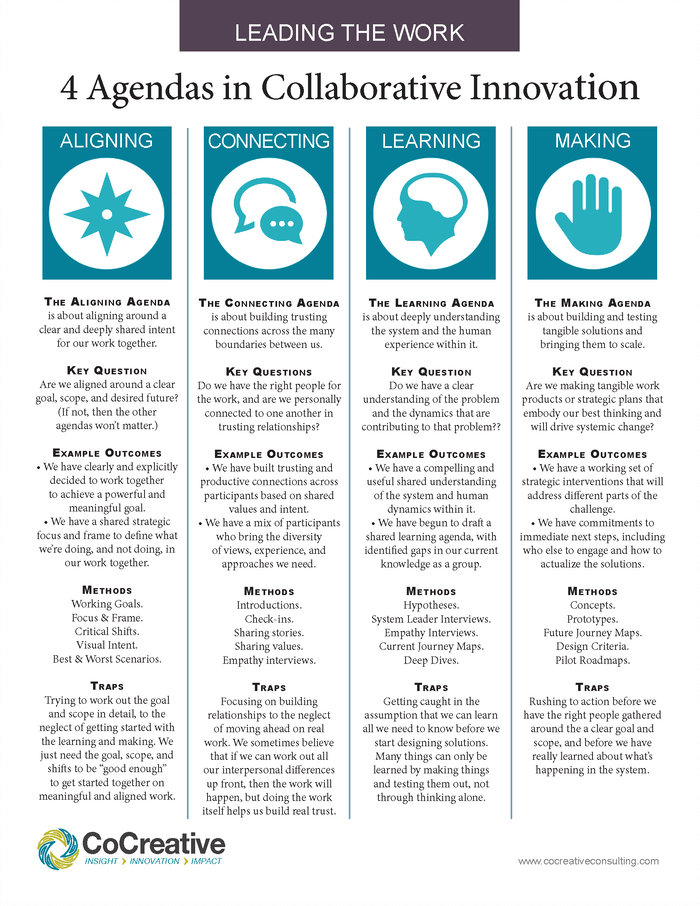
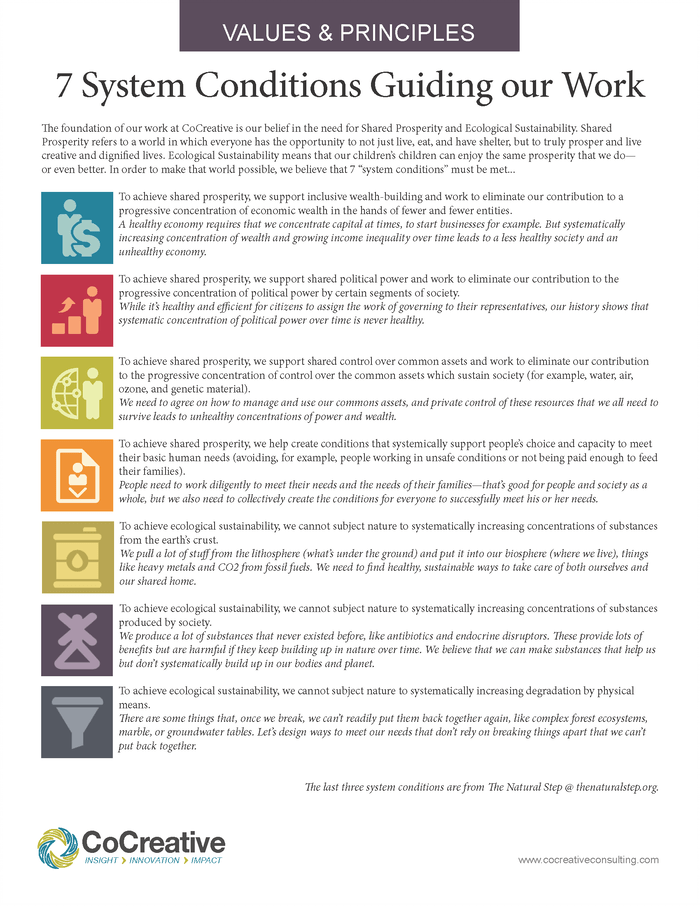
Also, (links with further info in newsletter link at top), two great visual pieces – agendas in collaborative innovation, and systems conditions guiding their (CoCollaborative) work:

Living Systems | James Grier Miller | 1978
The 1100+ page Living Systems book published in 1978 by the founder of Behavioral Science in 1956, James Grier Miller, became available as a softcopy on the Internet Archive in May 2017.
What is a living system and what does it do? Many scientists coming from diverse scientific backgrounds, when engaged in the search for general principles to integrate our understanding of the phenomena of life, have placed major emphasis on the notion of living systems composed of interrelated units. The various “systems theories” differ greatly in their concepts and definitions of basic terms. Their common goal is to organize the findings in some or all of the sciences of life and behavior into a single conceptual structure.
1. One general theory of living systems
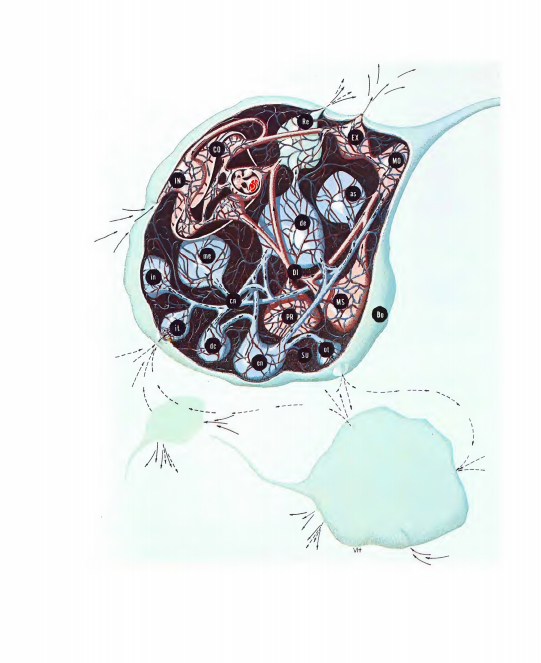
The general living systems theory which this book presents is a conceptual system concerned primarily with concrete systems (see page 17) which exist in space-time. Complex structures which carry out living processes I believe can be identified at seven hierarchical levels (see page 25) — cell, organ, organism, group, organization, society, and supranational system. My central thesis is that systems at all these levels are open systems composed of subsystems which process inputs, throughputs, and outputs of various forms of matter, energy, and information. I identify 19 critical subsystems (see page 32 and Table 1-1) whose processes are essential for life, some of which process matter or energy, some of which process information, and some of which process all three. Together they make up a living system, as shown in Fig. 1-1. In this table the line under the word “Reproducer” separates this subsystem from the others because that subsys- tem differs from all the others by being critical to the species or type of system even though it is not essen- tial to the individual. Living systems often continue to exist even though they are not able to reproduce. Subsystems in different columns which appear oppo- site each other have processes with important similar- ities — for instance, the processes carried out by the ingestor for matter and energy are comparable to those carried out by the input transducer for information. In general the sequence of transmissions in living systems is from inputs at the top of Table 1-1 to outputs at the bottom, but there are exceptions. [p. 1]
Fig. 1-1 A generalized living system interacting and intercommunicating with two others in its environment.
Subsystems which process both matter-energy and information: Reproducer (Re); Boundary (Bo).
Subsystems which process matter-energy: Ingestor (IN); Distributor (DI); Converter (CO); Producer (PR); Matter-energy storage (MS); Extruder (EX); Motor (MO); Supporter (SU).
Subsystems which process information: Input transducer (IT); Internal transducer (IN); Channel and net (CN); Decoder (DC); Associator (AS); Memory (ME); Decider (DE); Encoder (EN); Output transducer (OT). [p. 2]
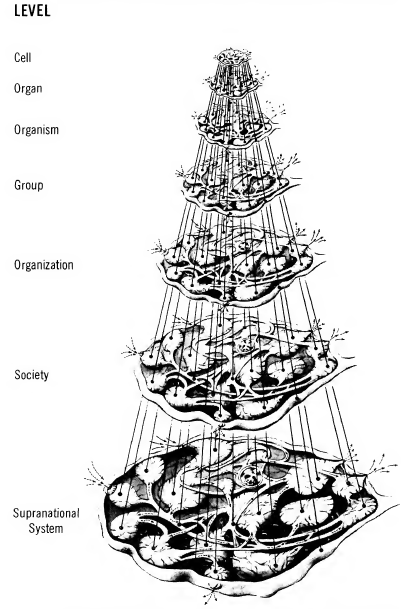
Systems at each of the seven levels, I maintain, have the same 19 critical subsystems. The structure and processes of a given subsystem are more complex at a more advanced level than at the less advanced ones. This is explained by what I call the evolutionary principle of “shred-out,” a sort of division of labor (see Fig. 1-2). Cells have the 19 critical subsystems. When mutations occurred in the original cells, the mutant could continue to exist only if it could carry out all the essential processes of life of the 19 subsystems; otherwise it would be eliminated by natural selection. The general direction of evolution is toward greater complexity. As more complex cells evolved, they had more complex subsystems, but still the same 19 basic pro- cesses. Similarly as cells evolved into more complex systems at advanced levels — organs, organisms, and so on — their subsystems shredded out into increasingly complicated units carrying out more complicated and often more effective processes. If at any single point in the entire evolutionary sequence any one of the 19 subsystem processes had ceased, the system would not have endured. That explains why the same 19 subsystems are found at each level from cell to supra- system. And it explains why it is possible to discover, observe, and measure cross-level formal identities (see page 17). [pp. 1,4]
Fig. 1-2 Shred-out. The generalized living system (see Fig. 1-1) is here shown at each level. The diagram indicates that the 19 subsystems at the level of the cell shred out to form the next more advanced level of system, the organ. This still has the same 19 subsystems, each being more complex. A similar shredding-out occurs to form each of the five more advanced levels — organism, group, organization, society, and supranational system. [p. 4]For each subsystem I identify about a dozen variables representing different aspects of its processes. It would be easy to identify more if one wanted an exhaustive list. Each of these variables can be measured at each of the levels, and the sorts of variation discovered can be compared across the levels. The interactions between two or more variables in a single subsystem or in multiple ones can also be observed, measured, and compared across the levels. This is how cross-level formal identities, basic to a general theory of living systems, can be examined (see page 27).
This book is an effort to integrate all the social, biological, and physical sciences that apply to structure or process at any of the seven levels. Physiology, biochemistry, genetics, pharmacology, medicine, economics, political science, anthropology, sociology, and psychology are all almost entirely relevant. Physical science and engineering also contribute. Logic, mathematics, and statistics yield methods, models, and simulations, including some involving the relatively new approaches of cybernetics and information theory. [p. 4]
References
Miller, James Grier. 1978. Living Systems. McGraw-Hill. https://archive.org/details/LivingSystems.
Behavioral Science, A New Journal | 1956 | James Grier Miller
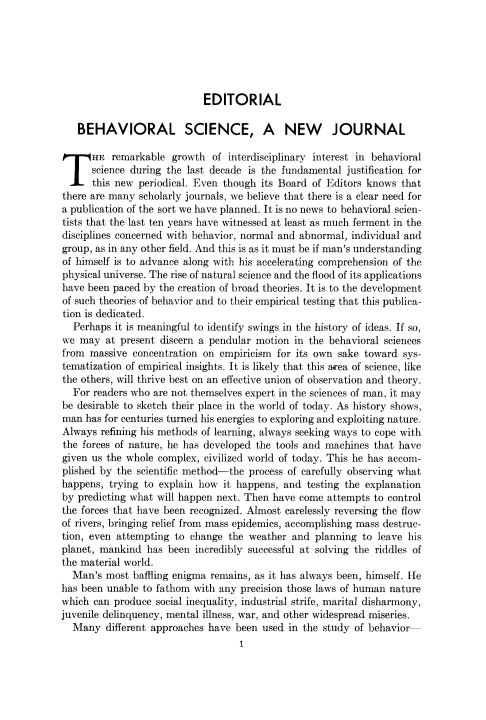
The founding of Behavioral Science in 1956, with James Grier MIller as the founding editor, was sponsored through research into mental health. This interdisciplinary approach was a precursor to the organization now labelled as the International Society for the Systems Sciences.
The remarkable growth of interdisciplinary interest in behavioral science duirng the last decade is the fundamental justification for this new periodical. [….]
Man’s most baffling enigma remains, as it has always been, himself. He has been unable to fathom with any precision those laws of human nature which can produce social inequality, industrial strife, marital disharmony, juvenile delinquency, mental illness, war, and other widespread miseries. [p. 1]
Many different approaches have been used in the study of behavior — mathematical biology, biochemistry, physiology, genetics, medicine, psychiatry, psychology, sociology, economics, politics, anthropology, history philosophy, and others. Though the term “interdisciplinary” is widely current, and for a long time efforts a t collaboration have been made, true unification of these fields still remains an unattained goal. And within each are various schools. Their approaches and skills are specific, but the problems are general. Can the scientific method solve the larger, more pervasive questions about man as well as the smaller, more particular ones? Is the tool with which man has won his victories over the physical world applicable to uncovering the laws which govern man’s conduct, the deepest causes of our strife and our harmony? If the fragments of multiple sciences were brought together in a unitary behavioral science and all the separate skills focused on the study of human behavior, perhaps the time required to find answers to these questions could be reduced. It is possible that inadequacies in the present studies of man could thus be avoided. The uniformities among disciplines could be recognized; better communication among them established ; generality of findings magnified; additional benefits derived from comparing theories in diverse fields, explaining both similarities and differences; and the validity and applicability of empirical work increased by planning individual studies as components of an explicit mosaic of research strategy. [pp. 1-2]
About 1949 a group of faculty members at the University of Chicago, some of whom have now moved to the University of Michigan, began to consider whether a sufficient body of facts exists to justify developing empirically testable general theories of behavior. This group used the term “behavioral science” to cover the diverse areas of their interests, primarily because its neutral character made it acceptable to both social and biological scientists.
Most of the participants were at first skeptical that our comprehension of these different areas had advanced sufficiently to justify such activity. The first meetings engendered a general hopelessness as the diversity of languages and the multitude of approaches to the study of man became increasingly apparent. But then we began to see among us certain commonalties of thinking, despite their many linguistic disguises, and this agree- ment gave us hope that our efforts were not unrealistic.
Members of this group have met intensively for several years as the Committee on Behavioral Science at the Universit,y of Chicago. Some are continuing this activity at Chicago; others went to staff the new Mental Health Research Institute, established in August, 1955, at the University of Michigan; and there they were joined by still others. The Regents of the University and the Legislature of the State of Michigan established this Institute on a permanent basis. [p. 2]
The aim is to conduct basic research; the expectation, that from such research will flow contributions, particularly in the field of mental health and disease, that will help to solve the many problems of human relations. Our understanding of mental illness is primitive compared with our knowledge of other forms of disease, partly because of the complexity of the problems and partly because research efforts have not been commensurate with their magnitude. Public interest in these issues is growing rapidly, as evidenced by the new or greatly increased appropriations for investigation by state legislatures and the Congress, and by additional support from foundations. [pp. 2-3]
In this area of behavioral science there are numerous schools with conflicting beliefs. No one as yet has seen how the insights of psychodynamics, the projective techniques of psychology, the facts of neuropathology, the discoveries of endocrinology, biochernistry, and neurophysiology , and the concepts of social science can be merged into a single framework for explaining the biological and psychiatric and social phenomena of mental illness. There is need now for renewed and exhaustive examination of these separate matters, and for creative attempts to integrate them, to test them empirically, and to apply them.
Such studies should be carried out at various levels. Our present thinking-which may alter with time-is that a general theory will deal with structural and behavioral properties of systems. The diversity of systems is great. The molecule, the cell, the organ, the individual, the group, the society are all examples of systems. Besides differing in the level of organization, systems differ in many other crucial respects. They may he living, nonliving, or mixed; material or conceptual; and so forth.
The strategy of the Michigan Institute’s work will emphasize identification of general principles, which extend across various levels of systems. We shall attempt to clarify and make precise both the general principles and the particular differences; and to test — in laboratories and in clinics, by group studies and by social surveys, with whatever methods prove appropriate — the validity and usefulness of such analysis. Research techniques will probably be derived from several areas, including the physiological, psychological, economic, political, social and cultural.
Although the Institute expects to pay particular attention to the similarities and dissimilarities among different behaving systems, this is only one of many legitimate approaches to behavior theory. Behavioral Science, as a journal with wider scope than any single Institute, will welcome articles which are constructively critical of this orientation or which advance other alternative strategies, as well as articles which present relevant empirical studies. [p. 3]
This is the official publication of the Mental Health Research Institute at the University of Michigan. As such it wil contain edited records of roundtable discussions on theory and reports of other activities involving the Institute. It is hoped that Ann Arbor can in the summer offer its facilities as a meeting center for scientists, many from other institutions, who are concerned with behavior theory or mental health or with related experimental and clinical work. Reports of such conferences and workshops will also be included in this journal. [pp. 3-4]
Other centers are carrying out closely related work. The Committee on Behavioral Science at Chicago, for example, maintains its original interests, and other universities are supporting or planning comparable programs. A particularly significant focus of activity is the Center for Advanced Study in the Behavioral Sciences established by the Ford Foundation and located at Stanford, California. This journal will welcome contributions from scholars a t these centers or elsewhere. It should serve as one channel of communication for members of the ever-increasing group engaged in advancing the sciences of man.
We are aware of no present journal with a primary policy of making its pages available to representatives of any field-the humanities, the social sciences, the biological and medical sciences, and the physical sciences — to discuss theory concerning behavior, and empirical studies clearly oriented to such theory. It has been rare for physicists, psychiatrists, political scientists, and historians to publish in, or even read, the same journal. We shall strive to achieve this end.
[….]
Franz Alexander
Alex Bavelas
David Easton
Ralph W. Gerard
Clyde Kluckhohn
Donald G. Marquis
Jacob Marschak
Anatol Rapoport
Ralph W. Tyler
Raymond W. Waggoner
Some this history is more fully explicated in the 2010 book The Science of Synthesis: Exploring the Social Implications of General Systems Theory, by Debora Hammond.
References
Alexander, Franz, Alex Bavelas, Ralph W. Gerard, Donald G. Marquis, Jacob Marschak, James G. Miller, Anatol Rapoport, Ralph W. Tyler, and Raymond Waggoner. 1956. “Editorial: Behavioral Science, A New Journal.” Behavioral Science 1 (1): 1–5. https://doi.org/10.1002/bs.3830010102.
Hammond, Debora. 2003. The Science of Synthesis: Exploring the Social Implications of General Systems Theory. University Press of Colorado. http://books.google.com/books?id=skSMuZycpTwC , or at a library near you.
About the Merger [of Systems Research, and Behavioral Science] | 1976 | James Grier Miller
After 40 years of research, James Grier Miller reflected on the original direction for Behavioral Science in 1956, and how the field had evolved with Systems Research (which started publication in 1984).
Statement from the Founding Editor of Behavioral Science
About the Merger
After more than 40 years as the editor of Behavioral Science, it is time for me to turn that job over to someone else. The journal will continue under a new name, Systems Research and Behavioral Science. This reflects its merger with the journal Systems Research. I will remain with it in a secondary capacity under Mike C. Jackson, Editor-in-Chief.
From the beginning, Behavioral Science has been interdisciplinary in intent and fact. My editorial in volume 1, number I, asked: ‘Can the scientific method solve the larger, more pervasive questions about man as well as the smaller, more particular ones? Is the tool with which man has won his victories over the physical world applicable to uncovering the laws which govern man’s conduct, the deepest causes of our strife and our harmony? If the fragments of multiple sciences were brought together in a unitary behavioral science and all the separate skills focused on the study of human behavior, perhaps the time required to find answers to these questions could be reduced. It is possible that inadequacies in the present studies of man could be recognized; better communication among the established; generality of findings magnified; additional benefits derived from comparing theories in diverse fields, explaining both similarities and differences; and the validity and applicability of empirical work increased by planning individual studies as components of an explicit mosaic of research strategy?’
The original editorial board reflected this ambitious goal. It included, besides myself, Franz Alexander, a psychoanalyst; Alex Bavelas, a social psychologist; David Easton, a political scientist; Ralph Gerard, a neurophysiologist; Clyde Kluckhohn, an anthropologist; Marion J. Levy Jr, a sociologist; Donald Marquis, a psychologist; Jacob Marschak, an economist; Anatol Rapoport, a mathematical biologist; Ralph W. Tyler, Dean of the Social Sciences Division of the University of Chicago and later director of the Center for the Behavioral Sciences (the Ford Center) in Palo Alto, California; and Raymond W. Waggoner, a psychiatrist. All these people were leaders in their fields at the time.
My focus on interdisciplinary science began early, at the Society of Fellows at Harvard University, of which I was a Junior Fellow. The Society was modeled after the Fellows of Trinity College, Cambridge. Like the young members of their English model, Junior Fellows received full support while pursuing studies in whatever field they chose. And all we had to do was go to dinner on Monday evenings! At those dinners I met as distinguished a group of scholars from all parts of the University as I have encountered anywhere since. Their interaction was fascinating, stimulating — and fun. The group of Junior Fellows I knew there were on their way to becoming leaders in the many fields they repre- sented. I met and became friends with James G. Baker, who specialized in astronomy and optics; Willard van Orman Quine, the logician; Arthur Schlesinger Jr in political science; Robert Woodward, Nobel prize-winning organic chemist, and Paul Samuelson, Nobelist in economics. Alfred North Whitehead, who had been my professor and mentor in my undergraduate studies, had been among the founders of the Society. He continued to be my friend and to encourage my interest in developing a comprehensive theory of human behavior comparable to those emerging in the ‘hard’ sciences.
After medical school and military service in the Office of Strategic Services, several years as Chairman of the Department of Psychology at the University of Chicago again brought me in contact with distinguished people in my own and other disciplines. Among them was Enrico Fermi, whom I met at a discussion club made up of professors. He was certain that only a deeper understanding of human behavior could avert the destruction of human society on a scale vastly larger than he had helped to bring about with the atom bomb. He went with me to President Robert Hutchins and helped to secure funds and support for a Committee on the Behavioral Sciences, to be made up of people of a broad range of interests, who would work toward unifying theory in the sciences of human behavior.
The journal Behavioral Science was an outgrowth of that theory group. I invented the term ‘behavioral science’, which was later recommended by Donald Marquis as the name of the Center for the Behavioral Sciences to express the diversity of our interests. While our journal was planned and designed at the University of Chicago, it did not become a complete reality until several members of the theory group moved with me to the University of Michigan, which offered us an Institute, professorships, and a new building. We became the nucleus of an interdisciplinary group there. The new Institute was called the Mental Health Research Institute. Behavioral Science was published from there for several years, until I moved it to the University of Louisville in Louisville, Kentucky in 1973, when I became president of that institution.
Behavioral Science was planned as an interdisciplinary journal to include all the sciences from those concerned with cells to those that studied supranational systems. We stated it clearly: ‘The editors especially want manuscripts of a theoretical or empirical nature which have broad interdisciplinary implications not found in a journal devoted to a single discipline. Papers should be based on precise observation and quantitative data, and present hypotheses testable at more than one level. Preference is for empirical studies whose findings lead to hypotheses which are testable at various levels . . . Simulation, modeling, and artificial intelligence manuscripts which can lead to verification of general theories applicable across all levels of living and nonliving systems are particularly welcome.’
A second important influence upon the new journal was the then new systems movement which began when Ludwig von Bertalanffy, a biologist, was able to publish his ideas after World War II had ended. He was opposed to the ‘vitalism’ of that day, which insisted upon a nonscientific origin for living things—a first principle or God. He emphasized that they were systems, like the systems of the non-living subjects of the sciences of non-living matter, and could be studied and eventually understood in the same way. The American systems society grew from discussions at the Ford Center in which some of our discussion group members, including Ludwig von Bertalanffy, were involved. We embraced that point of view and it was important to our journal from the beginning.Now this journal moves again, this time to England, where a new editor, a new pubisher and a new name will continue its interdisciplinary emphasis and its basic philosopy. I wish it well, remembering all the people who have worked on it, written for it, and influenced its history. So far the goal of a comprehensive theory of human behavior has not been reached but I believe it is attainable.
James G. Miller
Founding Editor, Behavioral Science
Reference
Miller, J. G. 1976. “Statement from the Founding Editor of Behavioral Science: About the Merger.” Systems Research and Behavioral Science 14 (1): 3–4. https://doi.org/10.1002/(SICI)1099-1743(199701/02)14:1<3::AID-SRES153>3.0.CO;2-F.
Complexity Labs – The world of complex systems http://complexitylabs.io
http://complexitylabs.io
[Wow – can’t quite believe I’ve never linked to this before – but it seems even on https://syscoi.com/model.report/model.report/newest.html I didn’t pick this up. Got it thanks to the wonderful Human Current podcast: http://www.human-current.com/episode-089-nonlinear-systems-technology-with-complexity-labs]
Complexity Labs is an online platform for the research, education, analysis and design of complex systems.
300+ Video Lessons Available
11K Users Per Month
92K Video Lessons Delivered Per Month
2.1M Total Video Lessons Delivered
List of subjects and glossary at http://complexitylabs.io/articles/
Systems Thinking
Critical Thinking
Network Theory
Systems Theory
Adaptive Systems
Emergence
Game Theory
Complexity Theory
Nonlinear Systems
Complexity Science
Social Complexity
Systems Ecology
Complexity Economics
Systems Design & Management
Systems Design
Complexity Management
Political Complexity
Health Systems
Design & Technology
Complex Technologies
Blockchain
Complex Analytics
Token Economics
Glossary
A
- A New Kind of Science
- Abductive Reasoning
- Abstraction
- Acceptance Criteria
- Access Economy
- Adaptation
- Adaptive Capacity
- Adaptive System
- Additivity Principle
- Adjacency Matrix
- Agent Based Models
- Agile Project Management
- Algorithm
- Algorithmic Game Theory
- Allopoiesis
- Anabolic – Catabolic Processes
- Analogical Reasoning
- Analysis
- Anthropocene
- Anthropogenic Biomes
- Argument
- Asymmetry
- Attractor
- Autocatalysis
- Autonomy
- Autopoiesis
- Average Path Length
- Awareness
- Axiom
- Axiom of Causality
B
C
- Carbon Lock-in
- Carrying Capacity
- Catastrophe Theory
- Causality
- Cellular Automaton
- Centrality
- Chaos
- Chaos Theory
- Charge-Discharge Cycle
- Choice Architecture
- Choice Theory
- Circular Economy
- Clique
- Closeness Centrality
- Clustering
- Clustering Coefficient
- Codependency
- Coercive Organizations
- Cognition
- Cognitive Dissonance
- Cognitive Science
- Collaboration
- Collaborative Organizations
- Community Stability
- Complex Adaptive System
- Complex Contagion
- Complex Engineered Systems
- Complex Event Processing
- Complex Projects
- Complex System
- Complexity
- Complexity Economics
- Complexity Management
- Complexity Science
- Complexity Theory
- Computational Complexity
- Computational Irreducibility
- Conceptual Framework
- Conceptual System
- Conflict
- Conflict Theory
- Conservation of Energy
- Consistent Choice Theory
- Constructal Law
- Constructivism
- Control Systems
- Coopetition
- Correlation
- Correlation
- Creative Destruction
- Creative Thinking
- Critical infrastructure
- Critical Mass
- Critical Point
- Critical Slowing Down
- Critical Thinking
- Cyber-physical systems
- Cybernetics
D
- Decentralized Network
- Deduction
- Degree
- Degree Centrality
- Degree Distribution
- Design
- Design Life
- Design Paradigms
- Design Thinking
- Dialectic Development
- Differentiation
- DIKW
- Directed Graph
- Disintegration
- Dissipative Systems
- Distributed Ledger
- Distributed Network
- Distributed Technology
- Divergent-Convergent Thinking
- Dominance Hierarchy
- Downward Causation
E
- Early Warning Signals
- Earth Systems Science
- Ecological Disturbance
- Ecological Network
- Ecology
- Economic Agents
- Economic Equilibria
- Economics
- Econophysics
- Ecosystem Dynamics
- Ecosystems
- Ecosystems Resilience
- Ecotone
- Edge
- Edge of Chaos
- Efficiency
- Efficient Market Hypothesis
- Eigenvector Centrality
- Elements of Reasoning
- Embeddedness
- Emergence
- Emergent Process
- Emergent Property
- Encapsulation
- Energetics
- Energy Pyramid
- Engineering
- Enterprise Architecture
- Entropy
- Environment
- Environmental Gradient
- Environmental Input-Output Analysis
- Epistemological Emergence
- Epistemology
- Equifinality
- Equilibrium
- Ergodic
- Eutrophication
- Event-Driven Architecture
- Evolution
- Evolutionary Psychology
- Evolvability
- Exergy
- Explore or Exploit
- Extrinsic Value
F
- Fallacy
- Fallacy of Composition
- Fallacy Of Division
- Far-From-Equilibrium
- Fast and Slow Variables
- Feedback Loop
- Financialization
- First Law of Thermodynamics
- Fitness Function
- Fitness Landscape
- Formal Language
- Formal Logic
- Formal Models
- Formal System
- Fractal
- Free Energy Principle
- Function
- Functionalism
- Fuzzy Logic
G
H
I
- I = PAT
- Iceberg Model
- IID
- Incentive Theory
- Incentive-Centered Design
- Independence Axiom
- Inductive Reasoning
- Industrial Age
- Industrial Design
- Industrial Ecology
- Industrial Engineering
- Industrial Symbiosis
- Informal Institutions
- Informal Logic
- Information Systems
- Ingroup and Outgroup
- Instantiation
- Integration
- Integrative Levels
- Interdependence
- Interference
- Intermediate Disturbance Hypothesis
- Internet of Things
- Inverse Infrastructure
- Iterative Map
L
M
- Maintainability
- Management
- Market Failure
- Maslow’s Hierarchy
- Maslow’s Hierarchy
- Material Flow Accounting
- Maximum Eco-Exergy Principle
- Maximum Power Principle
- Mean Field Theory
- Measure of Effectiveness
- Metacognition
- Metalanguage
- Metcalfe’s Law
- Metcalfe’s Law
- Methodological Individualism
- Methodological Naturalism
- Micro-Macro Dynamic
- Model
- Modeling Language
- Modernity
- Modular Design
- Modularity
- Motivated Reasoning
- Multi-agent System
- Multilayer Network
- Mutualism
N
- Negative Correlation
- Negative Interdependence
- Negative Synergy
- Negative-Sum Game
- Negentropy
- Nested
- Network Diameter
- Network Diffusion
- Network Dynamics
- Network Effects
- Network Robustness
- Network Topology
- Networked Organizations
- Neutral State
- Newtonian Paradigm
- Niche
- Non-equilibrium Thermodynamics
- Non-Rival Goods
- Non-Zero Sum
- Nonlinear
- Nonlinear Causality
- Nonlinear Correlation
- Nonlinear System
- Normative Organization
- Nudge Theory
O
P
- Paradigm
- Paradigm of Sustainability
- Paradigm Shift
- Path Dependency
- Pattern
- Pattern Formation
- Percolation Resiliency
- Percolation Theory
- Phase Transition
- Platform Organizations
- Platform Technologies
- Positive Correlation
- Positive Interdependence
- Positive Synergy
- Power Law Distribution
- Predation
- Preferential Attachment
- Price of Anarchy
- Process Philosophy
- Process Thinking
- Proof
- Provocation
- Punctuated Equilibrium
R
- R/K Growth
- Radical Uncertainty
- Random
- Random Network
- Rational Agents
- Rational Arguments
- Rationality-Individualism-Equilibrium Nexus
- Rationalizing
- Reason
- Red Queen Effect
- Red Queen Hypothesis
- Reductionism
- Regime
- Regime Shift
- Reification
- Relational Paradigm
- Relational Sociology
- Repeller
- Resiliency
- Rhetoric
- Rival Good
S
- Saltation
- Scale-Free Network
- Schema
- Science
- Second Law of Thermodynamics
- Self-Organization
- Service Design
- Service System
- Service-Oriented Architecture
- Services Revolution
- Servicization
- Silo Effect
- Simple Rules
- Sinks and Sources
- Small-World Network
- Social Adaptive Capacity
- Social Agents
- Social Attractor
- Social Capital
- Social Dilemma
- Social Dynamics
- Social Dysfunctionality
- Social Entropy
- Social Functions
- Social Institutions
- Social Interdependence Theory
- Social Network Analysis
- Social Power
- Social Role
- Social Science
- Social Structure
- Social System
- Socio-Ecological Systems
- Socio-technical systems
- Solutions Stack
- Stakeholder
- Standards of Thinking
- State Space
- STEM
- Strategic Management
- Strong Emergence
- Succession
- Superposition Principles
- Supervenience
- Suprasystem
- Sustainablity
- Symbiogenesis
- Symmetry
- Symmetry Breaking
- Synergy
- Synthesis
- System
- System Dynamics
- System Integration
- System Transformation
- Systems Ecology
- Systems Engineering
- Systems Hierarchy
- Systems Paradigm
- Systems Science
T
What’s normal for the spider is chaos for the fly. Power shift and co-production. #ChurchillFellowship Post 8

 Context is everything. Thanks to Beth Smith (@bethansmith93) for ‘what is normal to the spider is chaos to the fly’, which inspired the illustration above. The quote neatly describes the how different experiences of a situation (the context), can massively influence your feelings and also the decisions you make about the situation.
For the spider it’s ‘business as normal’. A calm and rational approach is the way to proceed. For the fly, its chaos. Total panic stations and doing anything to get yourself out of a dangerous situation. Calm and rational thinking is a long way off for the fly.
Beth used the quote at meeting of the Co-production Network for Wales (link here) and I think it is really effective at pointing out to the people who provide services (the doers), that ‘normal business’ might be experienced very differently (chaos) by the people who use the services (the…
View original post 737 more words
Creating containers and co-design: transforming collaboration Liz Weaver, Co-CEO, Tamarack Learning Centre
This paper was prepared for Tamarack’s Community Change Festival held in
Toronto, Canada from October 1-4, 2018. Learn more or to register visit:
http://events.tamarackcommunity.ca/community-change-festival
COLLABORATION AND COMPLEX PROBLEMS THE COLLABORATIVE PREMISE
It starts with collaboration. This is the coming together of two or more organizations to work collectively, share authority, decision-making and accountability to influence or resolve community opportunities or challenges. Collaboration is viewed as an opportunity for partners to create something new or scale up an existing approach together that might be impossible for a single organization to do on its own.
Collaboration has dominated the horizon of organizing for at least the last thirty years and perhaps longer. Funders have been encouraging and investing in organizations to collaborate to address complex community challenges. There are many reasons for collaboration to happen…
Continued in source:
Relations Between Architecture and Management | David L. Hawk | 1996 | J. Architectural and Planning Research
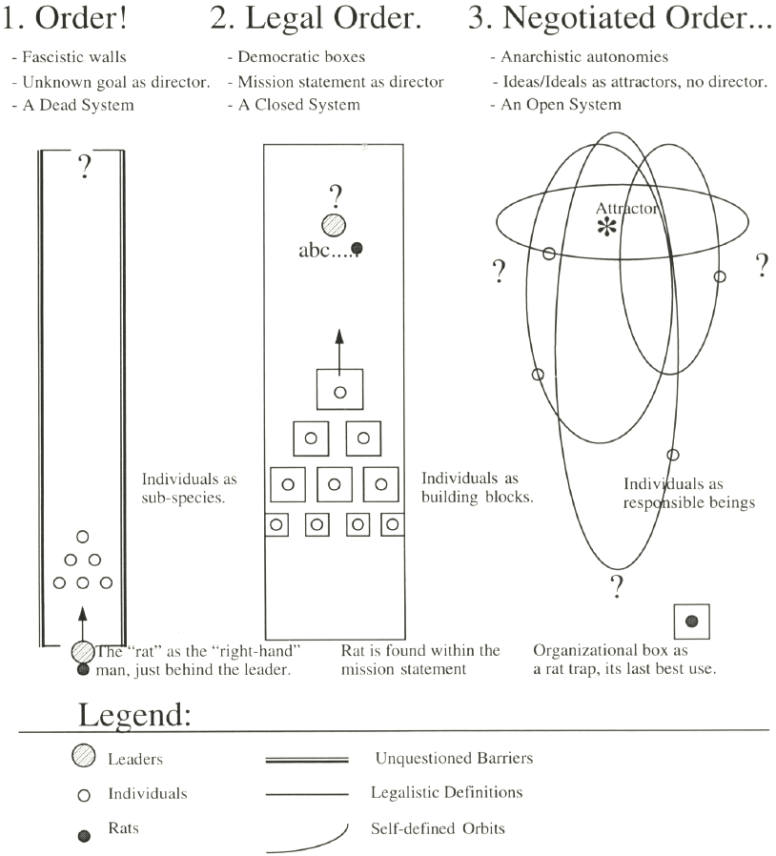
Distinctions between (1) Order!, (2) Legal Order, and (3) Negotiated Ordered are described as modes of management. As a previous coauthor of an article on Negotiated Order, I hadn’t seen this prior article!
Figure 1 points to three distinct modes of management, the evolution of the field, and to where the field must move if we are to meet the challenges of contemporary conditions. To understand the significance of the third mode, it is instructive to examine the first two. The diagram was largely the creation of undergraduate honors students from engineering and architecture while taking a basic principles of management course.
Three Management Models
Figure 1. Three modes of management — hard management for soft times, soft management for hard times
The first mode begins within the management confines of a narrow box. All a manager needs to do is get workers to head down the alley and then prod them to go faster and be more “productive.” Workers need not know to where they are moving or why they work. That is the prerogative of management. It is important to note the phenomenon of the “rat” in managing the operation. The rat is a worker that informs management of the nature and depth of worker discontent. In this way, human problems can be neutralized prior to an upheaval.
The second mode is a logical progression from the first. In this case, the straight lines of the alley-way expand into “democratic boxes,” within which people are undemocratically placed. The manager’s role is to articulate the organization’s mission and to convey it to employees that occupy the boxes. The “rat” retains a role, but in democratic circumstances its role is to help articulate the mission statement, which always tends toward the cynical.
The third mode is a different logical type. Management helps articulate the objectives and ideals of the mission, then falls back into a reduced profile. Each employee is expected to achieve the objective/ideals as he/she sees fit relying on teleological processes. Employees are allowed to question the mission by articulating a new ideal based on having gained better information nearer the front line of action. In this mode, the only use of the box is to bong the “rat.” Elsewhere, this third mode is known as the “negotiated order” mode of management.
Negotiated order processes of management are especially appropriate to the current difficult challenges of society. These require capabilities and capacities far beyond those of early industrial democracy, yet are consistent with ideas fight ancient cultures. An example of this is seen in the validity of principles articulated by Laotse in 500 B.C. China. His argument was that “he who manages least manages best.” This philosophy was the basis of my own 1970s development of the conception of the ideal manager as the “virtual management,” the manager who wasn’t. [pp. 23-24]
References
Hawk, David L. 1996. “Relations Between Architecture and Management.” Journal of Architectural and Planning Research 13 (1): 10–33, http://www.jstor.org/stable/43029192 , cached at https://www.academia.edu/37000183/Hawk_Architecture_Management_96
Parhankangas, Annaleena, David Ing, David L. Hawk, Gosia Dane, and Marianne Kosits. 2005. “Negotiated Order and Network Form Organizations.” Systems Research and Behavioral Science 22 (5): 431–52. https://doi.org/10.1002/sres.717.
How system thinking is killing your creativity – Our Future at Work – Medium
How system thinking is killing your creativity
an organization is not a system

The new open participatory organization (OPO) paradigm entails a move from thinking in terms of systems that can be “known” or “designed” or “intervened upon” by a person or persons who occupy a privileged position outside that system, to thinking in terms of complex responsive processes of human interaction. Since the 1940’s there have been different ways in which we came to think about organizations as systems. The early systems thinkers relied on cybernetic theories of regulatory feedback loops that were encountered or that could be designed inside the system to produce predictable outcomes. Today, cybernetics is still useful in creating operational frameworks where regulatory points function as reminders: what to measure, when to anticipate errors, when to test, how and when to review our work. Cybernetics works well inside closed operational systems that are simple and where results are reproducible.
Culture eats strategy for breakfast
However, whenever we are dealing with humans, complexity arises in the many many local interactions that take place between them in their ordinary everyday activities of organizational life. There is no “outside position” from which an individual or leader can take account of “the whole” and impose interventions on it. This is the meaning of the popular phrase Culture eats strategy for breakfast. Every attempt to control the complex responses of people in participation, only escalates complexity through other measures — adaptive push-back, gaming the system, deviant behavior, leveraging power, ranking and politicking strategies, obfuscations of all sorts, and the like.Furthermore, there is no way to align culture since culture is constituted by streams of values that are continuously shifting in every individual while simultaneously being negotiated among them. When people come together they spontaneously begin to accommodate, assimilate or reconcile power relationships that result from asymmetrical values, needs and skills. During this process, the field of participation continuously shifts from configuration to configuration, creating ever-more complex formulations of what it is to be an I,we, me or us. The notion of searching for fitness in a complex adaptive landscape readily comes to mind.
What “fitness” represents in this process of human interaction, is a coherence that is established when what it is to be I -me is generalized from the myriad particular instantiations that are possible within the context of individuals, into a imagined “whole” or “unity” that is experienced as we-us. This requires that both the autonomy of each individual — the felt sense of the I,accommodates a socially shared aspect — a role that functions as a me; and that this “me” is simultaneously assimilated by every other individual until the moment of reconciliation when the felt-sense of we-ness emerges as a shared reality. This we-ness can be further reified through shared narratives among the many, or rhetorical devices from the few, peer pressure and social anxiety, politics of exclusion and inclusion, and xenophobia and ethnocentric tendencies — to eventually construct a strong sense of an us which is dialectically opposed to a them. This is the point where group coherence — the lively, adaptive, responsive, creative and complex mode of collective participation — collapses into its invariant and pathological form, cohesion, an outcome of unconscious tendencies to concretize the I-me-we forming processes into abstract and invariant formulations of bounded wholes, with insides and outsides, strong delineations of inclusion and exclusion. It is at this point that the collective loses its capacity to authentically participate, and instead falls into paranoia, stasis, and group think that are key indicators of group cohesion. It is only in this state, where people begin to act more like programs than as authentic agents in a field of participation, that the manager can adopt the posture of “acting on” the collective from a privileged position where the manager is free to act, whereas everyone else is subject to interventions from “outside.” Except in extreme cases where either physical or psychological force is employed, the manager’s posture is merely an illusion, only made possible by the collusion of the collective, who, for reasons of their own, act along with the manager in sustaining a fiction that offers some convenience for everyone.
It is this convenience of human collusion, that we commonly call “the system.”
Source: How system thinking is killing your creativity – Our Future at Work – Medium
The Human Current podcast 090: Reclaiming Leadership for the Human Spirit with Margaret Wheatley
[I’ll mostly likely listen to this when it comes up in my podcast circulation, which could be two or three weeks or more – but I would really value any considered reflection and evaluation, since I am fascinated and a little uncertain about Wheatley’s approach. The quotes are ace!]
The Human Current Episode 90
Reclaiming Leadership For The Human Spirit
An Interview With Margaret Wheatley

July 5, 2018
In this episode, Angie interviews best-selling author, speaker, teacher and formal leader, Margaret Wheatley. Meg talks in detail about her new book, Who Do We Choose To Be? Facing Reality | Claiming Leadership | Restoring Sanity, and reveals why she is so driven by her “unshakable conviction that leaders must learn how to evoke people’s inherent generosity, creativity, and need for community”. She also describes how leaders can experiment with complexity theory and systems thinking to better understand the role of emergence and interconnectedness in their work. Meg offers a powerful and thought-provoking message for courageous leaders of this time, calling on them to become “warriors for the human spirit”.
Show Notes
Quotes from this episode:
“We have to give up the paradigm of command and control, of treating people like machines, of denying the fact that people are creative and have deep inward motivation.” — Meg Wheatley
“When people work within the complexity paradigm, you understand that life organizes without control there are dynamics and processes that lead to what Stuart Kauffman, the great complexity scientist said, ‘you get order for free’.” — Meg Wheatley
“My own work now is not in trying to shift the paradigm, but trying to wake up a few devoted, dedicated people to be leaders for this time, which means being warriors for the human spirit.” — Meg Wheatley
“Claiming leadership for me is a conscious choice to step forward with courage, with a stable mind and in a community of other warriors so we can be a peaceful, thoughtful, discerning presence for others.” — Meg Wheatley
“If you are really studying complexity theory and systems thinking, than you are being introduced into deeply spiritual recognition that the world is interconnected and everything depends on everything else.” — Meg Wheatley
“What spirituality means for me is to recognize that I am a minor, modest participant in a very large mystery.” — Meg Wheatley
“Fritjof Capra—who is a dear colleague and friend—his work on living systems theory is the best that’s out there and I would urge any of your listeners who don’t know his work to go to fritjofcapra.net and see what he is offering these days.” — Meg Wheatley
“For me the most overarching, most profound learning I ever got from complexity science was about emergence, and that’s what we are living with right now.” — Meg Wheatley
“This process of adapting as you go is what we humans have completely lost sense about, we just plunge ahead, but every other living system on the planet uses it’s intelligence, uses it’s sensing to take in information from the environment. They have a fundamental freedom in that they can decide what to notice and then they can decide how to respond to what they’ve noticed.” — Meg Wheatley
“There is no real boundary between an organism and its environment. It’s just a constant energy flow and it’s a constant exchange of information and the organism adapts.” — Meg Wheatley
“One of our fundamental flaws is that we believe evolution is a synonym for progress and it’s not.” — Meg Wheatley
“We keep trying to change the overall culture, which is always an emergent phenomenon, by working backwards, by changing the parts, but it doesn’t work that way, life doesn’t change that way.” — Meg Wheatley
“If we understood emergence, we would understand our work better because so many of us, myself included until about 8 years ago, were totally focused on changing large systems in order to change the world. The world needs changing but these large systems are emergent phenomenon, they cannot be changed.” — Meg Wheatley
“If we all become more reflective, we would all become much better equipped to be of service to this time and we would be much more content. It’s the franticness, the rushing around and the withdraw from one another that is really creating this disastrous time for the human spirit.” — Meg Wheatley
“Because we are all interconnected, we are seeing things differently, so of course we are going to be in conflict.” — Meg Wheatley (quote not in recorded episode)
Resources from this episode:

Meg’s most recent book
Meg is also the co-founder and President of the Berkana Institute
She will be teaching a leadership course at Cape Cod Institute July 23 – 27 2018. This course will be “a five-day exploration to discern the contributions we choose to offer as leaders of organizations, communities, and families — for this time.”
Source: Episode 090 Reclaiming Leadership for the Human Spirit with Margaret Wheatley — HumanCurrent
Which significant bodies have made a solid case for systems thinking?
A friend of a friend is facing some push-back on the status of systems thinking as compared e.g. to managemen, psychology, other organisational thinking. This could potentially have impacts on her immediate career prospects.
So we are looking to create a collection of high profile organizations who have stated that we need more systems/holistic/joined-up/integrated/etc. thinkers to solve world problems.
Ellen Lewis contributed three stonking examples:
1. 2017, UN Chief Executives’ Board for Coordination described systems thinking as a “key way of working” and an essential “leadership characteristic” needed to respond to the “interconnectedness and indivisibility” of the United Nations’ 2030 Agenda for Sustainable Development and its 17 Sustainable Development Goals (SDGs).
United Nations Chief Executives Board for Coordination, 2017
First regular session of 2017, summary of deliberations
Added to Library: 30 Jun 2018Last Updated: 02 Jul 2018
2. In 2018, the Governance Directorship of the OECD declared that “the time for piecemeal solutions in the public sector is over” and they recommended the use of systems thinking to instigate innovative solutions to cross-cutting and complex issues.
Governance Directorate of the OECD
Embracing Innovation in Government
Global Trends 2018
Click to access embracing-innovation-in-government-2018.pdf
3. The International Council for Science (ICSU), which reports to the UN, has released a report saying that a massive shift towards systems thinking for coordinating the SDGs is needed. This report is more systems-focused than any I have seen before, and ICSU are putting their money where their mouths are: they are integrating themselves with the Social Science equivalent body, to have a more systemic approach themselves.
Click to access Science-and-Technology-Major-Group-Position-paper-HLPF-2018.pdf
And I came up with (clearly linked to (2) above):
4. OECD-OPSI (Observatory of Public Sector Innovation) said this strongly:
Click to access SystemsApproachesDraft.pdf
https://oecd-opsi.org/scotland-improves-national-performance-with-systems-approach/
https://oecd-opsi.org/good-news-systems-change-in-the-public-sector-is-possible-2/
https://oecd-opsi.org/taking-the-systems-work-forward-workshop-for-senior-slovenian-officials/
5. Paulibe Roberts (who has featured here more than once as www.systemspractitioner.com) adds the World Health Organisation: www.who.int/alliance-hpsr/resources/9789241563895/en/
Any more for any more?
About Us – North Camden Zone for Children & Young People
 What is North Camden Zone?
Our Mission
A third of children in North Camden are living in poverty. We want to improve the life outcomes for all children and young people growing up in North Camden. We will optimise the conditions for citizens and professionals to achieve systems change and co-create a better future for the current and the next generation.
Our Aim
We want to build a movement of people that live, work and play, who are passionate about wanting to improve the lives of children in Camden, and have a shared vision and purpose to create sustainable change in North Camden. We want to build an active network of changemakers who want to work together differently.
Our Approach
Our work will be underpinned by systems change theory.
Poverty is a complex social problem that requires a radically different way of working. In order to understand and achieve change we need to look at the whole picture.
We need to understand how the systems are organised and interconnected.
There are many services, agencies and organisations working with and for children, young people and families in Camden doing valuable work and delivering positive outcomes. However, the way the system is structured is perpetuating economic inequality, poorer life outcomes and fewer opportunities for some of the children, young people and families living in Camden.
In order to improve the life chances of all children, young people and families, community members and professionals need to commit to taking collective responsibility and action to enable positive change. We need to take a step back, listen to the community, understand what needs to be improved, identify where intervention is most needed and better align how we all work together as a whole system.
Children, young people and families are also actors within the system who need to be at the centre of how we understand and co-design new ways of working. They are the experts with lived experience.
North Camden Zone uses an asset based community development approach. We support communities to release their potential, engage in social action and support one another. We will also work with partner organisations to broker their support and unlock the physical and resource assets in the Camden to benefit the community, and support local innovation.
See more in source: About Us – North Camden Zone for Children & Young People
The Vermont Complex Systems Center

The Vermont Complex Systems Center

Vermont Complex Systems Center
at the University of Vermont
Who we are:
A postdisciplinary team of faculty and students working at the University of Vermont on real-world, data-rich, and meaningful complex systems problems of all kinds.
What we do:
Describe, Explain, Create, Share
Our ethos: Play
Our mission:
To help people and their communities flourish at all scales through research and education about complex systems.





Research into Interesting Things
We work on many interesting things. And we’ll list them here. But not yet.

Scales of Learning








Working With Complexity – The EMK Method | Schumacher College
[Cor – this looks serious!]
Working With Complexity – The EMK Method

Key Info:
- Learn how to address a complex problem that appears to be intractable and not susceptible to other approaches
- Conduct in-depth interviews to elicit deep reflection on the challenges the organisation is facing
- Analyse data generated from interviews, using a method unique to the EMK Complexity Methodology, which identifies the multi-dimensional problem space
Professor Eve Mitleton-Kelly
Fee:
£ 1 495.00
Complex problems, whether organisational, societal or global, often appear not only difficult but intractable, and seem not to have an effective solution. The main reason is that the approach used is often inappropriate.
Complex problems have many aspects and multiple interacting causalities, yet we often focus on a few or even a single cause. We also insist on finding a ‘solution’ when such a solution would only be applicable within a certain set of circumstances and may no longer be relevant when those circumstances change.
Professor Eve Mitleton-Kelly has worked with the sciences of complexity for over 20 years to address practical problems in both the private and public sectors. She has worked with the UN, the European Commission, advised five government administrations and many organisations. In the process she has developed the EMK Complexity Methodology to address these problems.
This two-week course is for academics, business-people, policy-makers, overseas development professionals or anyone looking to effectively address complex problems in their work or lives.
Week 1 – Key Concepts, Interviewing Technique and Individual Analysis
This week will introduce participants to some key concepts in complexity science that underpin the EMK Complexity Methodology. Participants will be trained on how to conduct in-depth interviews in small groups and how to analyse the findings individually before experiencing a group analysis process the following week. The key feature of the approach is to identify the ‘critical co-evolving clusters’ in the problem space, i.e. those issues which are not only closely linked, but which influence each other and change the behaviour of the interacting entities. Using those clusters the participants will be shown how to help set up ‘enabling environments’ that address the critical clusters sustainably. Participants will conduct a series of interviews to enable them to use real data for the analysis and this will significantly increase the benefit they will derive from the course.
Week 2 – Group Analysis, Enabling Environments and Reflect-Back Workshop
Working on a common theme (e.g. leadership or sustainability) all participants will be taken through a group analysis process to (a) identify the multiple dimensions (social, cultural, political, economic, technical, physical, etc.) in the problem space; (b) identify the critical co-evolving clusters; (c) prepare for the enabling environment by addressing key critical co-evolving clusters at multiple scales (individual, group, organisational); (d) prepare and present findings and recommendations at a Reflect Back Workshop to be presented to the interviewees and others. The Group Analysis and the setting up of the Enabling Environment will be the main feature of Week 2.
Professor Eve Mitleton-Kelly

Professor Eve Mitleton-Kelly
Professor Eve Mitleton-Kelly is a Fellow in the Engineering Department at Cambridge University (2017-); was Founder and Director of the Complexity Research Programme at the London School of Economics (1995-2017); visiting Professor at the Open University; member of the World Economic Forum Global Agenda Council on Complex Systems (2012-2014); SAB member of the ‘Next Generation Infrastructures Foundation’, TU Delft; on Editorial Board of ‘Emergence: Complexity & Organisations’; Policy Advisor to European and USA organisations, the European Commission, the European Chemicals Agency (ECHA), the UN OCHA and UNEP, several UK Government Departments; an Indonesian Government Agency on deforestation; Scientific Advisor to the Governments of Australia, Brazil, Canada, Netherlands, Singapore and UK.
Eve’s research has concentrated on addressing apparently intractable problems at organisational, national and global levels and the creation of enabling environments based on complexity science. She has led, and participated in 45 research projects funded by the EPSRC, ESRC, AHRC, the European Commission, business and government to address complex problems. She has developed a theory of Complex Social Systems and a methodology to address complex problems. She has edited, co-edited and co-authored 5 books and has written extensively on the application of complexity theory to address complex problems. Her latest edited volum, the “Handbook of Research Methods in Complexity Science: Theory and Applications” includes 26 chapters written by over 50 international authors and was published by Edward Elgar in January 2018.
Source: Working With Complexity – The EMK Method | Schumacher College


You must be logged in to post a comment.