On the spatiotemporal extensiveness of sense-making – Laura Mojica and Tom Froese, April 2019

Adaptive social learning for systemic leadership – Catherine Hobbs

Community Member's avatarIntegration and Implementation Insights

Community member post by Catherine Hobbs

Catherine Hobbs (biography)

What’s involved in developing human capacity to address complexity, taking a mid- to longer-term viewpoint than is usual? How can we create the conditions in which people can cope with the daily challenges of living in a complex world and flourish? What form of leadership is required to inspire and catalyse this transformation?

Framework for adaptive social learning

The need for systems thinking is often referred to, but rarely considered, as a rich and comprehensive resource which could be developed further and applied. A critical systems thinking approach suggests that a variety of approaches should be drawn upon, in a manner of methodological pluralism, being aware of the strengths and weaknesses of different approaches and applying them adaptively using synthesis as well as analysis.

In the spirit of such an approach, I’ve developed a learning pathway for systemic…

View original post 782 more words

Mind, Body, Quantum Mechanics – Stuart Kauffman, April 2019

I’d be interested in opinions on this! V good or has he gone ‘late career’ and mystical?! 😀


Source: Mind, Body, Quantum Mechanics | SpringerLink

Activitas Nervosa Superior

pp 1–4Cite as

Mind, Body, Quantum Mechanics

  • Stuart KauffmanEmail author

Abstract

I discuss the following: The causal closure of classical physics implies that consciousness in a classical physics brain can at best be epiphenomenal. Quantum mechanics can break the causal closure of classical physics in two ways: measurement and a newly discovered Poised Realm. Conscious experience may be associated with quantum measurement. Here quantum mind has acausal consequences for the classical brain. I propose genetic experiments to test this. Entanglement may solve the “binding problem.” I believe these proposals unite mind and body in a new way and answer Descartes after 350 years of the Stalemate introduced by his dualism of Res cogitans and Res extensa.

Keywords

Causal closure Quantum mechanics Poised realm Mind body 

1960: The Year The Singularity Was Cancelled | Slate Star Codex

There should be more cybernetics on Slate Star Codex; as with Meaningness, it seems like a good fit. Look how many comments in a single day!


Source: 1960: The Year The Singularity Was Cancelled | Slate Star Codex

1960: THE YEAR THE SINGULARITY WAS CANCELLED

[Epistemic status: Very speculative, especially Parts 3 and 4. Like many good things, this post is based on a conversation with Paul Christiano; most of the good ideas are his, any errors are mine.]

I.

In the 1950s, an Austrian scientist discovered a series of equations that he claimed could model history. They matched past data with startling accuracy. But when extended into the future, they predicted the world would end on November 13, 2026.

This sounds like the plot of a sci-fi book. But it’s also the story of Heinz von Foerster, a mid-century physicist, cybernetician, cognitive scientist, and philosopher.

His problems started when he became interested in human population dynamics.

(the rest of this section is loosely adapted from his Science paper “Doomsday: Friday, 13 November, A.D. 2026”)

Assume a perfect paradisiacal Garden of Eden with infinite resources. Start with two people – Adam and Eve – and assume the population doubles every generation. In the second generation there are 4 people; in the third, 8. This is that old riddle about the grains of rice on the chessboard again. By the 64th generation (ie after about 1500 years) there will be 18,446,744,073,709,551,616 people – ie about about a billion times the number of people who have ever lived in all the eons of human history. So one of our assumptions must be wrong. Probably it’s the one about the perfect paradise with unlimited resources.

Okay, new plan. Assume a world with a limited food supply / limited carrying capacity. If you want, imagine it as an island where everyone eats coconuts. But there are only enough coconuts to support 100 people. If the population reproduces beyond 100 people, some of them will starve, until they’re back at 100 people. In the second generation, there are 100 people. In the third generation, still 100 people. And so on to infinity. Here the population never grows at all. But that doesn’t match real life either.

But von Foerster knew that technological advance can change the carrying capacity of an area of land. If our hypothetical islanders discover new coconut-tree-farming techniques, they may be able to get twice as much food, increasing the maximum population to 200. If they learn to fish, they might open up entirely new realms of food production, increasing population into the thousands.

So the rate of population growth is neither the double-per-generation of a perfect paradise, nor the zero-per-generation of a stagnant island. Rather, it depends on the rate of economic and technological growth. In particular, in a closed system that is already at its carrying capacity and with zero marginal return to extra labor, population growth equals productivity growth.

What causes productivity growth? Technological advance. What causes technological advance? Lots of things, but von Foerster’s model reduced it to one: people. Each person has a certain percent chance of coming up with a new discovery that improves the economy, so productivity growth will be a function of population.

So in the model, the first generation will come up with some small number of technological advances. This allows them to spawn a slightly bigger second generation. This new slightly larger population will generate slightly more technological advances. So each generation, the population will grow at a slightly faster rate than the generation before.

This matches reality. The world population barely increased at all in the millennium from 2000 BC to 1000 BC. But it doubled in the fifty years from 1910 to 1960. In fact, using his model, von Foerster was able to come up with an equation that predicted the population near-perfectly from the Stone Age until his own day.

But his equations corresponded to something called hyperbolic growth. In hyperbolic growth, a feedback cycle – in this case population causes technology causes more population causes more technology – leads to growth increasing rapidly and finally shooting to infinity. Imagine a simplified version of Foerster’s system where the world starts with 100 million people in 1 AD and a doubling time of 1000 years, and the doubling time decreases by half after each doubling. It might predict something like this:

1 AD: 100 million people
1000 AD: 200 million people
1500 AD: 400 million people
1750 AD: 800 million people
1875 AD: 1600 million people

…and so on. This system reaches infinite population in finite time (ie before the year 2000). The real model that von Foerster got after analyzing real population growth was pretty similar to this, except that it reached infinite population in 2026, give or take a few years (his pinpointing of Friday November 13 was mostly a joke; the equations were not really that precise).

What went wrong? Two things.

First, as von Foerster knew (again, it

Continues in source: 1960: The Year The Singularity Was Cancelled | Slate Star Codex

Taxonomies of the unknown – Kerwin’s Map of Ignorance (1983)

Along with many other ignorance taxonomies in the first link. H/t David Ing, I came to this from his ISSS Presidential inaugural presentation, just linked.

Main source: Taxonomies of the unknown [Andreas’ Notes]

Other sources:

http://web.archive.org/web/20120310033139/https://ignorance.medicine.arizona.edu/ignorance.html

https://www.researchgate.net/publication/323585599_From_Ignorance_Map_to_Informing_PKM4E_Framework_Personal_Knowledge_Management_for_Empowerment/figures?lo=1

Taxonomies of the unknown

A compilation with references of some classifications, systematics and other orders of what is not known.

The Map of Ignorance (Kerwin, 1983-)
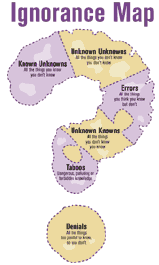
Domains of Ignorance

  • Known Unknowns: All the things you know you don’t know
  • Unknown Unknowns: All the things you don’t know you don’t know
  • Errors: All the things you think you know but don’t
  • Unknown Knowns: All the things you don’t know you know
  • Taboos: Dangerous, polluting or forbidden knowledge
  • Denials: All the things too painful to know, so you don’t

By Ann Kerwin and Marlys Witte (Q-cubed Programs: What Is Ignorance?). According to Ann Kerwin the Map of Ignorance was developed by her circa 1983. It has later been presented in 1985 and 1986 together with Marlys Witte.

This little map has traveled the globe. On its clones have scribbled Nobel Laureates, U.N. delegates, educators, physicians, artists, students, politicians, inventors, scientists, poets and ponderers from many walks of life. It’s just a prop, a cosmic swerve, a silly prompt for exploration and celebration of the fertile home territory of learning. (Ann Kerwin)

References

Ann KerwinHomepageCV

Ann KerwinNone Too Solid. Medical Ignorance. Knowledge: Creation, Diffusion, Utilization 15 (December 1993) 2: 166–185.

Abstract
Our ignorance encompasses, at least, all the things we know we do not know (known unknowns); all the things we do not know we do not know (unknown unknowns); all the things we think we know but do not (error); all the things we do not know we know (tacit knowing); all taboos (forbidden knowledge); and all denial (things to painful to know, so we suppress them). Medical ignorance seems especially threatening to many of us. If, however, we are to cope with our vast ignorance of the human body, its powers and processes, we must learn to acknowledge our nescience and optimize it. To do so, we need to rethink the nature and interrelations between knowledge and ignorance. We need to expand our capacities for self-learning and refine abilities to map our complex experience.

Ann KerwinOn no other planet. 2 essays, 47 pages.

MORE in source: Taxonomies of the unknown [Andreas’ Notes]

2011/07/22 ISSS Incoming Presidential Address | Coevolving Innovations – David Ing

A really brilliant meta-overview of some key issues in and about systems thinking from syscoi.com co-host David Ing (from 2011)


Source: 2011/07/22 ISSS Incoming Presidential Address | Coevolving Innovations

2011/07/22 ISSS Incoming Presidential Address

Submitted by daviding on Sat, 12/17/2016 – 22:59

Service Systems, Natural Systems: Sciences in Synthesis — An Outline for a Presidential Address

David Ing, International Society for the Systems Sciences, President, 2011-2012
isss@daviding.com

Audio [20110722_1110_isss_ing.mp3] (67MB, 1h05m)
Video (1h05m) nHD qHD HD
H.264 MP4 [480×272 m4v] (162MB) [720×400 m4v] (303MB) [1280×720 2m4v] (898GB)
WebM [480×272 webm] (83MB) [720×400 webm] (114MB) [1280×720 webm] (268MB)
OGG Video [480×272 ogv] (115MB) [720×400 ogv] (369MB) [1280×720 ogv] (519MB)

This written outline is a complement to the presentation slides presented in the incoming presidential address at 55th Annual Meeting of the ISSS on July 22, 2011. Leading up to the 56th Annual Meeting scheduled for July 2012, members of the society are encouraged to look for towards opportunities where the systems approach can support the development of new perspectives on service science and natural science.

[jump to the presentation preview (at the bottom of the page)]

[view/download the presentation slides as ODP] (3 MB)

[view/download the presentation slides as PDF] (2.2 MB)

jump to part [1 on the systems approach] [2 on service systems] [3 on natural systems] [4 on frames] [5 on learning and knowing]

0: Introduction — Synthesis across the sciences of service systems and natural systems in a systems approach is a promising way to deal with complexity in our world

As we look forward into 2012, I encourage members of the ISSS to continue the development of sciences in synthesis. Synthesis means putting things together, rather than taking them apart. Synthesis leads to emergence: properties of a whole that are not in its parts. The research communities centered on service systems and on natural systems may benefit from a synthesis through a systems approach.

This presidential address has 6 parts.

  • 1. Challenges where the systems approach can make a contribution
  • 2. Research into service systems
  • 3. Research into natural systems
  • 4. Some frames brought with a systems approach
  • 5. Learning and knowing

The address concludes with a call for participation at the 56th annual meeting of the ISSS in San Jose, California, in July 2012.

Continues in source: 2011/07/22 ISSS Incoming Presidential Address | Coevolving Innovations

Workshop: Complexity Methods – Neil Johnson – YouTube

Workshop: Complexity Methods – Neil Johnson

Published on 21 Apr 2016

Speaker: Neil Johnson Professor, Department of Physics, University of Miami Abstract: QUANTIFYING FUTURE CONFLICTS, TEERORISM AND FINANCIAL MARKET VOLATILITY: DIFFERENT PROBLEMS, SAME COMPLEXITY MODELS There are plenty of urgent national and international threats that might potentially benefit from Complexity Science, in order to assess and quantify their future risk and likely evolution. But what, if anything, can Complexity Science actually deliver? What is the game-changing ‘take-away’ for practitioners and policy-makers? Looking beyond the hype, Complexity Science needs to move beyond providing yet another verbal analogy to physical or biological systems, or arbitrary screen-shot from yet another idiosyncratic computer simulation. For example, the number of candidate complexity models of financial markets has exploded in the past decade — and looking across the computational, mathematical and social sciences, so has the number of descriptions of human conflict and terrorism. Indeed, it is now a significant challenge for any researcher (let alone graduate student) to translate between the various candidate models, compare their respective assumptions, and know which is better and for what reason. The natural tendency is therefore simply to create yet another new model, leading to further model proliferation. So has Complexity Science lost the plot? In this talk, I try to reverse this model proliferation by addressing a number of quite different societal threats using a common ‘bare-bones’ complexity model which mimics features of human grouping dynamics and decision-making. I will then compare its predictions to state-of-the-art high frequency data from the real-world domains of human insurgency, global terrorism, massively multiplayer online role-playing games (e.g. World of Warcraft), urban street gangs and cyberattacks — also in the financial domain, I will use it to examine the murky subsecond world of algorithmic trading which occupies 70% percent of all financial trades, is openly blamed in the media for flash-crash phenomena, but where the future risk has not yet been mitigated or regulated because of a lack of reliable models. http://www.paralimes.ntu.edu.sg/

BEING EMERGENCE VS. PATTERN EMERGENCE (2019) Complexity, control and goal-directedness in biological systems – Jason Winning and William Bechtel

source (pdf) https://philpapers.org/archive/WINBEV.pdf

BEING EMERGENCE VS. PATTERN EMERGENCE (2019)
Complexity, control and goal-directedness in biological systems
Jason Winning and William Bechtel

Emergence is much discussed by both philosophers and scientists. But, as noted by Mitchell (2012), there is a significant gulf; philosophers and scientists talk past each other. We contend that this is because philosophers and scientists typically mean different things by emergence, leading us to distinguish being emergence and pattern emergence. While related to distinctions offered by others between, for example, strong/weak emergence or epistemic/ontological emergence (Clayton, 2004, pp. 9–11), we argue that the being vs. pattern distinction better captures what the two groups are addressing. In identifying pattern emergence as the central concern of scientists, however, we do not mean that pattern emergence is of no interest to philosophers. Rather, we argue that philosophers should attend to, and even contribute to, discussions of pattern emergence. But it is important that this discussion be distinguished, not conflated, with discussions of being emergence. In the following section we explicate the notion of being emergence and show how it has been the focus of many philosophical discussions, historical and contemporary. In section 3 we turn to pattern emergence, briefly presenting a few of the ways it figures in the discussions of scientists (and philosophers of science who contribute to these discussions in science). Finally, in sections 4 and 5, we consider the relevance of pattern emergence to several central topics in philosophy of biology: the emergence of complexity, of control, and of goal-directedness in biological systems

Designing with Society: A Capabilities Approach to Design, Systems Thinking and Social Innovation

Simon's avatarTransition Consciousness

Scott Boylston is professor and graduate coordinator of the Design for Sustainability program at SCAD (Savannah College of Art and Design), author of three books, and founder of Emergent Structures. I would like to congratulate to Scott on the launch of his new book Designing with Society. He introduces his book in the following way:

“This is not a design book. It’s a book for designers. Specifically, it’s a book for designers who want to aim the design dictum, “what’s next,” directly at the heart of our own practice. To do so requires an honest look at what might be holding us back. Many say the barriers we still have to transcend exist within our ability to authentically incorporate other disciplines such as anthropology and nanotechnology.

Digging deeper, however, lies the question, “for what purpose?” This question suggests we look inward before looking further outward. It requires we tap into…

View original post 170 more words

The sociocybernetics of observation and reflexivity – Bernard Scott, 2019

No open access version available yet, AFAIK


Source: The sociocybernetics of observation and reflexivity – Bernard Scott, 2019


The aim of this article is to show how sociocybernetics can clarify and bring order to two key concepts in the social sciences: ‘observation’ and ‘reflexivity’. The article provides an introduction and conceptual overview of second order cybernetics, placing it in the larger context of cybernetics and systems sciences studies. Since its inception, in cybernetics the role of the observer has been paramount. It is the observer who distinguishes systems of interest. It is the observer who communicates her observations and theoretical interpretations to the wider community of other observers. Critically, as Heinz von Foerster emphasises, with second order cybernetics the observer, since she is herself an observing system, should ‘enter the domain of her own descriptions’. With her second order studies, she is explaining herself to herself. Reflexively, she is obliged to engage in self-observation. The article sets out some of the theoretical and methodological implications of these propositions.

On Becoming a Cybernetician: Highlights and Milestones: World Futures: Vol 75, No 1-2 – Bernard Scott, March 2019


Source: On Becoming a Cybernetician: Highlights and Milestones: World Futures: Vol 75, No 1-2


On Becoming a Cybernetician: Highlights and Milestones

Pages 101-112
Published online: 26 Mar 2019

In this article, I describe how I encountered cybernetics and how it became an important part of my life. I begin with an account of my time at Brunel University and also describe how I came to work with Gordon Pask, one of the few intellectuals and researchers in the UK who styled themselves as cyberneticians. To enrich my story, I include an overview of the story of cybernetics as I perceive it. Given the importance I attach to cybernetics as an intellectual tool, I end with a plea for it to be included in all educational curricula.

INTRODUCTION: ENCOUNTERING CYBERNETICS1

Between 1964 and 1968 I was an undergraduate at Brunel University, studying psychology. I was on a ‘sandwich course’, meaning that periods of study were interspersed with work placements with different kinds of organization. In my first two years of study, I accrued very mixed feelings about psychology as a scientific discipline. Only the behaviorists claimed to be fully scientific. The rest of the discipline appeared to be a ragbag of disparate topics, studied and theorized about in a wide variety of ways. The curriculum consisted of courses of lectures on largely unrelated topics: learning theory, perception, social psychology, individual differences, psychopathology, organizational psychology, and developmental psychology. The curriculum also included some lectures on sociology and social anthropology, taught as separate subjects. There was an early superficial mention of cybernetics in the lectures on learning theory but nothing substantial was covered. I was an indifferent and poorly motivated student in the midst of what I saw as a mess of a discipline, in which my teachers, espousing different paradigms, were incapable of constructive conversation with one another. It was cybernetics that eventually enabled me to make sense of this mess and inspired me to become an enthusiastic scholar.

In 1966, I had the good fortune to attend a course of lectures on cybernetics given by David Stewart, a newly appointed lecturer in the Department of Psychology. I had previously read W. Gray Walter’s (1963Walter, W. G. (1963). The Living BrainNew York, NYNorton & Co. [Google Scholar]The Living Brain and Wladyslaw Sluckin’s (1954Sluckin, W. (1954). Minds and machinesHarmondsworth, UKPenguin Books. [Google Scholar]Minds and Machines. Both helped me appreciate the larger philosophical tradition in which problems of mind and body, freewill and determinism have been debated. I recall that Sluckin reported on developments in cybernetics and related disciplines but was not committed to cybernetics as a unifying, “transdiscipline.” David Stewart’s stimulating presentations helped me be aware of that possibility. I was attracted to the thesis that cybernetics is a transdiscipline. It made sense that there should be unity in diversity. It made sense that there should be a discipline as important and as general as physics but one which was complementary to it. I grasped this as the aphorism “Physics is about matter and energy; cybernetics is about control and communication.” Later, I came across a similar distinction in the writings of Gregory Bateson (1972Bateson, G. (1972). Steps to an Ecology of MindNew York, NYPaladin. [Google Scholar]), who used the terms ‘pleroma’ and ‘creatura’ from C. G. Jung’s Septem Sermones ad Mortuos (http://gnosis.org/library/7Sermons.htm, accessed 10/03/2019) which have origins in gnostic, hermetic traditions. Pleroma refers to the ‘stuff’ of the world as formless content. Creatura is the world of the distinctions made by observers.

I began to see how cybernetic concepts could provide explanations of psychological processes in far more sophisticated ways than those offered by the behaviorists. Thanks to David Stewart, I had the opportunity to work with the UK cybernetician, Gordon Pask. At that time, Pask was Research Director of an independent, nonprofit research organization in Richmond, Surrey: System Research Ltd. I had a 6 months’ work placement there as a research assistant. Pask was the most obviously intellectually brilliant person I have ever met. I was awed just to be in his presence. I obtained a preprint of Pask’s most recent paper and studied it in detail (Pask, 1966Pask, G. (1966). A cybernetic model for some types of learning and mentation. In Oestreicher, H. C. & Moore, D. R., (Eds.), Cybernetic problems in bionics (pp. 531585). New YorkGordon and Breach. [Google Scholar]). To make sense of it, I spent many hours looking up his references and reading his earlier papers. From this reading, I gained what had eluded me thus far: an overarching, satisfying conceptual framework which allowed me to make sense of the biological, the psychological and the social in a coherent and enlightening way. I was becoming a cybernetician.

Eventually, I read W. Ross Ashby’s (1956Ashby, W. R. (1956). An introduction to cyberneticsLondonChapman and Hall.[Crossref] [Google Scholar]Introduction to Cybernetics. I think all of us who love cybernetics have drawn inspiration from Ashby’s bold declaration that “The truths of cybernetics are not conditional on their being derived from some other branch of science. Cybernetics has its own foundations” (p.1). He goes on, “Cybernetics ……takes as its subject-matter the domain of ‘all possible machines’” (p. 2). This is followed by “Cybernetics, might, in fact, be defined as the study of systems that are open to energy but closed to information and control – systems that are ‘information-tight’” (p. 4). Here Ashby is reflecting cybernetics’ primary concern with circular causality and anticipating later emphases on organizational closure.

Ashby highlights two primary uses of cybernetics: “It offers a single vocabulary and a single set of concepts for representing the most diverse types of systems” and “It offers a method for the scientific treatment of the system in which complexity is outstanding and too important to be ignored” (pp. 4-5). There are perhaps those who would disagree with Ashby’s claim that cybernetics provides “a single vocabulary and a single set of concepts” pointing to the enormous proliferation of specialist vocabularies and conceptual schema within the cybernetics and “systems thinking” areas. However, I suggest that in this variety, there is enormous consensus and that there is an underlying structure of primary concepts and distinctions that makes cybernetics what it is, much of which is captured in Ashby’s formal approach. In 1995, I attended an international multidisciplinary conference, entitled Einstein meets Magritte, and witnessed much difficulty, even distress, as physicists, philosophers, artists and humanists attempted to communicate with each other about a range of issues, many of global concern. Within the larger conference there was a symposium, convened by Francis Heylighen, on The Evolution of Complexity, with fifty or so participants, including management scientists, biologists, systems scientists, psychologists, neuroscientists, sociologists, engineers, computer scientists and physicists. The remarkable thing about this symposium, in contrast to the main conference, was that there was much effective interdisciplinary communication. This was because all the participants did have some grounding in concepts to do with complex systems and cybernetics. Indeed, many of the participants drew directly on Ashby, himself. Thus was the master vindicated.

Further reading persuaded me not only of the value of cybernetics as a unifying transdiscipline but also that cyberneticians were not naive or trivial in their epistemologies, that there was a deep sense of metadisciplinary self-awareness in their shared enterprise. I learned that there was an informal collegiate that included, amongst others, Gregory Bateson, Warren McCulloch, Heinz von Foerster, Gordon Pask, Stafford Beer and Humberto Maturana. There appeared to be a tacit understanding that, whatever their differences, they all had a reflexive sense of responsibility for their being in the world and were united in their commitment to a common good.

The concerns with the epistemology of the observer were made explicit in a coming together of ideas in the late 1960s and early 1970s. I have alluded to some of these events in more detail elsewhere (Scott, 1996Scott, B. (1996). Second-order cybernetics as cognitive methodologySystems Research13(3), 393406.[Crossref] [Google Scholar]). What I have in mind are Spencer-Brown’s (1969Spencer-Brown, G. (1969). The laws of formLondon, UKAllen and Unwin. [Google Scholar]) emphasis on the primacy of the act of distinction; Gordon Pask’s articulation of a cybernetic theory of conversations (Pask, 1975Pask, G. (1975). Conversation, Cognition and LearningNew York, NYElsevier. [Google Scholar]); Gunther’s (1971Gunther, G. (1971). Life as polycontexturality. In Collected works of the biological computer laboratoryPeoria, ILIllinois Blueprint Corporation. [Google Scholar]) concept of life as polycontexturality: the intersection of observers’ perspectives, including perspectives of others’ perspectives; von Foerster’s distinction between a first order cybernetics, the study of observed systems, and a second order cybernetics, the study of observing systems (von Foerster et al., 1974Von Foerster, H.Abramovitz, R.Allen, R. B. et al. (eds.) (1974). Cybernetics of cybernetics, BCL Report 73.38, Biological computer laboratory, department of electrical engineeringUrbana, ILUniversity of Illinois. [Google Scholar], p. 1); Maturana’s (1970Maturana, H. R. (1970). Neurophysiology of cognition. In Garvin, P. (Ed). Cognition: A multiple view (pp. 323). New York, NYSpartan Books. [Google Scholar]) arguments for the closure of the cognitive domain based on an account of the operational closure of the nervous system.

In 1972, Oliver Wells, editor of the cybernetics newsletter, Artorga2, convened the world’s first conference on self-referential systems, in London. The participants were Gotthard Gunther, Gordon Pask, Humberto Maturana, Dionysius Kallikourdis and myself. Heinz von Foerster was unable to attend. I was fortunate to meet him, later that year, when he visited Pask’s laboratory at System Research Ltd., where, following graduation, I had been invited back to work as a research assistant, and at Brunel University, where I was a postgraduate student in cybernetics.

I understood from Ashby (1956Ashby, W. R. (1956). An introduction to cyberneticsLondonChapman and Hall.[Crossref] [Google Scholar]) that the abstract principles, concepts and laws of cybernetics can be applied to any category of system. From Pask, Stafford Beer, and Frank George and others, I understood the role of models and analogies in cybernetics. I saw the power to be found in formal concepts and therefore studied set theory, formal logic and the theory of computation. I acquired new distinctions and new terminology: hierarchy and heterarchy; object language and metalanguage; programing and meta-programing; process and product; serial, parallel and concurrent processes; circularity and recursion; self-organization and autopoiesis; variety and information; structure and organization … and more.

As a transdiscipline, cybernetics empowered me to cross disciplinary boundaries. This was exhilarating. I also understood other transdisciplines (systems theory, Alfred Korzybski’s general semantics, synergetics) to be quite cognate with cybernetics and, at a high enough level of abstraction, homomorphic if not isomorphic with it.

I see all ‘versions’ of cybernetics as having a core commonality. It is a truism that every scholar or practitioner will have her own narrative and ways of doing things and that these may be undergoing changes with experience and further study and reflection. What I detect with cybernetics is a commonality that evolved amongst a community of scholars, where differences in emphasis, terminology and areas of interest and practice mask underlying agreements and similarities of form.

I was inspired, eventually, to regard myself as being a cybernetician. Louis Couffignal (1960Couffignal, L. (1960). Essai d’une definition generale de la Cybernetique, Proceedings of the Second Congress of the International Association for CyberneticsParis, FranceGauthier-Villars. [Google Scholar]) defines cybernetics as “the art of assuring the efficacy of action.” Heinz von Foerster states that “Life cannot be studied in vitro, one has to explore it in vivo.” (von Foerster 2003Von Foerster, H. (2003). Understanding understanding: Essays on cybernetics and cognitionBerlin, GermanySpringer-Verlag.[Crossref] [Google Scholar], p. 248) and “At any moment we are free to act towards the future you desire” (von Foerster 2003Von Foerster, H. (2003). Understanding understanding: Essays on cybernetics and cognitionBerlin, GermanySpringer-Verlag.[Crossref] [Google Scholar], p. 206). I took these ideas to heart. There was a coming together of my professional life as a research student and my personal life, which had previously been lived in separate compartments. I became reflexively aware that I was living my theories and my lived experiences were helping my theorizing.

My 20 s and 30 s, as for many in the 1960s and 1970s, were an intense period of intellectual and personal exploration in which I was sustained, sometimes tenuously, by the faith in God that I had acquired as a child and my deepening understanding and appreciation of cybernetics. I read widely, acquainting myself with Western philosophy, world history, including the history of science and mathematics, and, in a somewhat haphazard way with the teachings of various faiths (‘great’ and esoteric) and writings about the ‘occult’ and shamanism.

In those years, second-order cybernetics was a touchstone that provided rational grounding. With its help, together with the insights of Ludwig Wittgenstein (1953Wittgenstein, L. L. (1953). Philosophical InvestigationsOxford, UKBasil Blackwell. [Google Scholar]), in particular his meta-linguistic comments about language and philosophy, I escaped from becoming enmeshed in the conceptual and terminological morass of what is frequently referred to as ‘continental philosophy’. Cybernetics helped me see through the tricks and power plays of intellectual ‘gamesters’. Second-order cybernetics tells us that anything said is said by or to an observer. This gives a pragmatic immediacy to what is being said and what is the intention of the communicator. I became a cybernetic shaman, a child of the living God, someone who aspires to know the true and the good. I was particularly inspired by the writings of Lao Tsu and Confucius and their followers. At heart, I remained a Christian. In 1979, while training to be a schoolteacher, I summed up much of my thinking and practice in a brief essay, “Morality and the cybernetics of moral development” (Scott, 1983Scott, B. (2016). Cybernetic foundations for psychologyConstructivist Foundations11(3), 509517.[Web of Science ®] [Google Scholar]).

Not everyone who studies cybernetics becomes a cybernetician who studies ‘the cybernetics of cybernetics’. There are many scholars of cybernetics who look on only from their main area of practice and position themselves in the first instance as being historians, philosophers, architects, biologists, sociologists, psychologists and so on. In doing so, I believe they miss the point, the sense of what it is to be a cybernetician and a member of the cybernetics community. A recent example is Andrew Pickering, author of The Cybernetic Brain, whose self-imposed positioning as a philosopher and historian mars what in many ways is an admirable text. I have in mind his perfunctory, somewhat derogatory treatment of second order cybernetics in general and of Pask’s conversation theory in particular. I have similar reservations about the recent biography of Warren McCulloch by Tara Abraham, Rebel Genius, in which the author seems to see McCulloch’s enthusiasm for cybernetics as a transdiscipline to be self-aggrandizing and self-deceiving.3 I, myself, share McCulloch’s enthusiasm. The invention and creation of a new transdiscipline concerned with control and communication, cybernetics, is itself a great cybernetic achievement.

THE STORY OF CYBERNETICS

To make sense of my reminiscences, I feel I am obliged to provide some more details of my understandings of the history of cybernetics. I am not aware of any single text that gives a clear and inclusive account of the origins, early years and key later events concerning cybernetics. Here, I give a very brief summary.

The story has several possible beginnings. One common starting point is the publication, in 1943, of the paper “Behavior, purpose and teleology” by Arturo Rosenblueth, Norbert Wiener and Juliann Bigelow (Rosenblueth, Wiener, & Bigelow, 1943Rosenblueth, A.Wiener, N., & Bigelow, J. (1943). Behavior, purpose and teleologyPhilosophy of Science10(1), 1824. doi:10.1086/286788[Crossref] [Google Scholar]) and associated discussions that lead up to the Macy conferences on “feedback and circular causality in biological and social systems” convened by Warren McCulloch and held between 1946 and 19534. The paper proposed that the goal-seeking behavior that could be built into mechanical systems and the goal-seeking observed in biological and psychological systems have a similar form: they are structured so that signals about achieved outcomes are “fed back” to modify inputs so that, in due course, a prescribed goal is achieved (a cup is picked up) or a desired state of affairs (the temperature of a room or of a living body) is maintained. This process is referred to as “circular causality.” It was recognized at an early stage that many fields of study contain examples of these processes and that there was value in coming together in multidisciplinary fora to shed light on them, to learn from each other and to develop shared ways of talking about these phenomena. In 1948, Norbert Wiener, one of the participants, wrote a book (Wiener, 1948Wiener, N. (1948). CyberneticsCambridge, MAMIT Press. [Google Scholar]) that set out these ideas in a formal way that collected together many of the emerging shared conceptions and did so in a coherent way that not only facilitated interdisciplinary exchanges but also stood as a discipline in its own right: an abstract transdiscipline – the study of “control and communication in the animal and the machine.” Wiener called this new discipline “cybernetics.” Following the book’s publication, the Macy conference participants referred to their conferences as conferences on cybernetics, keeping “feedback and circular causality in biological and social systems” as the subtitle.

As the subtitle emphasizes, there was an interest in biological and social systems. The participants were interested not only in particular mechanisms, they also looked for the general forms to be found in the dynamics and organization of complex systems (living systems, small groups and communities, cultures and societies): how they emerge and develop, how they maintain themselves as stable wholes, how they evolve and adapt in changing circumstances.

In the years following the Macy conferences, cybernetics flourished and its ideas were taken in many disciplines. Cyberneticians also found common ground with the followers of Ludwig von Bertalanffy, who were developing a general theory of systems.

By the 1970s, cybernetics, as a distinct discipline, had become marginalized. A number of reasons have been suggested for this. I believe two are particularly pertinent. The first is that, at heart, most scientists are specialists. Having taken from cybernetics what they found valuable, they concentrated on their own interests. Second, in the USA, funding for research in cybernetics became channeled towards research with more obvious relevance for military applications, notably research in artificial intelligence. Attempts to develop coherent university-based research programs in cybernetics, with attendant graduate level courses, were short-lived. However, some developments in the field that occurred in the late 1960s and early 1970s are particularly pertinent for the theme of this article.

First, it is useful to note that the early cyberneticians were sophisticated in their understanding of the role of the observer. In the terminology of Heinz von Foerster, their concerns were both first-order (with observed systems) and second-order (with observing systems). It is the observer who distinguishes a system, who selects the variables of interest and decides how to measure them. For complex, self-organizing systems this poses some particular challenges. Gordon Pask (1960Pask, G. (1960). The natural history of networks. In M. C. YovitsS. Cameron (Eds.), Self-organizing systems (pp. 232261). London, UKPergamon Press. [Google Scholar]) spells this out particularly clearly. Even though such a system is, by definition, state-determined, its behavior is unpredictable: it cannot be captured as trajectory in a phase space. The observer is required to update his reference frame continually and does so by becoming a participant observer. Pask cites the role of a natural historian as an exemplar of what it means to be a participant observer. A natural historian interacts with the system he observes, looking for regularities in those interactions. Pask goes as far as likening the observer’s interaction with the system to that of having a conversation with the system. This insight was the seed for Pask’s development of a cybernetic theory of conversations.

Second, the early cyberneticians had the reflexive awareness that in studying self-organizing systems, they were studying themselves, as individuals and as a community. Von Foerster (1960Von Foerster, H. (1960). On self-organising systems and their environments. In M. C. Yovits and S. Cameron (Eds.), Self-organising systemsLondon, UKPergamon Press. [Google Scholar]) makes this point almost as an aside. He notes: “[W]hen we […] consider ourselves to be self-organizing systems [we] may insist that introspection does not permit us to decide whether the world as we see it is ‘real,’ or just a phantasmagory, a dream, an illusion of our fancy” (von Foerster, 2003Von Foerster, H. (2003). Understanding understanding: Essays on cybernetics and cognitionBerlin, GermanySpringer-Verlag.[Crossref] [Google Scholar], p.3f). Von Foerster escapes from solipsism by asserting that an observer who distinguishes other selves must concede that, as selves, they are capable of distinguishing her. ‘Reality’ exists as the shared reference frame of two or more observers. In later papers5, with elegant, succinct formalisms, von Foerster shows how, through its circular causal interactions with its environmental niche and the regularities (invariances) that it encounters, an organism comes to construct its reality as a set of ‘objects’ and ‘events,’ with itself as its own ‘ultimate object.’ He goes on to show how two such organisms may construe each other as fellow ‘ultimate objects’ and engage in communication as members of a community of observers. Von Foerster referred to this second order domain as the ‘cybernetics of cybernetics.’

It should be mentioned that others had been thinking along somewhat similar lines to those of Pask and von Foerster. Maturana (1970Maturana, H. R. (1970). Neurophysiology of cognition. In Garvin, P. (Ed). Cognition: A multiple view (pp. 323). New York, NYSpartan Books. [Google Scholar]) frames his thesis about the operational closure of the nervous system with an epistemological metacommentary about what this implies for the observer, who, as a biological system inhabiting a social milieu, has just such a nervous system. The closure of the nervous system makes clear that ‘reality’ for the observer is a construction consequent upon his interactions with her environmental niche (Maturana uses the term ‘structural coupling’ for these interactions). In other words, there is no direct access to an ‘external reality.’ Each observer lives in her own universe. It is by consensus and coordinated behavior that a shared world is brought forth.

In later writings (some written in collaboration with Francisco Varela), Maturana uses the term ‘autopoiesis’ (Greek for self-creation) to refer to what he sees as the defining feature of living systems: the moment by moment reproduction of themselves as systems that, whatever else they do (adapt, learn, evolve), must reproduce themselves as systems that reproduce themselves. In explicating his theory of autopoiesis, Maturana makes an important distinction: the distinction between the ‘structure’ of a system and the ‘organization’ of a system. A system’s structure is the configuration of its parts at a given moment in time, a snapshot picture of the system’s state. The organization of a system is the set of processes that are reproduced by circular causality such that the system continues to exist as an autopoietic unity. In general, a system with this ‘circular causal’ property is said to be ‘organizationally closed’ (Maturana & Varela, 1980Maturana, H. R., & Varela, F. J. (1980). Autopoiesis and cognitionDordrecht, The NetherlandsSpringer.[Crossref] [Google Scholar]).

THE WORK OF MY MENTOR, GORDON PASK

Although much of what von Foerster and Maturana have to say is pertinent to humans, arguably it is Pask, the psychologist, who has given us the most comprehensive observer-based cybernetic theory of human cognition and communication. From the earliest stages of his thinking, he was aware that the human self develops and evolves in a social context and that ‘consciousness’ (Latin con-scio, with + know) is about both knowing with oneself and knowing with others. Throughout his writings, from the 1960s onwards there is an acknowledgement by Pask of his indebtedness to the Russian psychologist Lev Vygotsky, who argued that, as a child develops, what begins as external speech eventually becomes internalized as an inner dialog (Vygotsky, 1962Vygotsky, L. S. (1962). Thought and languageCambridge MAMIT Press.[Crossref] [Google Scholar]).

Central in Pask’s research activity was the design of ‘teaching machines’ and ‘learning environments’ that interact with a learner, in a conversational manner, and adapt to the learner’s progress so as to facilitate her learning. Pask makes a distinction between a cognitive system and the ‘fabric’ or ‘medium’ that embodies it. This distinction is analogous to the distinction between programs and the computer in which they run. However, unlike the cognitivist science community, where the analogy is the basis of the thesis that both brains and computers are ‘physical symbol systems’, Pask is aware that this interpretation of what is a symbol is conceptually naive. He stresses how important it is to take account of the differences between brain/body systems and computing machinery. Brain/body systems are autopoietic systems, whose structure is constantly changing, whereas the structures of computers are designed to be stable. In Pask’s terms, there is an interaction between a cognitive system and its embodiment. A change in the structure of the brain/body system affects cognition. Changes in thinking affect the structure of the brain/body system. It is important to note that Pask’s distinction is an analytic distinction, not an ontological one. It affords a way of talking about organizationally closed ‘psychosocial’ systems distinct from brain/body systems and provides psychology and other social sciences with a coherent conceptual framework.6

DARKNESS AND LIGHTS

Pask, Maturana, Gunther, von Foerster, and other cyberneticians met regularly, often at von Foerster’s Biological Computer Laboratory at the University of Illinois, at Pask’s System Research Ltd. And at academic conferences. I witnessed the ways and incidents by which, over time, cybernetics was marginalized. I saw the courage and nobility with which the cyberneticians maintained their views and convictions in the face of the criticisms that they were old fashioned, misguided and defunct in the brave new world of artificial intelligence research and the emergent field of ‘cognitive science.’ In the sister transdiscipline, general systems theory (now referred to as ‘systems science’), cybernetics was often seen as a mere specialist subdiscipline concerned with control theory. From the 1980s onwards, the ‘new’ sciences of complexity, systems dynamics, and artificial life arose, with a new generation of scholars largely ignorant of the intellectual roots of those sciences in cybernetics. In cognitive science (psychology, philosophy of mind, robotics), there was an increasing interest in the biology of cognition and ‘enactivism,’ again, with little awareness of the sources of those ideas.

The lights in this darkness have been several. Notably there has been an ongoing interest in second order cybernetics, as seen in the journals Cybernetics and Human Knowing and Kybernetes. I do not have space to do more than mention some of the key players whom I see as the second generation of cyberneticians (I became good friends with many): Stuart Umpleby, Ranulph Glanville, Paul Pangaro, Soeren Brier, Albert Mueller, Karl Mueller, Phillip Guddemi, Randall Whitaker. I should also like to draw attention to the achievements of the learned societies that have worked to keep cybernetics alive and well: the UK Cybernetics Society, the American Society for Cybernetics and Research Committee 51 (on Sociocybernetics) of the International Sociological Association.

CONCLUDING COMMENTS

As an undergraduate, encountering cybernetics transformed my approach to studying and understanding psychology. It gave psychology a conceptual coherence that, previously, I had found lacking. In later years, as my understanding of cybernetics deepened, I continued to use second order cybernetics as a foundation and framework for my work as an experimental psychologist (summarised in Scott, 1993Scott, B. (1993). Working with Gordon: Developing and applying conversation theory (1968–1978)Systems Research10(3), 167182.[Crossref] [Google Scholar]) and my later work as a practitioner in educational psychology (Scott, 1987Scott, B. (1983). Morality and the cybernetics of moral developmentInternational Cybernetics Newsletter26520530. [Google Scholar]) and in educational technology (Scott 2001Scott, B. (2001). Conversation theory: A dialogic, constructivist approach to educational technologyCybernetics and Human Knowing8(4), 2546. [Google Scholar]). The transdisciplinary and metadisciplinary nature of second order cybernetics empowered me to read widely in other disciplines.7 I learned from von Foerster that “Social cybernetics must be a second-order cybernetics – a cybernetics of cybernetics – in order that the observer who enters the system shall be allowed to stipulate his own purpose […] [I]f we fail to do so, we shall provide the excuses for those who want to transfer the responsibility for their own actions to somebody else” (von Foerster, 2003Von Foerster, H. (2003). Understanding understanding: Essays on cybernetics and cognitionBerlin, GermanySpringer-Verlag.[Crossref] [Google Scholar], p. 286).

After some fifty years of involvement with cybernetics, I am more than ever persuaded of its value for making sense of the world and as an aid for self-steering. Ashby’s Law of Requisite Variety (“Only variety can destroy variety”) makes clear in the simplest terms that if a system is to survive in a changing environment it must manage the variety that it faces. It must learn to identify and minimize unnecessary constraints on its actions and at the same time it must act so as to maximize (increase the variety of) its choices. For humans this applies not only to the first order variety to be found in our environmental niches but also to the second order bewildering ‘wicked’8 complexity of variety to be found in our belief systems and in our perceptions and meta-perceptions of each other. I have written about these issues elsewhere (Scott, 2012Scott, B. (2011b). Education for cybernetic enlightenmentCybernetics and Human Knowing21(1–2), 199205. [Google Scholar]). Here I just wish to emphasize the need for what I refer to as ‘education for cybernetic enlightenment.’ I have outlined the curriculum for such an education in Scott (2011bScott, B. (2011a). Explorations in Second-Order cybernetics: Reflections on cybernetics, psychology and educationVienna, AustriaEdition echoraum. [Google Scholar]).

Discussions about how best to place cybernetics within educational curricula have been going on since shortly after its inception. The (now defunct) Department of Cybernetics at Brunel University where I studied for my PhD had postgraduate students only, arguing that one needed to have a strong disciplinary base before embarking on transdisciplinary studies. I myself am a supporter of Jerome Bruner’s concept of the ‘spiral curriculum’: “A curriculum as it develops should revisit the basic ideas repeatedly, building upon them until the student has grasped the full formal apparatus that goes with them” (Bruner, 1960Bruner, J. S. (1960). The process of educationHarvardHarvard University Press. [Google Scholar], p.13); “We begin with the hypothesis that any subject can be taught effectively in some intellectually honest form to any child at any stage of development.” (ibid, p.33). It makes sense to me – and I hope to the reader – that cybernetic understandings of educational processes should be used to help educate for cybernetic enlightenment. I also believe that cybernetic understandings of the human condition reveal how vital it is that those same understandings are promulgated, not just in formal educational settings but universally, as part of the ‘global conversation’.

Notes

1 In writing this article I have adapted some passages from earlier papers in which I have discussed my involvement with cybernetics. See Scott (1993Scott, B. (1993). Working with Gordon: Developing and applying conversation theory (1968–1978)Systems Research10(3), 167182.[Crossref] [Google Scholar]1996Scott, B. (1996). Second-order cybernetics as cognitive methodologySystems Research13(3), 393406.[Crossref] [Google Scholar]2004Scott, B. (2004). Second order cybernetics: an historical introductionKybernetes33(9/10), 13651378. doi:10.1108/03684920410556007[Crossref][Web of Science ®] [Google Scholar]2016Scott, B. (2012). Using the logic of life to reduce the complexity of lifeCybernetics and Human Knowing19(3), 93104. [Google Scholar]). The first three are available as separate chapters in Scott (2011aScott, B. (2011a). Explorations in Second-Order cybernetics: Reflections on cybernetics, psychology and educationVienna, AustriaEdition echoraum. [Google Scholar]).

2 There is an archive of 32 issues of Artorga here: https://wellcomelibrary.org/item/b20219490#?c=0&m=0&s=0&cv=0&z=-0.1422%2C-0.0403%2C1.2843%2C0.8068 (accessed 21/07/2017). Many issues contain preprints of articles by renowned early cyberneticians. Pask was a subscriber, so I had the opportunity to read them.

3 Oddly, Abraham’s account of McCulloch’s life includes little of his activities as a cybernetician amongst fellow cyberneticians. There is no mention of his significant encounters with Heinz von Foerster, Stafford Beer and Gordon Pask and his achievements in obtaining funding for cybernetics related research. See McCulloch (1965McCulloch, W. S. (1965). Embodiments of mindCambridge, MAMIT Press. [Google Scholar]).

4 The proceedings of the later Macy Coferences were published. The editors’ introduction gives an interesting account of the origins and precursors of cybernetics. See Von Foerster, Mead and Teuber (1953Von Foerster, H.Mead, M., & Teuber, H. L. (1953). Editors’ Introduction to cybernetics: Circular causal and feedback mechanisms in biological and social systemsNew York, NYJosiah Macy, Jr Foundation. [Google Scholar]).

5 Many of these papers are to be found in von Foerster (2003Von Foerster, H. (2003). Understanding understanding: Essays on cybernetics and cognitionBerlin, GermanySpringer-Verlag.[Crossref] [Google Scholar]).

6 For more on this theme, see Scott (2016Scott, B. (2012). Using the logic of life to reduce the complexity of lifeCybernetics and Human Knowing19(3), 93104. [Google Scholar]).

7 A propos of this, the developmental psychologist, Jean Piaget (1977Piaget, J. (1977). Psychology and Epistemology. Harmondsworth, UKPenguin.[Crossref] [Google Scholar], p. 136) writes, “Thus cybernetics is now the most polyvalent meeting place for physicomathematical sciences, biological sciences, and human sciences.”

8 I refer here to ‘wicked problems’, defined as those that are difficult or impossible to solve because of incomplete, contradictory, and changing requirements that are often difficult to recognize. The use of the term ‘wicked’ here has come to denote resistance to resolution, rather than evil. See https://en.wikipedia.org/wiki/Wicked_problem(accessed 19/07/2017).

References

  • Ashby, W. R. (1956). An introduction to cyberneticsLondonChapman and Hall.
  • Bateson, G. (1972). Steps to an Ecology of MindNew York, NYPaladin.
  • Bruner, J. S. (1960). The process of educationHarvardHarvard University Press.
  • Couffignal, L. (1960). Essai d’une definition generale de la Cybernetique, Proceedings of the Second Congress of the International Association for CyberneticsParis, FranceGauthier-Villars.
  • Gunther, G. (1971). Life as polycontexturality. In Collected works of the biological computer laboratoryPeoria, ILIllinois Blueprint Corporation.
  • Maturana, H. R. (1970). Neurophysiology of cognition. In Garvin, P. (Ed). Cognition: A multiple view (pp. 323). New York, NYSpartan Books.
  • Maturana, H. R., & Varela, F. J. (1980). Autopoiesis and cognitionDordrecht, The NetherlandsSpringer.
  • McCulloch, W. S. (1965). Embodiments of mindCambridge, MAMIT Press.
  • Pask, G. (1960). The natural history of networks. In M. C. Yovits & S. Cameron (Eds.), Self-organizing systems (pp. 232261). London, UKPergamon Press.
  • Pask, G. (1966). A cybernetic model for some types of learning and mentation. In Oestreicher, H. C. & Moore, D. R., (Eds.), Cybernetic problems in bionics (pp. 531585). New YorkGordon and Breach.
  • Pask, G. (1975). Conversation, Cognition and LearningNew York, NYElsevier.
  • Piaget, J. (1977). Psychology and Epistemology. Harmondsworth, UKPenguin.
  • Rosenblueth, A.Wiener, N., & Bigelow, J. (1943). Behavior, purpose and teleologyPhilosophy of Science10(1), 1824. doi:10.1086/286788
  • Scott, B. (1993). Working with Gordon: Developing and applying conversation theory (1968–1978)Systems Research10(3), 167182.
  • Scott, B. (1996). Second-order cybernetics as cognitive methodologySystems Research13(3), 393406.
  • Scott, B. (2001). Conversation theory: A dialogic, constructivist approach to educational technologyCybernetics and Human Knowing8(4), 2546.
  • Scott, B. (2016). Cybernetic foundations for psychologyConstructivist Foundations11(3), 509517.
  • Scott, B. (1987). Human systems, communication and educational psychologyEducational Psychology in Practice3(2), 415. doi:10.1080/0266736870030203
  • Scott, B. (1983). Morality and the cybernetics of moral developmentInternational Cybernetics Newsletter26520530.
  • Scott, B. (2004). Second order cybernetics: an historical introductionKybernetes33(9/10), 13651378. doi:10.1108/03684920410556007
  • Scott, B. (2007). The cybernetics of Gordon Pask. In R. Glanville and K. H. Müller (Eds.). Gordon pask, philosopher mechanic: An introduction to the cybernetician’s cyberneticianVienna, AustriaWISDOM.
  • Scott, B. (2011a). Explorations in Second-Order cybernetics: Reflections on cybernetics, psychology and educationVienna, AustriaEdition echoraum.
  • Scott, B. (2011b). Education for cybernetic enlightenmentCybernetics and Human Knowing21(1–2), 199205.
  • Scott, B. (2012). Using the logic of life to reduce the complexity of lifeCybernetics and Human Knowing19(3), 93104.
  • Sluckin, W. (1954). Minds and machinesHarmondsworth, UKPenguin Books.
  • Spencer-Brown, G. (1969). The laws of formLondon, UKAllen and Unwin.
  • Von Foerster, H. (1960). On self-organising systems and their environments. In M. C. Yovitsand S. Cameron (Eds.), Self-organising systemsLondon, UKPergamon Press.
  • Von Foerster, H. (2003). Understanding understanding: Essays on cybernetics and cognitionBerlin, GermanySpringer-Verlag.
  • Von Foerster, H.Mead, M., & Teuber, H. L. (1953). Editors’ Introduction to cybernetics: Circular causal and feedback mechanisms in biological and social systemsNew York, NYJosiah Macy, Jr Foundation.
  • Von Foerster, H.Abramovitz, R.Allen, R. B. et al. (eds.) (1974). Cybernetics of cybernetics, BCL Report 73.38, Biological computer laboratory, department of electrical engineeringUrbana, ILUniversity of Illinois.
  • Vygotsky, L. S. (1962). Thought and languageCambridge MAMIT Press.
  • Walter, W. G. (1963). The Living BrainNew York, NYNorton & Co.
  • Wiener, N. (1948). CyberneticsCambridge, MAMIT Press.
  • Wittgenstein, L. L. (1953). Philosophical InvestigationsOxford, UKBasil Blackwell.

Recursivity and Contingency | Yuk Hui – Academia.edu 

Preface available for download


Source: (99+) (PDF) Recursivity and Contingency | Yuk Hui – Academia.edu


Recursivity and Contingency
2019
Yuk Hui
Yuk Hui

Cybernetics in Late Soviet Culture: • Kultur • Osteuropa-Institut, Freie Universitat Berlin, 17 June 2019

Not much detail yet!


Source: Cybernetics in Late Soviet Culture: • Kultur • Osteuropa-Institut

Cybernetics in Late Soviet Culture:

17.06.2019

Workshop: Cybernetics in Late Soviet Culture

News vom 10.04.2019

The discourse on cybernetics is one of the most inspiring and thought-provoking intellectual currents in post-war science. As a truly interdisciplinary approach linking physics, psychology, computer science, sociology, philosophy and many disciplines more, its influence is topical in current epistemological understandings of “systemic” thinking. Although the history of cybernetics has been studied for the Western and Latin American context, cybernetics in the East European context has been brought to our fore only to some extent. Our workshop on June 17th aims to address cybernetics from an interdisciplinary point of view, linking historical and philosophical approaches with insights from literary and cultural studies. It is centered on the period from the early 1950s to the late 1970s and wants to draw attention to the peculiarities of Soviet and Socialist cybernetic thinking.

Programme and speakers t.b.a.

Killer robots are not science fiction – they have been part of military defence for a while | The Independent


Source: Killer robots are not science fiction – they have been part of military defence for a while | The Independent


Killer robots are not science fiction – they have been part of military defence for a while

They are just one of the fears with developing technology, but such bots have been here for much longer than you think, writes Mike Ryder
Killer robots may seem new, but they've been around for a long time
Killer robots may seem new, but they’ve been around for a long time ( Getty/iStock )

Humans will always make the final decision on whether armed robots can shoot, according to a statement by the US Department of Defence. Their clarification comes amid fears about a new advanced targeting system, known as Atlas, that will use artificial intelligencein combat vehicles to target and execute threats. While the public may feel uneasy about so-called “killer robots”, the concept is nothing new – machine-gun wielding “Swords” robots were deployed in Iraq as early as 2007.

Our relationship with military robots goes back even further than that. This is because when people say “robot”, they can mean any technology with some form of autonomous element that allows it to perform a task without the need for direct human intervention.

These technologies have existed for a very long time. During the Second World War, the proximity fuse was developed to explode artillery shells at a predetermined distance from their target. This made the shells far more effective than they would otherwise have been by augmenting human decision making and, in some cases, taking the human out of the loop completely.

So the question is not so much whether we should use autonomous weapon systems in battle – we already use them, and they take many forms. Rather, we should focus on how we use them, why we use them, and what form – if any – human intervention should take.

The birth of cybernetics

My research explores the philosophy of human-machine relations, with a particular focus on military ethics, and the way we distinguish between humans and machines. During the Second World War, mathematician Norbert Wiener laid the groundwork of cybernetics – the study of the interface between humans, animals and machines – in his work on the control of anti-aircraft fire. By studying the deviations between an aircraft’s predicted motion, and its actual motion, Wiener and his colleague Julian Bigelow came up with the concept of the “feedback loop”, where deviations could be fed back into the system in order to correct further predictions.

Wiener’s theory therefore went far beyond mere augmentation, for cybernetic technology could be used to pre-empt human decisions – removing the fallible human from the loop, in order to make better, quicker decisions and make weapons systems more effective.

In the years since the Second World War, the computer has emerged to sit alongside cybernetic theory to form a central pillar of military thinking, from the laser-guided “smart bombs” of the Vietnam era to cruise missiles and Reaper drones.

It’s no longer enough to merely augment the human warrior as it was in the early days. The next phase is to remove the human completely – “maximising” military outcomes while minimising the political cost associated with the loss of allied lives. This has led to the widespread use of military drones by the US and its allies. While these missions are highly controversial, in political terms they have proved to be preferable by far to the public outcry caused by military deaths.
Military drones are widely used by the US and its allies (Getty Images)


Continues in source: Killer robots are not science fiction – they have been part of military defence for a while | The Independent

Pace Layering: How Complex Systems Learn and Keep Learning – Stewart BRand


Source: Pace Layering: How Complex Systems Learn and Keep Learning


Pace Layering: How Complex Systems Learn and Keep Learning

Pace layers provide many-leveled corrective, stabilizing feedback throughout the system. It is in the contradictions between these layers that civilization finds its surest health. I propose six significant levels of pace and size in a robust and adaptable civilization.
Updated Feb 04, 2018 (1 Older Version)
Pace Layering: How Complex Systems Learn and Keep Learning

“Civilizations with long nows look after things better,” says Brian Eno.  “In those places you feel a very strong but flexible structure which is built to absorb shocks and in fact incorporate them.”

1

You can imagine how such a process could evolve—all civilizations suffer shocks; only the ones that absorb the shocks survive.  That still doesn’t explain the mechanism.In recent years a few scientists (such as R. V. O’Neill and C. S. Holling) have been probing the same issue in ecological systems: how do they manage change, how do they absorb and incorporate shocks?  The answer appears to lie in the relationship between components in a system that have different change-rates and different scales of size.  Instead of breaking under stress like something brittle, these systems yield as if they were soft.  Some parts respond quickly to the shock, allowing slower parts to ignore the shock and maintain their steady duties of system continuity.

Consider the differently paced components to be layers.  Each layer is functionally different from the others and operates somewhat independently, but each layer influences and responds to the layers closest to it in a way that makes the whole system resilient.

From the fastest layers to the slowest layers in the system, the relationship can be described as follows:

Fast learns, slow remembers.  Fast proposes, slow disposes.  Fast is discontinuous, slow is continuous.  Fast and small instructs slow and big by accrued innovation and by occasional revolution.  Slow and big controls small and fast by constraint and constancy.  Fast gets all our attention, slow has all the power.

All durable dynamic systems have this sort of structure.  It is what makes them adaptable and robust.

Take a coniferous forest.  The hierarchy in scale of pine needle, tree crown, patch, stand, whole forest, and biome is also a time hierarchy.  The needle changes within a year, the crown over several years, the patch over many decades, the stand over a couple of centuries, the forest over a thousand years, and the biome over ten thousand years.  The range of what the needle may do is constrained by the crown, which is constrained by the patch and stand, which are controlled by the forest, which is controlled by the biome.  Nevertheless, innovation percolates throughout the system via evolutionary competition among lineages of individual trees dealing with the stresses of crowding, parasites, predation, and weather.  Occasionally, large shocks such as fire or disease or human predation can suddenly upset the whole system, sometimes all the way down to the biome level.

The mathematician and physicist Freeman Dyson makes a similar observation about human society:

The destiny of our species is shaped by the imperatives of survival on six distinct time scales.  To survive means to compete successfully on all six time scales.  But the unit of survival is different at each of the six time scales.  On a time scale of years, the unit is the individual.  On a time scale of decades, the unit is the family.  On a time scale of centuries, the unit is the tribe or nation.  On a time scale of millennia, the unit is the culture.  On a time scale of tens of millennia, the unit is the species.  On a time scale of eons, the unit is the whole web of life on our planet.  Every human being is the product of adaptation to the demands of all six time scales.  That is why conflicting loyalties are deep in our nature.  In order to survive, we have needed to be loyal to ourselves, to our families, to our tribes, to our cultures, to our species, to our planet.  If our psychological impulses are complicated, it is because they were shaped by complicated and conflicting demands.

2


In terms of quantity, there are a great many pine needles and a great many humans, many forests and nations, only a few biomes and cultures, and but one planet.  The hierarchy also underlies much of causation and explanation.  On any subject, ask a four-year-old’s sequence of annoying “Why?”s five times and you get to deep structure.  “Why are you married, Mommy?”  “That’s how you make a family.”  “Why make a family?”  “It’s the only way people have found to civilize children.”  “Why civilize children?”  “If we didn’t, the world would be nothing but nasty gangs.”  “Why?”  “Because gangs can’t make farms and cities and universities.”  “Why not?”  “Because they don’t care about anything larger than themselves.”

I propose six significant levels of pace and size in the working structure of a robust and adaptable civilization.  From fast to slow the levels are:

  • Fashion/art
  • Commerce
  • Infrastructure
  • Governance
  • Culture
  • Nature
The order of a healthy civilization.  The fast layers innovate; the slow layers stabilize.  The whole combines learning with continuity.

In a durable society, each level is allowed to operate at its own pace, safely sustained by the slower levels below and kept invigorated by the livelier levels above.  “Every form of civilization is a wise equilibrium between firm substructure and soaring liberty,” wrote the historian Eugen Rosenstock-Huessy.

3

Each layer must respect the different pace of the others.  If commerce, for example, is allowed by governance and culture to push nature at a commercial pace, then all-supporting natural forests, fisheries, and aquifers will be lost.  If governance is changed suddenly instead of gradually, you get the catastrophic French and Russian revolutions.  In the Soviet Union, governance tried to ignore the constraints of culture and nature while forcing a five-year-plan infrastructure pace on commerce and art.  Thus cutting itself off from both support and innovation, it was doomed.We can examine the array layer by layer, working down from the fast and attention-getting to the slow and powerful.  Note that as people get older, their interests tend to migrate to the slower parts of the continuum. Culture is invisible to adolescents but a matter of great concern to elders.  Adolescents are obsessed with fashion while elders are bored by it.

The job of fashion and art is to be froth—quick, irrelevant, engaging, self-preoccupied, and cruel.  Try this!  No, no, try this!  It is culture cut free to experiment as creatively and irresponsibly as the society can bear.  From all that variety comes driving energy for commerce (the annual model change in automobiles) and the occasional good idea or practice that sifts down to improve deeper levels, such as governance becoming responsive to opinion polls, or culture gradually accepting “multiculturalism” as structure instead of just entertainment.

If commerce is completely unfettered and unsupported by watchful governance and culture, it easily becomes crime, as in some nations after Communism fell.  Likewise, commerce may instruct but must not control the levels below it, because it’s too short-sighted.  One of the stresses of our time is the way commerce is being accelerated by global markets and the digital and network revolutions.  The proper role of commerce is to both exploit and absorb those shocks, passing some of the velocity and wealth on to the development of new infrastructure, but respecting the deeper rhythms of governance and culture.

Infrastructure, essential as it is, can’t be justified in strictly commercial terms. The payback period for things such as transportation and communication systems is too long for standard investment, so you get government-guaranteed instruments like bonds or government-guaranteed monopolies.  Governance and culture have to be willing to take on the huge costs and prolonged disruption of constructing sewer systems, roads, and communication systems, all the while bearing in mind the health of even slower “natural” infrastructure—water, climate, etc.

Education is intellectual infrastructure.  So is science.  They have very high yield, but delayed payback.  Hasty societies that can’t span those delays will lose out over time to societies that can.  On the other hand, cultures too hidebound to allow education to advance at infrastructural pace also lose out.

In the realm of governance, the most interesting trend in current times—besides the worldwide proliferation of democracy and the rule of law——is the rise of what is coming to be called the “social sector.”  The public sector is government, the private sector is business, and the social sector is the nongovernmental, nonprofit do-good organizations.  Supported by philanthropy and the toil of volunteers, they range from church charities, local land trusts, and disease support groups to global players like the International Red Cross and World Wildlife Fund.  What they have in common is that they serve the larger, slower good.

The social sector acts on culture-level concerns in the domain of governance.  One example is the sudden mid-20th-century dominance of “historic preservation” of buildings, pushed by organizations like the National Trust for Historic Preservation in America and English Heritage and the National Trust in Britain.  Through them, culture declared that it was okay to change clothing at fashion pace, but not buildings; okay to change tenants at commercial pace, but not buildings; okay to change transportation at infrastructure pace, but not neighborhoods.  “If some parts of our society are going to speed up,” the organizations seemed to say, “then other parts are going to have to slow way down, just to keep balance.”  Even New York City, once the most demolition-driven metropolis in America, now is preserving its downtown.

Culture’s vast slow-motion dance keeps century and millennium time.  Slower than political and economic history, it moves at the pace of language and religion.  Culture is the work of whole peoples.  In Asia you surrender to culture when you leave the city and hike back into the mountains, traveling back in time into remote village culture, where change is century-paced.  In Europe you can see it in terminology, where the names of months (governance) have varied radically since 1500, but the names of signs of the Zodiac (culture) are unchanged in millennia.  Europe’s most intractable wars have been religious wars.

As for nature, its vast power, inexorable and implacable, just keeps surprising us.  The world’s first empire, the Akkadian in the Tigris-Euphrates valley, lasted only a hundred years, from 2300 BCE to 2200 BCE.  It was wiped out by a drought that went on for three hundred years.  Europe’s first empire, the Minoan civilization, fell to earthquakes and a volcanic eruption in the 15th century BCE.  When we disturb nature at its own scale, such as with our “extinction engine” and greenhouse gases, we risk triggering apocalyptic forces.  Like it or not, we have to comprehend and engage the longest now of nature.

The division of powers among the layers of civilization lets us relax about a few of our worries.  We don’t have to deplore technology and business changing rapidly while government controls, cultural mores, and “wisdom” change slowly.  That’s their job.  Also, we don’t have to fear destabilizing positive-feedback loops (such as the Singularity) crashing the whole system.  Such disruption can usually be isolated and absorbed.  The total effect of the pace layers is that they provide a many-leveled corrective, stabilizing feedback throughout the system.  It is precisely in the apparent contradictions between the pace layers that civilization finds its surest health.


Acknowledgements

The idea of pace layering has a history.  The text above is a slightly edited version of a chapter in my 1999 book The Clock of the Long Now: Time and Responsibility.  I first created the healthy-civilization diagram with Brian Eno at his studio in London in ­­­­1996.   Earlier still, in the early 1970s, the English architect Frank Duffy wrote, “A building properly conceived is several layers of longevity of built components.”  He identified four layers in commercial buildings—Shell (lasts maybe 50 years), Services (swapped out every 15 years or so), Scenery (interior walls, etc. move every 5 to 7 years), and Set (furniture, moving sometimes monthly.)  For my 1994 book How Buildings Learn: What Happens After They’re Built I expanded Duffy’s four layers to six: Site, Structure, Skin, Services, Space Plan, and Stuff.  The chapter on how the components play out in a healthy building I titled “Shearing Layers.”  Some reviewers of the book on Amazon claim that How Buildings Learn is really about software and systems design.
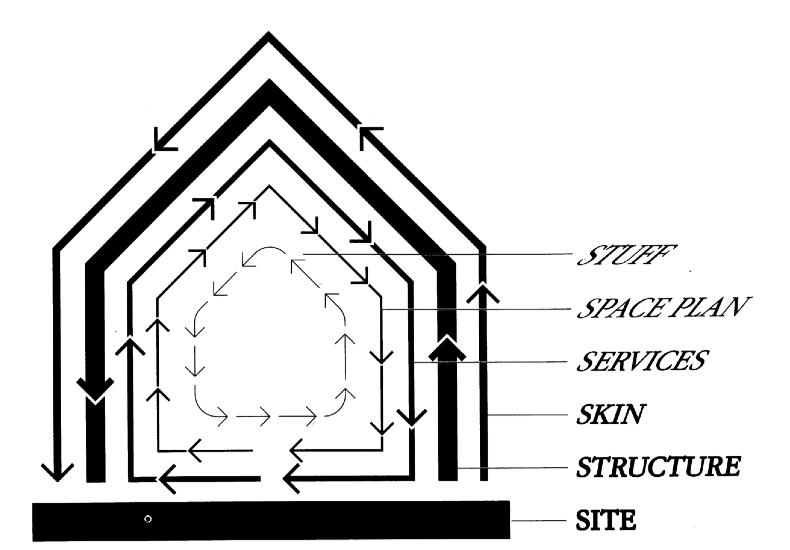
This is the diagram on which How Buildings Learn (1994) is based.
s
search
c
compose new post
r
reply
e
edit
t
go to top
j
go to the next post or comment
k
go to the previous post or comment
o
toggle comment visibility
esc
cancel edit post or comment