Gerald Midgley – A Systems Theory of Marginalization and its Implications for Systemic InterventionNov 2021 – SCiO (systems and complexity in organisation) open meeting recording – YouTube

SCiO systems and complexity in organisation

Gerald Midgley – Nov 2021 – SCiO Open Meeting

Gerald Midgley – Nov 2021 – SCiO Open Mtg – YouTube

A Systems Theory of Marginalization and its Implications for Systemic Intervention: In this talk, Gerald Midgley will present the systems theory of marginalization that he has been developing and applying in systemic interventions for almost 30 years. This theory offers a generic model of marginalization processes that is equally relevant to relationships between people in small groups, organizations, communities and international relations. Both people and the issues that concern them can become marginalized. Gerald will share several strategies for challenging marginalization when it has negative consequences. However, some of these strategies have a dark side that needs to be acknowledged if our projects are not to have unforeseen side-effects. The theory will be extensively illustrated with practical examples of projects from the UK and New Zealand.

Rethinking Education Podcast #16: Guy Claxton on neotraditional myths

2:26:28

Rethinking Education

24 Apr 2021

Professor Guy Claxton is a hugely influential academic, thinker and author of over 30 books on learning, intelligence and creativity, including Hare Brain, Tortoise Mind, Wise Up, What’s the point of school, Intelligence in the flesh, Educating Ruby and The Learning Power Approach. Guy previously appeared on the Rethinking Education podcast, an episode you can access here:   / re07-guy-claxton  .

0:01 / 2:26:28•IntroRethinking Education Podcast #16: Guy Claxton on neotraditional mythsRethinking Education320 subscribersSubscribed 12345678901234567890123456789 ShareDownloadClipSave157 views 24 Apr 2021Professor Guy Claxton is a hugely influential academic, thinker and author of over 30 books on learning, intelligence and creativity, including Hare Brain, Tortoise Mind, Wise Up, What’s the point of school, Intelligence in the flesh, Educating Ruby and The Learning Power Approach. Guy previously appeared on the Rethinking Education podcast, an episode you can access here:   / re07-guy-claxton  .

Rethinking Education Podcast #16: Guy Claxton on neotraditional myths – YouTube

Or on podcast

https://overcast.fm/+n2xyDvHhM/50:25

Barn Doors on Perspectives – flowchainsensei (Bob Marshall)

Dataart Publishes Ukrainian IT Visionary Victor Glushkov’s Complete Memoirs For The First Time

8/24/2023 10:01:04 AM

DataArt IT Museum unveils Ukrainian cybernetics founder’s exclusive memoirs to commemorate his centennial anniversary.

Dataart Publishes Ukrainian It Visionary Victor Glushkov’s Complete Memoirs For The First TimeDate8/24/2023 10:01:04 AM Share on Facebook Tweet on Twitter (MENAFN- EIN Presswire)DataArt IT Museum unveils Ukrainian cybernetics founder’s exclusive memoirs to commemorate his centennial anniversary.

Dataart Publishes Ukrainian It Visionary Victor Glushkov’s Complete Memoirs For The First Time | MENAFN.COM

https://menafn.com/1106935842/Dataart-Publishes-Ukrainian-It-Visionary-Victor-Glushkovs-Complete-Memoirs-For-The-First-Time

Direct link:

https://museum.dataart.com/en/victor-glushkov/

BBC Great Lives Kate Raworth on Donella Meadows

Great Lives – Kate Raworth on Donella Meadows – BBC Sounds
https://www.bbc.co.uk/sounds/play/m001pt9w?partner=uk.co.bbc&origin=share-mobile

Ashoka: Roots of Change: How Social Entrepreneurs Advance Systems Change in Africa

How do systems-change approaches address the root causes of deeply entrenched societal problems rather than the symptoms only? What are examples of systems-change strategies led by social entrepreneurs in Africa? What are key learnings for key stakeholders to scale social innovation on the continent?

Ashoka is launching the Roots of Change report with 5 cases of Ashoka Fellows in Africa to demystify systems change and contextualize it for the African continent. The report also distills How To’s and insights for social change leaders, impact investors and philanthropists, and influential players such as corporates and governments to accelerate positive change.

Much still needs to be done to support systems-changers in Africa. Please help us spread the word!

Roots of Change: How Social Entrepreneurs Advance Systems Change in Africa

Roots of Change Report | Ashoka | Everyone a Changemaker

https://www.ashoka.org/en-us/roots-of-change

Illuminate Systems Change on YouTube

Illuminate Systems Change

Illuminate Systems Change – YouTube

https://www.youtube.com/@illuminatesystemschange1988

Including power, justice, and systems change series

SCiO Global mini-Conference and AGM – Wednesday 4 October 2023, 9am UK time (details to be confirmed) – online

Wednesday 4th October 2023

09:00 GMT+1   (details to be confirmed)

Online

It’s six weeks to the SCiO Global mini-Conference and AGM on Wednesday 4th October 2023 – to be held online.

This is our first SCiO global meeting and we hope you will join us. The AGM will be held during the meeting – all can attend but only members can vote.  ALL ARE WELCOME.

Details will be updated on the SCiO website – see https://www.systemspractice.org/events/scio-global-mini-conference-and-agm.

Please book via Eventbrite: https://www.eventbrite.co.uk/e/705259168157?aff=oddtdtcreator. Booking is FREE.

Details of speakers and sessions currently confirmed (not necessarily in this order!)

Whatever works – Adventures of a couple of systemic consultants in IT organizations – Ed van der Winden (SCiO NL)

In this light-hearted talk Ed van der Winden will share some of his experiences in trying to help IT departments move to a better place. A lot of systemic models have played a role in this: the talk will focus on examples of their practical use. Some of the more well-known models that will be discussed in this talk will be: The Viable System Model, causal loop diagrams and Fernando Flores’ conversations-for-action model. But also lesser known models have been used, such as the 4D-model for dealing with organizational stress (based on Perceptual Control Theory), Will McWhinney’s Paths of Change and the use of the makigami technique from Kaizen and Lean to ‘go to the gemba’.

The Purpose Thing….  – Patrick Hoverstadt

There is a split within Systems in both thinking and practice around purpose. Is it about ‘intention’ or is it about effects – the POSIWID position. This split is not limited to the field of systems, as an example it also splits the field of ethics, but for us in our discipline it has had enormous consequences. This talk will explore this from several angles – why the split exists, how different approaches are grouped either side of the split, how it has driven factionalism and mutual incomprehension  in the past and how the split itself represents one of the most fundamental issues in systems thinking and presents a dilemma for the systems practitioner and one that needs to be worked with. Finally we’ll look at the resolution of this in practice.

New Meta-systems Thinking for Regenerative Leadership – Jan de Visch (SCiO Belgium)

Socially, we see a trend in organizations toward being more conscious and sustainable. The number of companies seeking to reduce their carbon footprint to zero is growing. To achieve this, new business and operational models are emerging, often focused on ecosystemic collaboration. Often a broad common ground is lacking, and one must cooperate in diversity.

The leadership required for this requires significantly better assessing the parties’ positions to influence ideas and solution developments in real time. Systemic thinking is a necessary requirement here but perhaps insufficient. Meta-systemic thinking is needed to handle the potential areas of tension in real-time and make evaluative comparisons between different systemic options. It is thinking based on assessing the blind spots in systemic thought processes.

Jan De Visch illustrates how this meta-systemic thinking leads to the estimation of new opportunities the way CEOs deal with climate challenges and develop a kind of regenerative leadership.

Additional sessions and speakers to be confirmed

SCiO Global mini-Conference and AGMWed 4 October 2023 09:00–13:00  GMT+1Organiser(s):SCiOEvent access:All welcome

SCiO Global mini-Conference and AGM | SCiO

https://www.systemspractice.org/events/scio-global-mini-conference-and-agm

CECAN Webinar:Setting Boundaries in Evaluation; The role of Critical Systems Heuristics – Bob Williams, 18 October 2023, 10:00 UK time

CECAN Webinar:
Setting Boundaries in Evaluation; The role of Critical Systems Heuristics
 Wednesday 18th October 2023, 10:00 – 11:00 BST

Presenter: Bob Williams, Evaluator

https://mailchi.mp/8e4dd1c03484/cecanwebinar-6655710?e=68c639d876

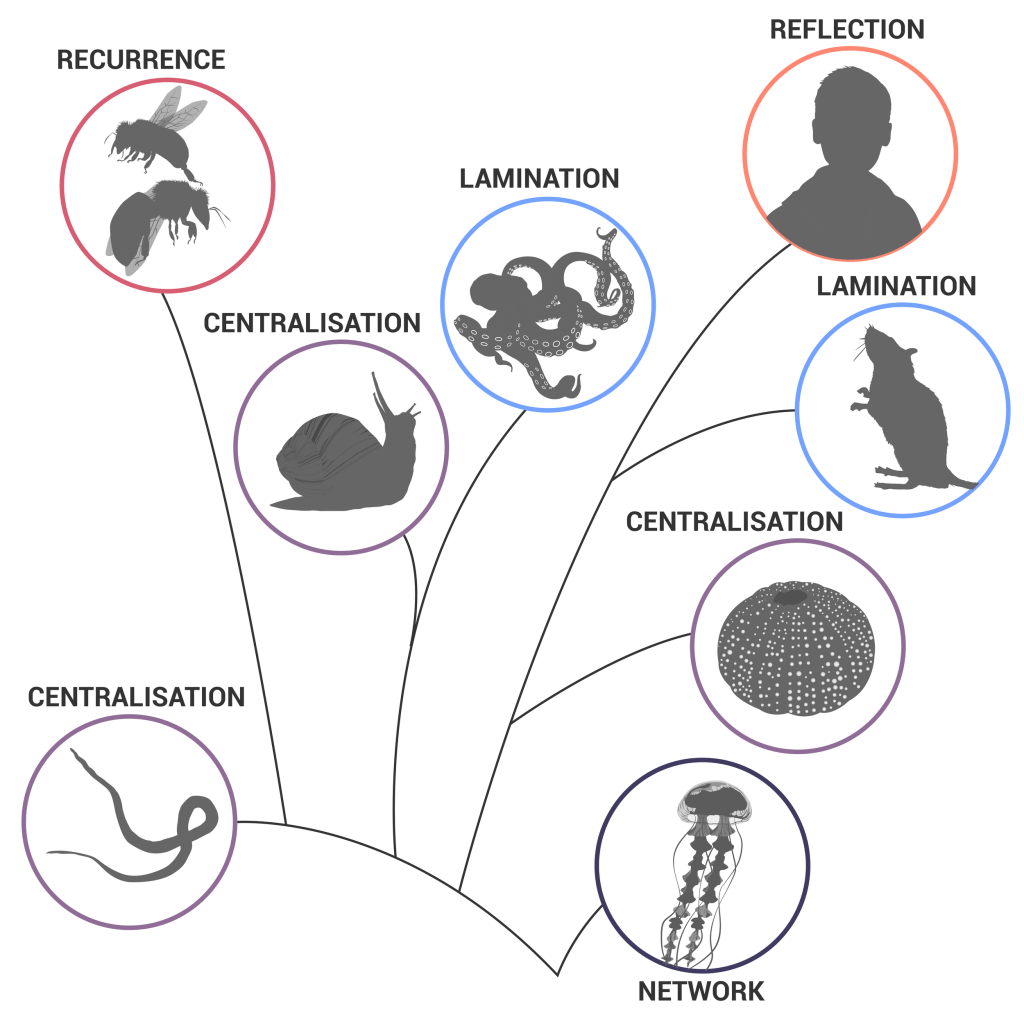
The Many Minds podcast / the Diverse Intelligences Summer Institute: The five portals of cognitive evolution – Andrew Barron on behalf of the Major Transitions project

Note the care in making these distinctions with awareness of the teleological fallacy and the superiority fallacy.

The overall project at https://www.majortransitions.org/about is fascinating from a systems | cybernetics | complexity perspective (I wonder if they have any reference to cybernetics?) in identifying possible major distinct forms of ‘intelligence’. It makes me speculate about how different forms of utopian (or merely normative) prescription for organisation might usefully be distinguished as targeting different forms of ‘cognition’ as ‘optimal’…

Episode transcript

https://drive.google.com/file/d/1b_7-I78y_wmdSK7VapX1QalXzccKDm7X/view?usp=drive_link

  • August 9, 2023
  • Andrew Barron
  • 1 hr, 4 min

COMPUTATIONAL COMPLEXITY. Complexity Theory’s 50-Year Journey to the Limits of Knowledge – Brubaker in Quanta Magazine (2023)

How hard is it to prove that problems are hard to solve? Meta-complexity theorists have been asking questions like this for decades. A string of recent results has started to deliver answers.

Complexity theorists are confronting their most puzzling problem yet: complexity theory itself.

Ben Brubaker

Staff Writer


August 17, 2023

https://www.quantamagazine.org/complexity-theorys-50-year-journey-to-the-limits-of-knowledge-20230817/?mc_cid=220b7c326d&mc_eid=a53de31710#

Editorial: ‘Bad apples’: time to redefine as a type of systems problem? – Shojania and Dixon-Woods (2023)

(A bad system may beat good people, but evil people often beat even quite good systems)

  1. Kaveh G Shojania1
  2. Mary Dixon-Woods2
  3. Correspondence to Dr Kaveh Shojania, Department of Medicine, University of Toronto, Sunnybrook Health Sciences Centre, 2075 Bayview Avenue, Rm H468, Toronto, Ontario, Canada M4N 3M5; kaveh.shojania@sunnybrook.ca

http://dx.doi.org/10.1136/bmjqs-2013-002138

https://qualitysafety.bmj.com/content/22/7/528.long

Designing interagency responses to wicked problems: A viable system model board game – Sydelko, Espinosa, and Midgley (2023)

European Journal of Operational Research

Available online 4 August 2023

In Press, Corrected ProofWhat’s this?

Decision Support

Designing interagency responses to wicked problems: A viable system model board game

Pamela Sydelko

Angela Espinosa

Gerald Midgley

https://www.sciencedirect.com/…/pii/S037722172300512X

Abstract

Government agencies struggle to address wicked problems because they are open-ended, highly interdependent issues that cross agency, stakeholder, jurisdictional, and geopolitical boundaries. While both quantitative modelling and qualitative problem structuring methodologies have been used to support interagency decision making in the past, co-designing an effective interagency organization to collaboratively tackle wicked problems is more challenging. Few approaches have been developed to enable such efforts. This paper explains how the viable system model (VSM) was implemented through a board game, which was employed to co-design an interagency meta-organization that would be capable of more effectively collaborating to jointly address a wicked problem: international organized drug crime and its interface with local gangs in Chicago, USA. The board game was developed to make the VSM easier for the participants to learn, given that the cybernetic language and engineering-influenced diagrams in the original literature can be off-putting to leaders and managers. The board game was used as the final stage of a multi-method, systemic approach, which involved boundary critique and problem structuring as well as deployment of the VSM. The research findings indicate that the VSM board game, used as part of a larger mixed-methods systemic intervention, contributes to building trust in the value of systems thinking amongst the participants, and sets up a rich context for collaboration on multi-agency co-design. The game therefore offers significant promise as part of the co-design of interagency responses to wicked problems because it creates an embodied process for stakeholders to learn about the VSM. It also reduces the work involved in this learning. Thus, the game enables an effective appropriation of the VSM language and criteria.

Leading in a VUCA world – Mowles (2023)

Article at https://medium.com/@chris_39461/leading-in-a-vuca-world-7a5d249bdb2, part of Taking Experience Seriously

Possibly unpublished papers on Cybersyn / Project Synco by Stafford Beer and associates

On Twitter, Pedro Carcamo Petridis said (translated)

(Almost) sure that these notes are not published anywhere (maybe I’m wrong, but I have not found copies on the web). They are Synco project documents. I’d like to post them somewhere so they’re available. There are 8 short documents

https://twitter.com/pedrocarcamop/status/1690728311595352064?s=46&t=PsBiwVGq1KB__T4DxrBdDw

This was spotted by Jaime Alvarez, who flagged it on the Systems Change Finland (https://systemschange.fi/) Slack under a discussion on the Morozov podcasts (https://stream.syscoi.com/2023/07/22/the-santiago-boys-nine-episode-podcast-season-yevgeny-morozov-on-project-cybersyn/) where Mikael Seppala pinged me.

So here we have the eight documents from Pedro, who in an email says (paraphrased):

Here are the cybersyn project documents that I have. These belonged to my grandfather Lautaro Cárcamo, a Chilean engineer who participated as a consultant on the project and forged a close friendship with Stafford Beer. Among the documents, some in Spanish and some in English, there are texts written by Stafford, as well as others by Lautaro Cárcamo and Humberto Gabella, a partner in my grandfather’s company and also a consultant on the project. I am grateful for their publication, I believe they will be of interest to researchers.

I am currently going through archives and old documents to see if I can find anything else that might be of interest. I will let you know if I find anything. I personally have also followed cybernetics studies closely (much more on the philosophy and sociology side) so I am very grateful also for the possibility to meet people who have somehow been involved in all this.

Pedro Cárcamo Petridis

I’ve put Pedro in touch with some folks who will find the papers interesting and provide further connections (and see if these really are unpublished – I’ve found that one of these papers was referenced in a Liverpool John Moores University PhD)