
Link:
https://www.zotero.org/groups/4453812/postrat_reading_list/library
Arose from
Latest update here:
‘Postrat’ is somewhat defined in the tweet thread and also here:
I like postrats, though of course I’m not in the ingroup.
Link:
https://www.zotero.org/groups/4453812/postrat_reading_list/library
Arose from
Latest update here:
‘Postrat’ is somewhat defined in the tweet thread and also here:
I like postrats, though of course I’m not in the ingroup.
What is the economy? People used to tell stories about the exchange of goods and services in terms of flows and processes — but over the last few hundred years, economic theory veered toward measuring discrete amounts of objects. Why? The change has less to do with the objective nature of economies and more to do with what tools theorists had available. And scientific instruments — be they material technologies or concepts — don’t just make new things visible, but also hide things in new blind spots. For instance, algebra does very well with ratios and quantities…but fails to properly address what markets do: how innovation works, where value comes from, and how economic actors navigate (and change) a fundamentally uncertain shifting landscape. With the advent of computers, new opportunities emerge to study that which cannot be contained in an equation. Using algorithms, scientists can formalize complex behaviors – and…
View original post 103 more words
European Union for Systemics (EUS) – 11th EUS International Congress Hellenic Society for Systemic Studies (HSSS) – 17th National & International Conference Systemic Design Thinking for Creativity Online Attendance 06-09 October 2021 Athens, Greece
Home – Hellenic Society of Systemic Studies
On LinkedIn, Ray says:
Am delivering invited Keynote talk Friday 8th October at 1000 Athens time.
11th EUS International Congress; 17th HSSS National & International
Conference 6-9th October 2021
https://lnkd.in/gUzugfh9
Title: Critical reflections on contemporary systems practice: implications for scholarship and social impact
Exploring complexity and the implications for leadership and decision making in a changing world. In conversation with Marco Valente. Arnaldo Pellini Following Oct 6 · 10 min read
Exploring complexity and the implications for leadership and decision making in a changing world. In conversation with Marco Valente. | by Arnaldo Pellini | Systems Change Finland | Oct, 2021 | Medium
How can systems thinking enhance stewardship of public services? 15 OCT 2019 Karen Gardner, Sue Olney, Luke Craven, Deborah Blackman PUBLISHER Public Service Research Group (UNSW Canberra)
How can systems thinking enhance stewardship of public services?
Not sure how I missed this:
15 OCT 2019Karen Gardner, Sue Olney, Luke Craven, Deborah BlackmanPUBLISHERPublic Service Research Group (UNSW Canberra)
And upcoming one in a series of webinars:
System stewardship is emerging as a new way of thinking about the role of government.
14 October 2021 | 5pm – 6.15pm AEDT
Described as “a new way of working that allows governments and their agents to effectively influence and steward systems from which outcomes emerge”, system stewardship is seen as being critical to contemporary public service practice. But what does it mean and look like in practice?
Join this conversation to explore the concept of system stewardship, and how to encourage more of it within and across government agencies, so that our systems work to serve the people who they are supposed to benefit.
Speakers:
Facilitated by:
Gene Bellinger will present a webinar titled Systems Thinking: Trial and Learning
Systems Thinking: trial and learning Tickets, Tue 12 Oct 2021 at 12:00 | Eventbrite
“Systems Thinking: Trial & Learning” a presentation by Gene Bellinger on October 12, 2021 12:00 GMT as part of the Open University Systems Thinking in Practice Jubilee
source:
Remystifying Supply Chains – by Venkatesh Rao – Ribbonfarm Studio
| Venkatesh Rao | 4 hr ago | 9 |
If you’re like me, you’ve been avidly consuming supply-chain news and analysis lately. Semiconductor shortages and stuck container ships are the charismatic megafauna everybody is watching, but I’m primarily watching for more mundane little things that surprise me in some way. I’m hoping they will serve as clues that point to new ways of thinkingabout supply chains, because I think our existing mental models are failing us.
A big reason is that we thinksupply chains are old and well-understood parts of the world (after all, ships still ply trade routes that have been in use for millennia), but as I will argue, they’re not. Supply chains as they exist today are as young and mysterious as the internet. The ongoing supply chain crisis is at least as novel an event in human history as the recent big Facebook outage. Arguably more novel.
And we won’t take supply chains seriously enough until we remystify them in a way that forces us to make up new frames that center their recently evolved novel aspects rather than their ancient and familiar aspects. Frames that encompass the entire vast scope of things that move along global supply lines today. Not just shipping containers full of durable manufactured goods, but bulk-carried materials, air-shipped perishables, seafood, livestock, piped materials, electricity, and so on. Viewed this way, the internet is just one supply chain among many, a bits-and-bytes-specific member of a cohort of technologies that date approximately to the 1960s.
continues in source:
Remystifying Supply Chains – by Venkatesh Rao – Ribbonfarm Studio
source
Systems Thinking Ontario – 2021-10-18
October 18 (the third Monday of the month, dodging Canadian Thanksgiving) is the 94th meeting for Systems Thinking Ontario. The registration will be on Eventbrite at https://ee-st.eventbrite.ca.
For this session, Katie Kish and David Mallery will lead a discussion on Ecological Economics in two parts.
(1) Where is Ecological Economics going with Systems Thinking?
In the “Critical Pluralism” paper (see below), the newest generation of EE scholars is portrayed as taking a regenerative approach to research and learning. This is best navigated with critical pluralistic approaches well-developed in systems thinking. The shift might be better supported through a wider set of systems tools, which might also have complementary effects on systems methodologies.
(2) What could a 30-year research agenda for Ecological Economics be?
The “Paying Attention” paper (see below), is one in a special section of “Ecological Economics: The next 30 years”.
Katie has been working for the Global Footprint Network, that uses big data to produce the Ecological Footprint Accounts. Applying this data on individual and group behaviour change raises questions on the role and ethics associated with big data.
The special section of the journal aims to find synergies between existing work and how to evaluate matters that have urgency and importance. Katie welcomes discussion on any of these papers, and is providing access to a private cache (to those without access to a university library).
Topic 1:
Topic 2:
Registration on Eventbrite includes links to the cache of journal articles.

Bloggers are encouraged to write about their learning and experiences at the meeting. Links will be added to this page.
source and booking link via:
Systems Thinking Ontario – 2021-10-18
The Fifteen Fundamental Properties Pages 144-235 of Christopher Alexander’s The Nature of Order Volume One: The Phenomenon of Life contain a theory of beauty as perceived by humans, conveyed in fifteen “fundamental properties.” Not every property occurs in every beautiful object, but in very beautiful buildings and objects, many of these properties are usually apparent, baked into the logic, structure, and detail. Here I will briefly explain the fifteen fundamental properties, with reference to an early 20th century ivory dog netsuke and a Jeff Koons balloon dog sculpture.
The Fifteen Fundamental Properties – Carcinisation
DRS 2022 25th June — 3rd July We have recently lived through extraordinary times where design in many forms has been necessary to counter the enormous problems we have faced and continue to face in our conflicting coexistence. How has the discipline of design research responded? Can design and design research bring the insights and methods needed to transform conflict into collaboration? Join us in Bilbao for DRS2022, a hybrid conference with unique participation opportunities and a showcase for the best in design research. Whatever your orientation to design research we encourage you to participate, to show the true diversity and potential of our discipline. DRS2022 is hosted by the city of Bilbao in association with the University of the Basque Country (Universidad del País Vasco) and the wider ecosystem of local academic and design institutions. In 2014 Bilbao became a member of the UNESCO City of Design network. As such, it hosts a permanent Design and Creativity Council with a mission to promote design-oriented urban policies and to integrate goals related to the cultural and creative industries into local development plans. Bilbao recently joined the Global Destination Sustainability Index with a commitment to meet specific guidelines for the development of more sustainable conferences. DRS2022 is also hosted online in a hybrid mode, with opportunities for new interactions between the place-based and online conferences. The extended conference format will give you the chance to experience the energy and creativity of Bilbao wherever you choose to participate from.
DRS 2022 Bilbao · DRS 2022
via Ben Sweeting
Tracks include:
https://www.drs2022.org/theme-tracks/
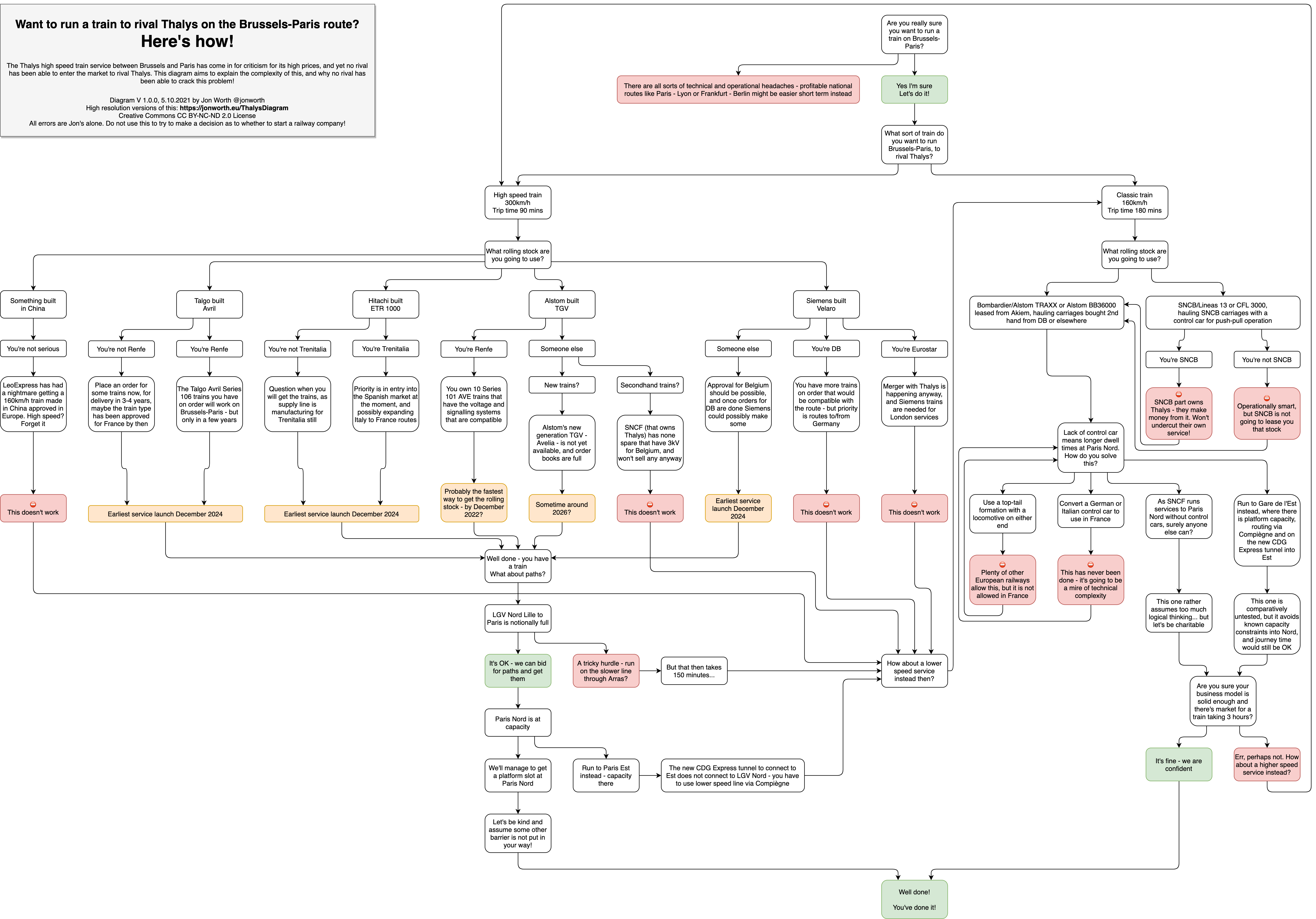
Thalys has been in the news this week – because its proposed merger with Eurostar is supposedly back on… … so it’s time to examine why a rent seeking monopolist firm like Thalys can even exist on the Brussels-Paris route
(2) Jon Worth on Twitter: “Well… it’s complicated. And how do I explain complicated stuff? With a diagram of course! You’re going to need a high resolution version of this! Find that here: https://t.co/9VCYfA81vD https://t.co/2Xa8bh95zq” / Twitter
Tweet thread:
Diagrams via: https://jonworth.eu/ThalysDiagram/
Call for Papers: Special Issue on Alexander Bogdanov For more information, please see here. Submission Deadline: 15 January 2022 Please note all special issue papers must be submitted through the ScholarOne site: https://mc.manuscriptcentral.com/srbs
Systems Research and Behavioral Science – Wiley Online Library
СИСТЕМНЫЙ МИР АЛЕКСАНДРА АЛЕКСАНДРОВИЧА БОГДАНОВА НАУЧНО-ПРАКТИЧЕСКАЯ КОНФЕРЕНЦИЯ-БИЕННАЛЕ 09–10 ДЕКАБРЯ 2021 ГОДА
Системный мир А.А. Богданова | Всероссийская научно-практическая конференция
Blog from Gene Bellinger
https://systemswiki.substack.com/
Stanford Report, February 16, 2006 Noted cognitive scientist asserts that analogy is (almost) the whole enchilada BY BARBARA PALMER
Noted cognitive scientist asserts that analogy is (almost) the whole enchilada
Paper Analogy as the Core of Cognition
(Previously published in: The Analogical Mind: Perspectives from Cognitive Science, Dedre Gentner, Keith J. Holyoak, and Boicho N. Kokinov (eds.).
Cambridge MA: The MIT Press/Bradford Book, 2001, pp. 499-538.)
Click to access Hofstadter%20-%20Analogy%20as%20the%20Core%20of%20Cognition.pdf
Lecture at: https://www.youtube.com/watch?v=n8m7lFQ3njk

 Systems Community of Inquiry
You must be logged in to post a comment.