
Ritual, Sanctity, and Cybernetics Roy A. Rappaport American Anthropologist New Series, Vol. 73, No. 1 (Feb., 1971), pp. 59-76 (18 pages) Published By: Wiley
Ritual, Sanctity, and Cybernetics on JSTOR
Category Archives: Discussion
A view or perspective on the world
POSITIONAL TRANSDUCTION: AN ALTERNATIVE TO CODE: Nadir (1984) Cybernetics and Systems: Vol 16, No 2-3
POSITIONAL TRANSDUCTION: AN ALTERNATIVE TO CODE MARK T. NADIR Pages 191-227 | Received 01 Nov 1984, Published online: 03 Apr 2007 Download citation https://doi.org/10.1080/01969728508927766 References Citations Metrics Reprints & Permissions Get access Abstract A new method of transducing information into digitized form is described. This method does not result in any form of code, nor does it bear any resemblance to code. In this new system of information digitization the only data that appears on the transmission medium are the addresses of the multiplicity of receptors being addressed. The methodology is compatible witJi digital technology. This method (positional transduction) very markedly alters the characteristics of the systems wherein it is employed (in favorable ways). Unlike code that has one basic form, positional transduction can (and does) assume a multitude of differenl forms, which share a common characteristic. The systems resulting from employment of the described technology can be made self-routing, automatically multiplexing, parallel processing—or all three. Several of the multiplicity of ways in which positional transduction might be employed are described. Part I of the article is devoted to describing ways of employing positional transduction. The descriptions are illustrated with communications examples. In Part II, a calculator system is briefly described, which leads to a computational system. The article concludes with a description of the salient features of a computer whose hardware is “software wired.”
POSITIONAL TRANSDUCTION: AN ALTERNATIVE TO CODE: Cybernetics and Systems: Vol 16, No 2-3
The Many Careers of Jay Forrester – by Peter Dizikes, 2015
https://www.technologyreview.com/2015/06/23/167538/the-many-careers-of-jay-forrester/
The Many Careers of Jay Forrester
Computing pioneer Jay Forrester, SM ’45, developed magnetic-core memory. Then he founded the field of system dynamics. Those are just two of his varied pursuits.by
June 23, 2015
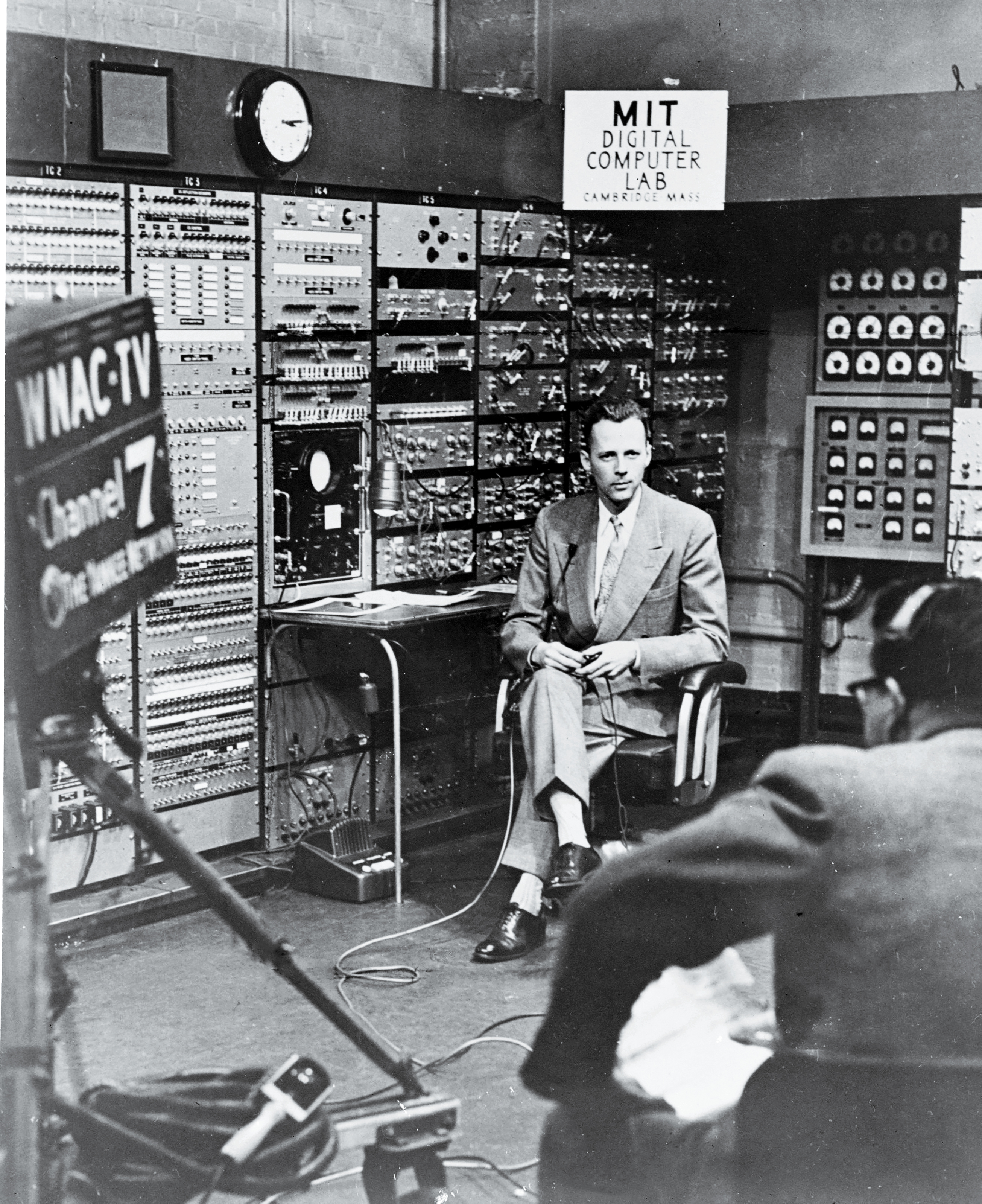
It is a late March day in Massachusetts. The sky is clear, but the air is frigid and the wind fierce. Looking outside, Jay Forrester, SM ’45, turns to glimpse the swaying treetops. He knows all about the power of wind. As a teenager, he harnessed it to bring electricity to his family’s ranch in Nebraska.
A precocious tinkerer, Forrester studied electrical engineering at the University of Nebraska. He arrived at MIT as a graduate student in 1939 and never left, staying on as researcher, professor, and now professor emeritus. He has been at MIT for more than half the time that has passed since the Institute opened its doors.
Yet Forrester’s 76-year MIT tenure is even more notable for its breadth than its duration. He helped develop digital computing. He oversaw the creation of a national air defense system and helped launch MIT’s Lincoln Laboratory. Then he joined what is now the MIT Sloan School of Management and founded the field of system dynamics, which examines complex business, economic, and environmental systems—and the unexpected feedback effects human activity creates within them. “I’ve had several careers,” says Forrester, who turns 97 in July. “Starting with ranch hand.”
continues at source: https://www.technologyreview.com/2015/06/23/167538/the-many-careers-of-jay-forrester/
Exploring practical systems change: why are we not learning all the lessons we could about fire safety? – session on #systemschange
source:
Exploring practical systems change: why are we not learning all the lessons we could about fire safety? – the once-chosen path
Exploring practical systems change: why are we not learning all the lessons we could about fire safety?
antlerboy – Benjamin P TaylorUncategorized October 3, 2021 4 Minutes
“Institutions established to serve the public can over time, become insular and increasingly focussed on self-preservation. Against this, a changing world posing new risks and opportunities, an absence of competition or change catalysts, and limited public input can then create a growing gap between what is, and what could be. When the gap and cost become intolerable it is time to act. This describes the current situation of reliance on a professional response model for fires. It is now time to disrupt the current model by amplifying the public voice and creating a space for innovation.”
David Wales
Why is this – and what can we do about it? Your thoughts would be welcome in the comments – and there’s an opportunity to participate:
- Practice your thinking about system transformation
- Monday 25 October 16:30-17:30 UK time
- Register at https://zoom.us/meeting/register/tJctd–qrT8iGtELOsPqYrlJbpdGDVjLiHuk
continues in source:
Exploring practical systems change: why are we not learning all the lessons we could about fire safety? – the once-chosen path
Catastrophe and Systemic Change: Learning from the Grenfell Tower Fire and Other Disasters – The London Publishing PartnershipThe London Publishing Partnership
Catastrophe and Systemic Change: Learning from the Grenfell Tower Fire and Other Disasters
Book: £18.99 (including free P&P within the UK)

Gill Kernick
Buddhist and Taoist Systems Thinking: The Natural Path to Sustainable – Coll (2021)
Buddhist and Taoist Systems Thinking The Natural Path to Sustainable Transformation By Josep M. Coll Copyright Year 2021
Buddhist and Taoist Systems Thinking: The Natural Path to Sustainable
Network Training Slide Decks – NetworkWeaver
Network Training Slide Decks
FREE
A package of presentation slide decks that can be used by you for training or sharing with people who want to learn more about networks.
Network Training Slide Decks quantityADD TO CART Report AbuseCategory: Free Resources Packages Description Reviews (0) Description A package of presentation slide decks that can be used by you for training or sharing with people who want to learn more about networks. Network Basics Presentation Slide Decks Network Skills Presentation Slide Decks Map Analysis & Weaving Related
Network Training Slide Decks – NetworkWeaver
Walking in circles | Max-Planck-Gesellschaft
https://www.mpg.de/596269/pressRelease200908171
Walking in circles
Scientists from Tübingen show that people really walk in circles when lostAUGUST 20, 2009
It is a common theme in many books and films: when people get lost in a desert or a jungle, they end up walking in circles. No matter how hard they try, at some point they will cross their own tracks and despair, because they realize that they will never make it back to civilization. Surprisingly enough, the belief that people walk in circles when lost is mainly based on anecdotal evidence and has never been studied systematically in a real desert or forest. (Current Biology, August 20th 2009)
the Tektological҉’s Newsletter – e.g. Common Cybernetic Resources (C\cyb) – by Tektological҉ – Serendipity
A new newsletter (via substack, but currently free) on cybernetics.
Main link:
https://tektology.substack.com/
I’d particularly draw your attention to:
Common Cybernetic Resources (C\cyb) A web of links and resources. Tektological҉ – Serendipity Jul 22 5 12
Common Cybernetic Resources (C\cyb) – by Tektological҉ – Serendipity – Tektological҉’s Newsletter
Laws of Form Course – An Introduction to George Spencer-Brown’s ‘Laws of Form’ – YouTube
via Ivo Velitchkov
George Spencer-Brown’s Laws of Form is a work that deserves to be better known. Since its first publication in 1969, it has become something of a cult classic. It outlines a powerful content-free calculus based on a single act of making a distinction. From there, Spencer-Brown traces the path the universe takes to come into being in and of itself in order (as he argues) to know itself. In this video, Leon Conrad gives an overview of an on-line course he has designed to help people engage with the work in more depth – chapter by chapter – theorem by theorem, in a rigorous but easy-to-understand way. I recommend following through the course with a copy of the 2011 edition of Laws of Form. A great story-based introduction to the calculus and the way it works is George Burdett-Stuart’s website – The Markable Mark – www.markability.net
(3) Laws of Form Course – An Introduction to George Spencer-Brown’s ‘Laws of Form’ – YouTube
Russell Ackoff ‘on ‘POSIWID”
Classic Ackoff, via Alidad Hamidi, who says
HumanSelection (@Alidad Hamidi) Tweeted: POSIWID. Ackoff in this wonderful short video talk about the fact that we have sickness system and not health system and most of our social systems are doing the opposite of what the state they do.
(He clarified that the concept of POSIWID is from Stafford Beer)
Russell Ackoff
(1) Russell Ackoff / Haynes Media Works – YouTube
Cybernetic Aspects in the Agile Process Model Scrum – Bogner, Hronek, Wiesinger (2014)
Cybernetic Aspects in the Agile Process Model Scrum
M. Bogner, Maria Hronek, F. Wiesinger
Published in ICSEA 2014 Engineering
Agile process models provide guidelines for modern software development. As one of their main purposes is to complete projects under external influences as successfully as possible, the question arises as to how reliably and routinely given project goals can be achieved by means of such process models. This is all the more relevant as today, unfinished software projects frequently lack certain functionality, or missed project deadlines are still on the daily agenda in software development. Therefore, research has been done to identify the coherences between agile process models and cybernetics. Cybernetics is a natural science based on biocybernetics which forms the basis for well-functioning processes. It was analysed how it helps to cope with complexity, thus allowing for viable complex systems or processes. Cybernetics, as a science of functioning, is also relevant for agile process models. Once the basic cybernetic aspects are applied, processes are kept under control and organized in ways that ensure long-term viability. This paper reports the results of the selected agile representative Scrum. It shows that although some major cybernetic aspects like communication, feedback and circularity are covered, other basic cybernetic principles are missing in Scrum. Yet, these shortcomings can be compensated in order to get essential reliability, especially in critical situations. Keywords–agile software development; Scrum; cybernetics; biocybernetics.
[PDF] Cybernetic Aspects in the Agile Process Model Scrum | Semantic Scholar
Down the Rabbit Hole: Tracking the Humanizing Effect of John Dewey’s Pragmatism on Norbert Wiener – Moorhead (2015)
Down the Rabbit Hole: Tracking the Humanizing Effect of John Dewey?s Pragmatism on Norbert Wiener September 2015IEEE Technology and Society Magazine 34(3):64-71 DOI: 10.1109/MTS.2015.2461231 Laura Moorhead
(11) (PDF) Down the Rabbit Hole: Tracking the Humanizing Effect of John Dewey?s Pragmatism on Norbert Wiener
Neuropragmatism: A Neurophilosophical Manifesto – Solymosi and Shook (2013)
Neuropragmatism: A Neurophilosophical Manifesto
Tibor Solymosi and John Shook https://doi.org/10.4000/ejpap.671
Abstract
Over the past three decades, cognitive science has been making a turn towards pragmatism. Here we outline steps towards completing this turn. As a handful of cognitive scientists and philosophers have been arguing more recently, the insights of William James, John Dewey, and George Herbert Mead are not only being re-discovered, they are also proving rather prescient in light of growing research. The new field of neuropragmatism aims to take these insights seriously and further into new directions for both pragmatism and cognitive science. In this manifesto, a brief history of the relationship between classical pragmatism and the sciences of life and mind is offered as a background for twelve proposed theses of neuropragmatism. These theses serve as general guidelines for further philosophical and scientific research. To illustrate the possibilities and consequences of this neuropragmatic framework, neuropragmatist views on traditional questions of philosophy of mind, such as the mind-body relationship, are situated among other leading philosophical perspectives, like enactive, embodied, and embedded theories of cognition and mentation. Such views, however, when taken from a neuropragmatist perspecitve, have significant consequences for the philosophical project of reconciliation be- tween what Wilfrid Sellars called the scientific and manifest images of humanity. The difference in conceptions of experience and subesequently science are crucial for understanding the difference between Sellarsian neurophilosophy and neuropragmatism, as well as how to reach rapprochement between the sciences and the humanities.
Neuropragmatism: A Neurophilosophical Manifesto
Lifeworld Analysis – Agre and Horswill (1997?)
Lifeworld Analysis Philip Agre pagre@ucsd.edu Department of Communication 0503 University of California, San Diego La Jolla, CA 92093, USA and Ian Horswill ian@ils.nwu.edu Northwestern University Computer Science Department 1890 Maple Avenue Evanston, IL 60201, USA
Lifeworld Analysis
 Systems Community of Inquiry
You must be logged in to post a comment.