
How’s this ? Open Systems Theory – Making adaptive and Lasting Change 2x3day course 17th – 19th and 24th to 26th of February 2023 – Canberra, Australia with Merrelyn Emery and Peter Aughton @Mihail Sestakov, @Alidad Hamidi, @Trond Hjorteland and @Peter Aughton are helping to organize a a course in Canberra Australia in late February on Open Systems Theory (OST), this will be facilitated by none other than Merrelyn Emery, who along with her husband Fred Emery are the experts not only on the theory of OST but also on how it can be practically applied. OST is one of the most coherent application of systems thinking that we have seen, with a thorough scientific theoretical back ground and immediate practical application supporting organisations and groups to be equipped to handle the true nature of being a viable adaptive organisation. OST is elates people and their organizations to their extended social field. It promotes participation and democracy. Learn OST through the application of theory to the methods experiencing why some methods work while others don’t. You will learn about all the OST methods, the Search Conference, Participative Design Workshop, 2 Stage Model and Unique designs. This suite of methods covers all contingencies in all contexts. To find out more please let us know or click below to find out more https://events.humanitix.com/ost_canberra/
Fri 17th Feb 2023, 3:00 pm – Sun 26th Feb 2023, 9:00 pm AEDT
Open Systems Theory, Making Adaptive Lasting Change, Belconnen, Fri 17th Feb 2023, 3:00 pm – Sun 26th Feb 2023, 9:00 pm AEDT | Humanitix
Category Archives: Discussion
A view or perspective on the world
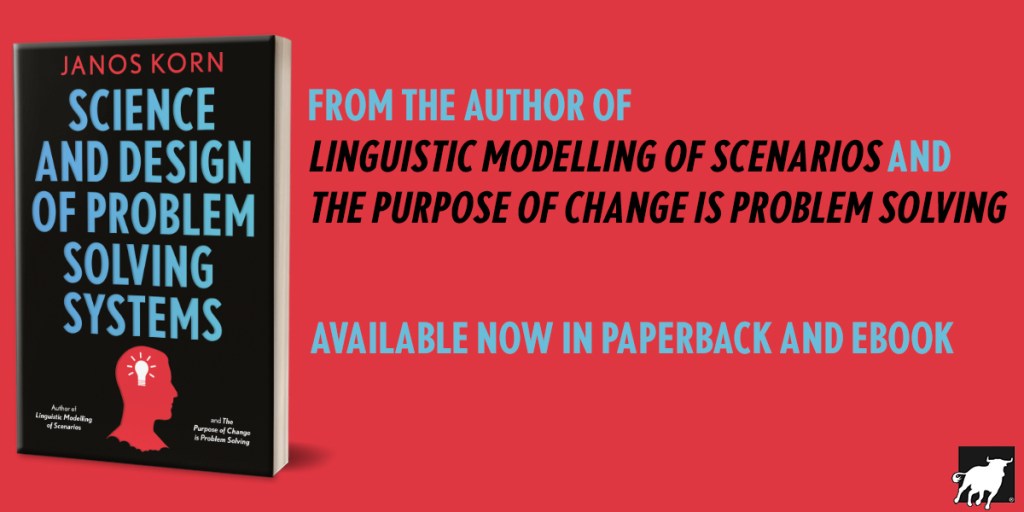
Science and Design of Problem Solving Systems – Janos Korn (2022)
The book is about an empirical, systems theory of a general, systemic/structural view of parts of the world integrated with creative problem solving procedure with the latter generating a ‘product and systems’ design method. As an alternative to the speculative and fragmented nature of current ‘systems thinking’ and practice, the book proposes three principles of systems: ‘Generality/nested hierarchy, changes of equilibrium states and problem solving/purpose’ together with ‘linguistic modelling’ using processed, natural language or transformation of narratives of scenarios into sequences of logical conditionals, the executor of the principles. Implementation of the creative, innovative, inspirational stage leads to ‘design parameters’ which guide the detailed design of systems and products defined as any entity capable of generating interaction. Uncertainties and mathematical models are introduced at the object/agent level as required. The theory is ‘property driven’ i.e., uses qualitative, quantitative properties including social, emotive and other mental states. Elementary, systemic or structural properties are ‘1 – and 2 – place simple sentences’ which can lead to operational representations when appropriate. Meaning preserving, linguistic transformations convert a narrative or story into such sentences. A user driven approach to the analysis of ‘information’ is introduced. Recent paradigm changes and problematic issues in current ‘systems thinking’ are reviewed. The theory is based on accepted branches of knowledge such as linguistics, network theory, biology, physics, chemistry, social science as needed, it is highly teachable, introduces linguistics in addition to mathematics as a symbolic model and can inspire further research. It introduces four criteria for judging the ‘soundness’ of symbolic models. However, it needs peer review, software development to work out the dynamics of scenarios and further developments for applications to more practical problem situations in organisations, technical and natural circumstances.
Science and Design of Problem Solving Systems eBook : Korn, Janos: Amazon.co.uk: Kindle Store
Extending the Predictive Mind

Andy Clark
Australasian Journal of Philosophy
How do intelligent agents spawn and exploit integrated processing regimes spanning brain, body, and world? The answer may lie in the ability of the biological brain to select actions and policies in the light of counterfactual predictions—predictions about what kinds of futures will result if such-and-such actions are launched. Appeals to the minimization of ‘counterfactual prediction errors’ (the ones that would result under various scenarios) already play a leading role in attempts to apply the basic toolkit of the neurocomputational theory known as ‘predictive processing’ to higher cognitive functions such as policy selection and planning. In this paper, I show that this also leads naturally to the discovery and use of extended processing regimes defined across heterogeneous mixtures of biological and non-biological resources. This solves a long-standing puzzle concerning the ‘recruitment’ of the right non-neural processing resources at the right time. It reveals how…
View original post 16 more words
Preview | Toward a theory of multifunctional liberalism: Systems-theoretical reflections on the nature of statehood
Roth S. and Valentinov V. (in press), Toward a theory of multifunctional liberalism: Systems-theoretical reflections on the nature of statehood, Systems Research and Behavioral Science.

Abstract: As neoliberalism is sinking into disrepute, states are responding to current crises by inroads on basic rights. This constellation adds urgency to the timeworn subject of statehood and its relationship to law and liberty. The paper addresses this subject by enhancing the neoliberal concept of an encased economy with James Coleman’s concept of law as indicator of social change and Niklas Luhmann’s functional differentiation. The resulting multifunctional liberalism associates liberties and rights with the autonomy of function systems—such as politics, economy, or law—and envisions an ecosystem of multifunctional organizations able to navigate the full spectrum of functional differentiation.
Keywords: Neoliberalism, law, economy, functional differentiation, social systems theory.
The author accepted manuscript of this article is available for download here.
Recommended citation: Roth S. and Valentinov V. (in press), Toward a theory of multifunctional liberalism: Systems-theoretical reflections on the nature of statehood, Systems Research and Behavioral Science.
Full article: Application of perceptual control theory to a Beer Game supply chain model – White, Brodie and Censlive (2022)
Key Concepts in Systems Thinking: for students, voters, journalists and politicians – J F Evans
In the systems thinking network group on LinkedIn, John Evans shared his book
He gives the caveat “It’s a bit dense, terse even, because it started out as a backup to an in house training course” – but I and others thought on first look that it seems useful. John (I hope he doesn’t mind me saying) can be on the curmudgeon scale – sometimes quite extremely so – but he certainly has useful experience, techniques, and perspective to share.
The book:
key concepts in systems thinking – John Evans
He also shared this:
https://www.academia.edu/48912553/Chapter_2_The_Biological_Basis_of_Thought_and_Perception
Understanding the impact of physicality on network structure
Márton Pósfai, Balázs Szegedy, Iva Bačić, Luka Blagojević, Miklós Abért, János Kertész, László Lovász, Albert-László Barabási
The emergence of detailed maps of physical networks, like the brain connectome, vascular networks, or composite networks in metamaterials, whose nodes and links are physical entities, have demonstrated the limits of the current network science toolset. Indeed, link physicality imposes a non-crossing condition that affects both the evolution and the structure of a network, in a way that is not captured by the adjacency matrix alone, the starting point of all graph-based approaches. Here we introduce a meta-graph that helps us discover an exact mapping between linear physical networks and independent sets, a central concept in graph theory. The mapping allows us to analytically derive both the onset of physical effects and the emergence of a jamming transition, and show that physicality impacts the network structure even when the total volume of the links…
View original post 61 more words
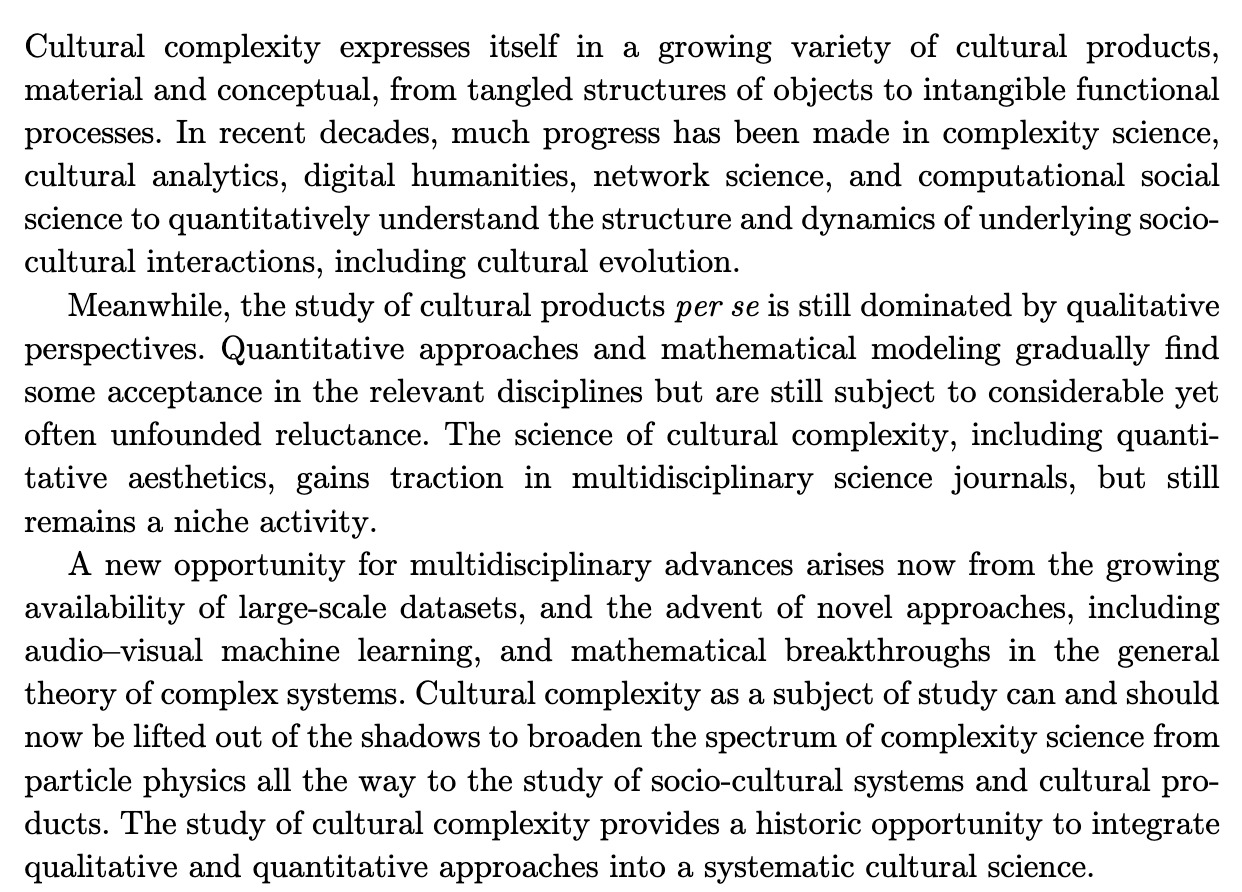
EDITORIAL: A TOPICAL ISSUE ON CULTURAL COMPLEXITY
Ramona Roller, Maximilian Schich, Hyejin Youn and Mikhail Tamm
Advances in Complex SystemsVol. 25, No. 05n06, 2202002 (2022)
Read the full article at: www.worldscientific.com
The Significance of Regenerative Learning – webinar with Shakti Sharan in conversation with Satish Kumar, Founder, Schumacher College, facilitated by Andrea Stone – December 8, 2022 8:30pm Mumbai, Kolkata, New Delhi time
The Significance of Regenerative Learning
One of the root causes of our global environmental crisis is the way in which education is imparted and the manner in which it is used to fuel relentless economic growth. Contemporary education systems remain long on building an ‘extractive’ mindset and are hopelessly ‘unfit for purpose’ as we wrestle with converging crises of climate emergency, ecological collapse, racial inequality and worsening social injustice.
Regenerative learning is a response to this harsh reality and goes beyond structured education. By collectively focusing on ‘nurturing people and caring for the planet’, we can transcend old paradigms and explore how to repurpose old structures, schools and universities.
This webinar will feature Shakti Saran, Founder, Shaktify in conversation with Satish Kumar, Founder, Schumacher College and will be facilitated by Andrea Stone, an emotional intelligence leadership coach. They will explore the realm of regenerative learning, its significance, how it manifests itself, and what can be done to overhaul education systems to make them more humanistic and sensitive to the needs of our planet.Time
Dec 8, 2022 08:30 PM in Mumbai, Kolkata, New Delhi
Webinar Registration – Zoom
Phase Transitions and Criticality in the Collective Behavior of Animals — Self-organization and biological function
Pawel Romanczuk, Bryan C. Daniels
Collective behaviors exhibited by animal groups, such as fish schools, bird flocks, or insect swarms are fascinating examples of self-organization in biology. Concepts and methods from statistical physics have been used to argue theoretically about the potential consequences of collective effects in such living systems. In particular, it has been proposed that such collective systems should operate close to a phase transition, specifically a (pseudo-)critical point, in order to optimize their capability for collective computation. In this chapter, we will first review relevant phase transitions exhibited by animal collectives, pointing out the difficulties of applying concepts from statistical physics to biological systems. Then we will discuss the current state of research on the “criticality hypothesis”, including methods for how to measure distance from criticality and specific functional consequences for animal groups operating near a phase transition. We will highlight the emerging view that de-emphasizes the…
View original post 52 more words
Mindfulness and Behavioural Insights: Reflections on the Meditative Brain, Systems Theory and Organisational Change – Lilley, Whitehead, and Midgley (2022)
Prof Gerald Midgley says:
Here’s a new paper that I have co-authored with Rachel Lilley and Mark Whitehead, entitled “Mindfulness and Behavioural Insights: Reflections on the Meditative Brain, Systems Theory and Organisational Change”. Access is free – there’s no paywall.ABSTRACT This paper explores the impacts of the Mindfulness-Based Behavioural Insights and Decision-Making (MBBI) programme. Combining mindfulness with behavioural insights instruction, the authors have developed the MBBI programme through a series of iterative trials over the last ten years. In addition to fusing mindfulness and behavioural insights, this programme also draws on the theories of autopoiesis, anticipatory systems, the predictive brain and constructed emotions, which all challenge the common assumption that behavioural and emotional responses are automatic (triggered by given stimuli and not open to change through self-reflection). The paper explores the use of the MBBI in the Welsh Civil Service. Employing evidence from in-depth interviews with participants and a SenseMaker analysis, it rethinks the role of mindfulness at work, repurposes the application of behavioural insights training toward a more ethical and systemic direction, and develops a reflective approach to capability building amongst public servants.https://jabsc.org/index.php/jabsc/article/view/3857/4199…
https://jabsc.org/index.php/jabsc/article/view/3857/4199?fbclid=IwAR1YuMaJ2e8lbW2N3NMlIWQr6i-__OS-DCEduvmwYcHXp4mzQAlwSTSzSww
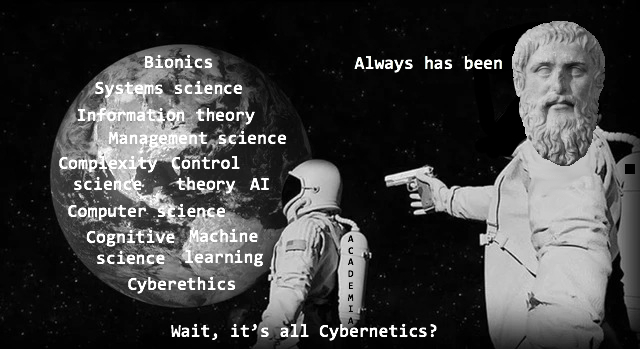
Wait, it’s all cybernetics?
b l a c k B o x
stpodrSoen5407c0l0h03598i5471l7hf5i9a791u9c07226162ic60ghtu5 ·
Plato introduced the κυβερνήτης (kubernḗtēs); the person who has acquired the art of steersmanship, as a metaphor for the adequate manager of a system.
As a result, a core value of cybernetics – transdisciplinary dialogue, evaporated. The loss of dialogue is naturally accompanied by a deteriorated learning process and ethical decline.
That’s not a functional frame.
So, back to Plato!
Plato, The Republic, book VI:
“Imagine a situation like this, on one ship or many: a captain who outstrips everyone on board in size and in strength, but nearsighted, partially deaf, and with knowledge of sailing to match; sailors in mutiny over the navigation, each thinking that he ought to steer, though none has learned the skill or can point to his teacher or to the time when he learned it, who deny in fact that navigation can even be taught and are ready to cut down anyone who says that it can, always swarming around the captain begging for the wheel and sometimes, if one group persuades him and another does not, the one kills off the other or pitches them overboard, and, having stupified the noble skipper with drugs or wine, they take over and revel and party on the ship’s stores and sail as you’d expect of such rowdies, and on top of it all they praise as a navigator and sailor with knowledge of shipcraft the man who’s sharpest at persuading or coercing the captain into letting them rule, but denounce as useless a man who lacks this ability, refusing even to hear that a navigator must necessarily study the seasons and climates, the sky, the stars, the winds and everything else that pertains to his craft if he’s to become a true shipmaster, and that he will be a navigator whether anyone wants it or not, and disbelieving that 𝙩𝙝𝙚𝙧𝙚 𝙞𝙨 𝙖 𝙨𝙠𝙞𝙡𝙡 𝙤𝙧 𝙥𝙧𝙖𝙘𝙩𝙞𝙘𝙚 𝙤𝙛 𝙨𝙩𝙚𝙚𝙧𝙞𝙣𝙜 𝙩𝙝𝙖𝙩 𝙘𝙖𝙣 𝙗𝙚 𝙖𝙘𝙦𝙪𝙞𝙧𝙚𝙙 along with navigation. In such a state of affairs, is it any wonder that the true navigator is called a useless, babbling stargazer by the crews of such topsy-turvy ships?”
(1) Facebook
https://boxblack.online/
https://www.facebook.com/mediasystemics
AFSCET
 Association Française de Science des SystèmesENSAM, 151 Bd de l’Hôpital, Paris 13ème
L’Association Française de Science des Systèmes
Cybernétiques Cognitifs Et Techniques
est heureuse de vous accueillir
https://www.afscet.asso.fr/
Réseau Intelligence de la Complexité | Faire pour comprendre, comprendre pour faire – Complexity resources in French, including the work of Jean-Louis Le Moigne, who died on November 16, 2022
Jean-Louis Le Moigne died on November 16.Sometimes words are inadequate to express the magnitude of our emotions. If, as Paul Valéry puts it, ” Death speaks to us in a deep voice without saying anything “, we still have, for those who had the good fortune to work with him, the memory of intense reflections, and for all numerous writings of Jean-Louis. Much more than writings, it is a work, if we take the time to reread, to reconnect the multiple threads and inspirations that have woven it “ on the way ”. We will soon take the time for this tribute.March which saw him born, month of the beginning of spring and the prospect of harvests in the near summer, is the marker of Jean-Louis’ work. It announces the renewal, always identical to the cycles of previous seasons, but paradoxically always new and singular. Irreducible duality of the work of Jean-Louis and his friend Edgar Morin: ” from Aristotle to HA Simon via R. Descartes and GB Vico “, rooting oneself deeply in the soil of human thought to argue that this who organizes us is only a shadow of the possible. One option among a thousand others in the hope of a broader and necessary emancipation of the human.“ Make room for doubt? Avoiding judging things too quickly and definitively, Jean-Louis’ work encourages us to begin by understanding what it means to “grasp reality” in its contradictions. But much more than that and beyond, to question ourselves deeply about the tools and categorizations that allow us to talk about this famous and elusive “real” always in the making but also, always marked by the path travelled.Among those who claim to belong to “the” complex thought, the original furrow that Jean-Louis has traced from the beginning is to consider it not as a tool that immediately resolves perceived problems, but as the way in which we commit ourselves humanly and if possible collectively in the intelligibility of these so-called complex systems: “ Our questions do not relate to the phenomena themselves, but to the multiple representations (designed models) that the actors concerned construct. »The month of March also heralds the prospect of sharing the harvest, that is to say the nuggets of wisdom accumulated and deepened by Jean-Louis throughout his life. Jean-Louis has continuously sought to promote a space of epistemological expressions, that is to say of discussion of the processes of thought and modeling that we use to understand the realities that we consider complex. The “Modelisation de la CompleXité” association (AE-MCX) and its dedicated site – armed wing of Jean-Louis – succeeded in uniting all interested players, bringing together researchers and “reflective practitioners” without exception. Spanish hotel ? Alchemy of exchanges? Ecosystem of performative ideas? This possibility of expressing our diversities, understand to act ⇔ act to understand ”.Everyone, aware of their intentions and possibilities, is part of this ongoing debate, where they feel the most comfortable, the most useful. Very unconventional! Speech certainly moderate and balanced – refusing to oppose the slogans to the slogans – but a force of persuasion which involved us in the adventure “Modelling of the CompleXity”.Come on, twilight is here: “ The wind is rising!… We must try to live! (Paul Valéry) and we must try to continue the work of Jean-Louis. Tributes to Jean-Louis Le Moigne@edgarmorinparis 18hJean-Louis Le Moigne this great spirit, this good and generous man has just disappeared; he was the most lucid and creative master of systems thinking in its complexity. His work and his collaboration were of paramount importance to me. He was my brother and companion
Réseau Intelligence de la Complexité | Faire pour comprendre, comprendre pour faire
Recursive and teleological rationality involved in the modeling process of self – organizing socio-economic systems – Le Moigne
Posted by Orsan Senalp in various systems | cybernetics | complexity groups:
Le Moigne, a close friend and colleague of Edgar Morin argued that cybernetics, systems, tektology, and complexity are found integral in Morin’s framework. For Le Moigne, Morin’s Method Vol. 1 presents a synthesis of these four paradigms: “From “Cybernetic Modelling” to “Systemic modelling,” the Paradigm of OrganisaCtion initially formulated by the Russian economist A. Bogdanov and rather completely synthesized today by Edgar Morin in the first four volumes of “la Méthode,” gives us a general framework (or “Method”) which present the basic inquiring principles guiding the intelligible modelling of complex systems, and particularly of evolving socioeconomics organizations” (Le Moigne, p. 3 – http://archive.mcxapc.org/docs/ateliers/0508jlm12.pdf)
Complex Adaptive Systems | Facebook
In the CAS group, Helene Finidori links to Von Glasersfeld
Thanks for this Örsan! This is quite serendipitous, as I was reading about something similar yesterday (Von Glasersfeld – http://vonglasersfeld.com/225)
The Ecology of Systems Thinking | Facebook
Systems Thinking Network on LinkedIn
https://www.linkedin.com/feed/update/urn:li:activity:7004118411869868032/
SCiO group LinkedIn (members only but membership excellent value – www.systemspractice.org)
https://www.linkedin.com/feed/update/urn%3Ali%3AgroupPost%3A8146034-7004118202104315904/
Le Moigne paper:
http://archive.mcxapc.org/docs/ateliers/0508jlm12.pdf?fbclid=IwAR3_3En9JqwteG1Tcx-q2UR2rK1IJgrfwxZOxXBtGWBdPukzUgsRenSzCQU
Also at
Réseau Intelligence de la Complexité
https://www.intelligence-complexite.org/media/document/ateliers/recursive-and-teleological-rationality-involved-modeling-process-self/open
 Systems Community of Inquiry
You must be logged in to post a comment.