Paradigm shift – RationalWiki


Source: Paradigm shift – RationalWiki

Paradigm shift

“”Really — in order to be a scientist — one should not only be comfortable, but willing to go against the grain. And I think this is true, to a certain degree. But when it’s taken too far you get into this area of obscurantism. You know, you are pushing so hardagainst the grain that you are encouraged to essentially create nonsense because you need to carve out this “extra” space that doesn’t already exist, and I think this happens a lot in the social sciences.
—Mike Rugnetta, PBS Idea Channel[1]

A paradigm shift is a phenomenon described by philosopher Thomas Kuhn in The Structure of Scientific Revolutions.

Kuhn posited a process to explain the persistence of incorrect ideas, and the seemingly rapid and sudden abandonment of these ideas when they finally are rejected.

People tend to believe in what they know, and science is basically conservative. A current “paradigm” or theory is difficult to dislodge. It takes either a large volume of evidence, or a particularly powerful single piece of evidence to overturn major scientific theories (scientific revolution). When this occurs, it is called a “paradigm shift”.

Contents

Examples

Newton’s Dark Legacy of ‘Science as the Seeker of Truth’ and the misunderstanding of Mach and Miner

Newton developed the first post-Renaissance view on how the Universe worked but it also created a serious problem regarding how science was and is viewed by the public. Newton’s concept of the Universe was essentially clockwork and created the view in the public’s mind (and in many scientists) that “fact” and “truth” were the same thing. Moreover, Newton states that everything was knowable and there were things like Absolute Time and Space and Science’s goal was to expand our knowledge and uncover this Truth and that scientists anywhere would see the exact same thing and be able to discern this Truth through Facts.

The problem was (and is) is that in terms of philosophy, “fact” and “truth” are are actually totally different things.[2] “A fact is a reality that cannot be logically disputed or rejected.” whereas, “Truths are those things that are not simply acknowledged, but must be discovered, or created” or to over simplify, a fact is what can be demonstrated to be true through observation and-or testing. Truth on the other hand is subjective.

At one time stating that the Sun revolved around the Earth was the truth; that didn’t change the fact the Earth revolves around the Sun. Newton’s theory of gravity assumes that the force of gravity acts instantaneously but this does not change the fact that it propagates at the speed of light, a prediction by Einstein’s general theory of relativity that has been verified by observation of gravitational waves. In some denominations of Buddhism, the truth is that the deities, the heavens, the hells, and the world itself are all an illusion that prevents one from achieving enlightenment. In some other religions, the truth is the exact opposite.

The problem with that view science as the seeker of truth is it created a totally inaccurate view of science. This erroneous view continues to this day, Just watch the totally inaccurate way science is portrayed in The Flight of DragonsWikipedia's W.svg cartoon for an example of just how bad it can get.

So when Newton’s model of the universe got replaced with Einstein‘s and later with quantum mechanics (which Einstein didn’t like as it stated that you could not know everything and there were no certainties only probabilities; hence his famous “God does not play dice” comment), the public concept of “Science as the Seeker of Truth”, born of Newton, got kicked in the head and there really wasn’t anything certain and concrete to replace it with.

More over Ernst Mach demonstrated that what was viewed as “fact” was dependent on your senses and frame of reference which echoed ideas of Immanuel Kant — science creates structures to explain and predict how the world works, and that model could effect what is viewed as acceptable data (i.e., Fact).

One such example of how bad that could get was in France regarding stories that peasants would tell the aristocrat scientists of, “these here rocks that fell from the sky”, which partly due to the class system were dismissed. Come the evolution where said peasants were running things and presto-chango all those dismissed stories suddenly became “vital astronomical data”, and within a few years there was a book on meteorites by one of the new peasant scientists.

With his deeply sarcastic 1956 Body Ritual among the Nacirema article, Horace Miner hammered into his fellow anthropologists another example of the model driving the data rather then the data driving the model[3] and James Burke‘s 1985 The Day the Universe Changed (especially the last episode “Worlds Without End: Changing Knowledge, Changing Reality”) brought this view to the masses, but Burke also makes the unfortunate comment that religious systems “explain the world just as well as science does” reinforcing the idea among many that science was no different from religion.

In the decades that followed the Newtonian revolution, technology took off and the public got another misconception into its collective consciousness: that science wastechnology. In fact, science studies how the world works while technology takes advantage of that knowledge for practical applications. However, it is true that science and technology develop together; deeper scientific knowledge generally allows for higher technology, which, in turns, aids further scientific developments. Moreover, religion was quite able to produce technology as demonstrated by the clock and gunpowder as well as warfare (screwdriver, town planning, and better map-making). Unfortunately, this misconception held sway during one of the biggest social upheaval of the Western World, World War I. It is no surprise, therefore, that the anti-science movement gathered steam especially the years following World War II.

Paradigm shifts and the demarcation problem

The concept of paradigm shifts offers one means of resolving the demarcation problem. Kuhn drew a division between sciences in a pre-paradigm state and those in a post-paradigm state, i.e. having a unifying theory or school of thought. Before a consensus is built around a single paradigm, the field is not a “true science” but a protoscience at best or a pseudoscience at worst.

Misuses and criticisms

Pseudoscientists

Creationists, New Agers, and other pseudoscientists often reference Kuhn when citing the supposed “fragility” of scientific theories. They anticipate a paradigm that shift “is coming soon” where evolution, naturalism, etc will be rejected by the scientific community, only for the consensus to return to old discredited models such as special creation, Lamarckism and vitalism. The main problem with this approach is that once a paradigm has been shifted, the old position has been thoroughly discredited, and the paradigm isn’t likely to return to its original position. Suggesting it does amounts to nothing more than trying to move the goalposts or special pleading, claiming that some area (God, the soul, whatever) is off-limits to scientific inquiry.

Postmodernists

During the period of the so-called Science Wars, some advocates of “science studies” abused the term paradigm shift to justify their conclusions as a kind of scientific knowledge. (“Science studies” was a program of postmodernist pseudointellectual hogwash treating scientific knowledge as a socially constructed cultural-literary text, to be creatively critically deconstructed so as to satisfy the deconstructors’ sociopolitical agenda to reveal its underpinnings as an instrument of oppression. No, really, you can’t make this stuff up; Poe’s law applies to loony-left whackadoodles, too.)

History of science

Some scientists and historians of science have criticized the concept on various grounds, a common one being that paradigm shifts don’t occur in the revolutionary sense as often as Kuhn claimed, but happened more gradually.[4][5] The second point is that as scientific understanding progresses, scientists address smaller and smaller problems of less and less overall significance, and paradigm shifts in the understanding of details do not affect the overall big picture because they are related only to details.

External links

The Quietus | Features | Tome On The Range | Dead Precedents: How Hip Hop Hacked The Future

Source: The Quietus | Features | Tome On The Range | Dead Precedents: How Hip Hop Hacked The Future


The Quietus - A new rock music and pop culture website

Tome On The Range

Dead Precedents: How Hip Hop Hacked The Future
The Quietus , March 17th, 2019 08:56

In an exclusive extract from his new book Dead Precedents: How Hip-Hop Defines the Future, Roy Christopher explores rap and cybernetics

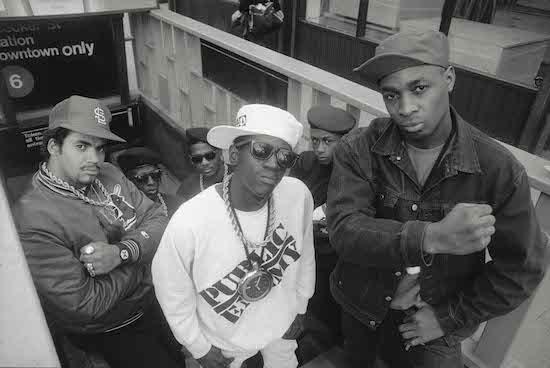
Credit: GLEN E. FRIEDMAN © Photo Public Enemy New York City Early 1987

At the end of the 1980s, it was finally evident that something needed to be done about digital sampling. Hip-hop producers were making money off of the talent and toil of other artists. This would not stand! The Turtles sued De La Soul for $1.7 million, Gilbert O’Sullivan went after Biz Markie, the Beastie Boys spent a quarter of a million dollars clearing samples for their cluttered kaleidoscope, 1989’s Paul’s Boutique. In another case of technology and culture outpacing The Law, the sampling crackdown coincided with the hacker crackdown.

One of the most recognisable cultural contributions of rap music is sampling. In its simplest form, a sample is a piece of previously recorded sound, mechanically lifted from its original context, and arranged into a new composition. In hip-hop, samples were originally manipulated using turntables and vinyl records, but the practice has since largely moved on to more efficient digital samplers. Commerce and copyright laws notwithstanding, anything that has been recorded can be used as a sample (e.g., beats, guitar riffs, bass lines, vocals, horn blasts, etc.). “Using everything from drum pads and samplers to magpie the last few centuries of speeches, music, and commercials and turn them upside-in for the betterment of the practitioner and listener,” emcee and producer Juice Aleem tells me. “Hip-hop is hacking.” Sampling technology allows producers to make new compositions out of old ones, using old outputs as new inputs, like a hacker cobbling together code for a new program or purpose.

The first example of this sort of sound hacking on the Billboard charts was a 1956 song called “The Flying Saucer” by Bill Buchanan and Dickie Goodman. The two collaged clips of songs of the time together on a reel-to-reel magnetic tape recorder creating a ridiculous alien-invasion scenario. Four record labels sued the two composers and lost. The judge deemed their looting a new and original work.

Mining the past for samples and sounds, hip-hop hacks recorded sound for self-expression, and, like cyberpunk, hip-hop has spread around the world. Both are a part of a globalized network culture that decentralizes the human subject’s stability in space and time and in which the technologically mediated subject reforms and remixes ideas of body normativity. With everything from clothes and glasses to tattoos and piercings, technology changes what is considered normal to have on or in your body.

Cybernetics, the science of command-control systems and from hence the “cyber” in “cyberpunk,” defines humans as “information-processing systems whose boundaries are determined by the flow of information.” Technologically reproduced memories disrupt more than just body normativity: media theorist Marshall McLuhan once declared that an individual is a “montage of loosely assembled parts,” and furthermore that when you are on the phone, you don’t have a body. Technology dismembers the body. Our media might be “extensions of ourselves” in McLuhan’s terms, but they’re also prosthetics, amputating parts as they extend them.

Grandmaster Flash once described another DJ as using “his hands like a heart surgeon.” In his book on Public Enemy’s undisputed and sample-heavy classic, 1988’s It Takes a Nation of Millions to Hold Us Back, Christopher R. Weingarten draws a lengthy and effective analogy between records and the body, casting samples as organ transplants. Tales of transplanted organs causing their recipients to adopt the tastes and behaviours of their dead donors read like the “meatspace” anxieties of cyberpunk:

“A 68-year-old woman suddenly craves the favorite foods of her 18-year-old heart donor, a 56-year-old professor gets strange flashes of light in his dreams and learns that his donor was a cop who was shot in the face by a drug dealer. Does a sample on a record work the same way? Can the essence of a hip-hop record be found in the motives, emotions and energies of the artists it samples? Is it likely that something an artist intended 20 years ago will re-emerge anew?”

Conceived as a combination of the hip-hop of Run-DMC and the punk rock of the Clash, Public Enemy emerged from Strong Island, New York in the late 1980s. Made up of emcees Chuck D and Flavor Flav, DJ Terminator X, and Professor Griff and the S1Ws (the Security of the First World), their paramilitary dance squad, P.E. upended not only what hip-hop could be but the power of sound itself. Their production team, the Bomb Squad (Eric “Vietnam” Sadler, brothers Hank and Keith Shocklee, as well as Chuck D) used upwards of forty-eight separate recording tracks to build their apocalyptic collages. Where their 1987 debut, Yo! Bumrush the Show relied on live instrumentation in addition to sampling, Nation of Millions is one of the most sample-ridden recordings ever made, its layers coalescing and collapsing, its chaos barely contained. Scott Herren says of the record, “it sounded like science fiction.” It remains one of the boldest sonic statements not only in hip-hop but in all of modern music. The Bomb Squad experimented in the studio like Dr. Frankenstein in his laboratory. They built a body out of noise, and it came alive, thrashing everything in its past and in its path, including copyright law.Though Russell Simmons called them “Black punk rock,” Public Enemy stated: “We’re media hijackers.” About the song “Caught, Can I Get a Witness” from Nation of Millions, Chuck D says, “We got sued religiously after the fact, but not at that time. The song itself was just challenging the purpose of it”:

Found this mineral that I call a beat Paid zero I packed my load ‘cause it’s better than gold People don’t ask the price, but it’s sold

Chuck’s use of the word “witness” is curious in our current context. “Cultural memory is most forcefully transmitted through the individual voice and body,” Hirsch and Smith write, “through the testimony of a witness.” In occult practices, a witness is an object that can link people across times, just as musical samples do. To establish such a connection is called a witness effect. Preston Nichols explains, “As a noun, it refers to an object that is connected or related to someone or something […] As a verb, ‘witness’ means to use an object to enter a person’s consciousness or otherwise have an effect on them.” A lock of hair, a piece of clothing, a proper beat, bassline, or vocal sample — any of these could have that bridging effect, tying two separate times together. The song ends: “They say that I stole this. I rebel with a raised fist; can we get a witness?” When their future is outlawed, the outlaws become the future.

Elon Musk’s “Giant Cybernetic Collectives” – Jennifer Sensiba | CleanTechnica


Source: Elon Musk’s “Giant Cybernetic Collectives” | CleanTechnica


Elon Musk’s “Giant Cybernetic Collectives”

March 17th, 2019 by 


Elon Musk often mentions cyborgs at events and during interviews. This concept is not just a funny remark, a sci-fi reference, or a way to throw around big terms to sound smarter. It’s an important paradigm, a lens we can look at the past with, and more importantly, a concept that will have a great impact on the future of our species.

Before unveiling the Tesla Model Y on Thursday night, Elon Musk walked us through the history of Tesla. In the beginning, there was only the original Roadster, and a relatively small team developed the Model S in a small corner of a SpaceX rocket building facility. To mass produce cars, he arranged to buy a shuttered General Motors factory in Fremont, California. He said some people though that buying a car factory meant he could just start building cars, but it was really just an empty shell of a building, like an abandoned warehouse.

To build cars, Tesla had to finish building the inside of the factory. It needed machines, tooling, computers, robots, and people to all work together to go from parts to functioning cars.

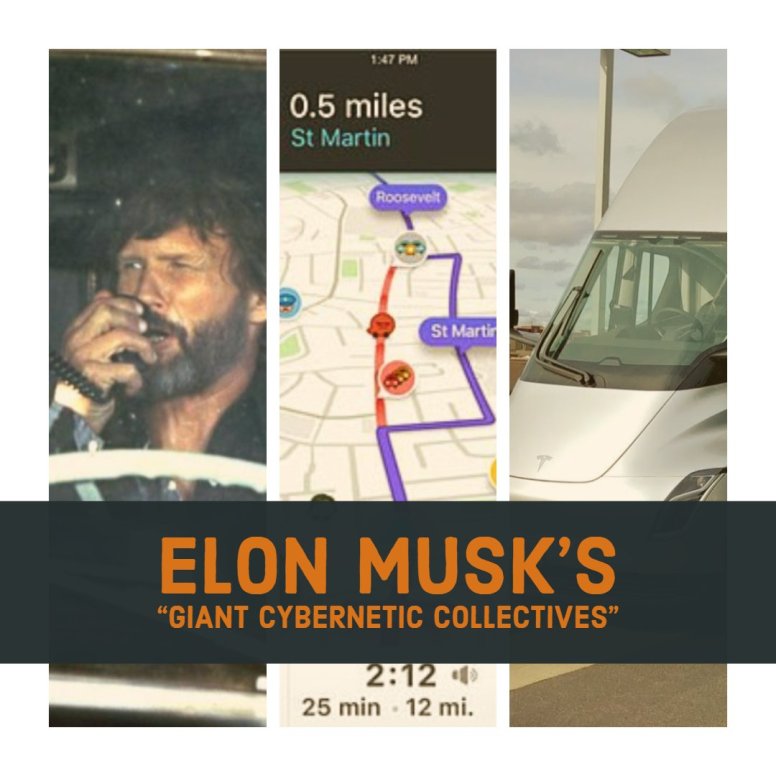
He described the end result as a “giant cybernetic collective” where 20,000 people, countless machines, numerous computers, and communications systems all work together over 4–5 shifts to build cars.

This wasn’t a cute or witty comment he threw around. If you look at various interviews on YouTube, Elon explains the idea in much more depth. It’s an important lens through which he views the past and present, and has very important implications for the future of humanity. But, to understand this concept and its importance, we have to go through a good bit of background information.

Our Brains Are NOT Computers
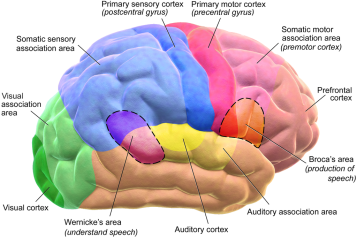
Image result for brainWhen looking at the “man vs. machine” question, we have to be careful to not get the two mixed up. Computers are designed to do certain tasks as efficiently and quickly as possible by crunching the numbers. The human brain, on the other hand, has a much more interesting history and structure.

In the mid 20th century, researchers started comparing the structures of the human brain with those of animals. What they found is that we have a lot in common with some animals, and only some things in common with others. Why? Because brains evolve to take care of the survival needs of the being in question, mostly because animals with brains ill-suited to survival don’t survive, and don’t pass those features on to offspring. Different animals will have different brains, but features inherited from a common ancestor that work well in both animals will stay much the same.

In nature, brains can vary widely. Sea stars, for example, don’t technically have a brain like we do (and that’s why Patrick is portrayed as unintelligent in Sponge Bob Square Pants). They do, however, have brain-like cells distributed throughout their bodies and it works well for what they do to live. Among invertebrates, mollusks have the most advanced brains, and evolved to have brains at least four separate times. While humans and mollusks do have a common ancestor, that common ancestor probably didn’t have a brain. A brain developed separately only after the lineages of the vertebrates and invertebrates split. Because our ancestors’ survival needs differed greatly from theirs, our brains look and work very differently. Even the individual neurons/brain cells in our brains differ from those of the invertebrates.

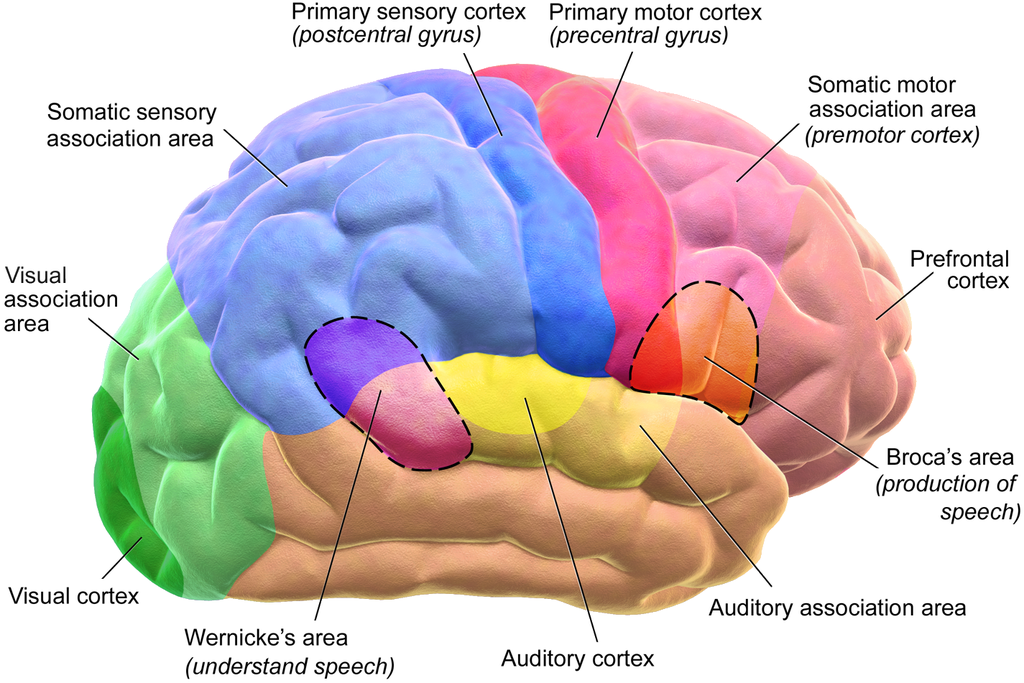
Compared to other animals with backbones, though, we have a lot more in common. Neuroscientist Paul D. MacLean identified three basic divisions in our brain:

  • The “reptilian” brain
  • The “lower mammal” brain
  • The “higher mammal” brain

Our very basic life functions, our basic emotions, and our movement are all controlled in our “reptilian” brain, and those structures look and act much like the brain of a reptile. On top of that, we have the “mammal” brain, also known as the limbic system, that governs mammalian needs, like feeding, nurturing and social behavior with other mammals. That commonality is probably why humans are so good at relating to our most popular pets: cats and dogs.

Built atop all of that, we have a “higher mammal” brain, also known as the neocortex. Among primates, ours is the largest and most advanced. This part of our brains helps us do things like language, abstract thinking, perception, and planning. While we would like to think this part of our brain rules it all, we use our smarts mostly to satisfy the needs and impulses of the lower parts of the brain (eating, reproduction, etc.).

This complicated mess doesn’t always work like it should, and it definitely doesn’t work like a computer. We have conflicting needs, instincts, and myriad disorders that can develop. Much of our brain’s evolution happened in a hunter-gatherer environment, while we live in a very different world today with very different survival needs.

Networking With Other People’s Brains
Image result for brainHugh Howey points out in Wired that our brains are very good at figuring out what other brains are thinking. In a hunter-gatherer situation, it’s important for Ug to know whether the other caveman is going to kill him or trade with him. We are very good, but not perfect, at reading other people’s facial expressions, guessing what might be bothering them, or otherwise trying to predict the future of others.

However, we don’t dare point that flashlight into the dark of our own minds. We tend to tell ourselves stories about ourselves and our motivations that differ from reality. Why? Because that truth is often too depressing and we need to keep moving to survive.

He also points out that the common parts of the brain might work very differently from person to person. For example, the part of our brain that looks to reproduce might not ever achieve that goal because it drives us toward partners of the same sex in some of us. Meanwhile, other humans don’t understand it because their brain doesn’t work like that.

While not perfect at it, the human brain is built to connect to other brains. Our survival is almost always dependent on our interaction with other humans and even some animals, so much of the neocortex and parts of the “lower” brain spend most of their time trying to send and receive data from other brains through language, facial expressions, writing, and speech. Many in our society who are considered disabled have perfectly functioning arms and legs, and are quite mobile and strong, but fail to provide for themselves because they can’t communicate or relate to other humans like the rest of us can.

The human brain is so dependent on the brains of others, that we even store information in other people’s heads. We do this without thinking about it, often with those we are closest to. Members of a group in a family, a job, or in other tight-knit social settings tend to start taking on specialized tasks. We all have our talents and areas that we are better at than the others, so the others expect us to remember the relevant information so they don’t have to. The important thing is remembering who knows what, so we know who to ask for information when it’s needed. This is known as group transactional memory.

The larger point here is that human brains evolved to work with other brains to get things done. It’s in our nature to network and reach out. Thousands of years ago, writing systems developed and we took our first steps toward storing information using non-living things and extending our mental networking reach past the reach of our voice and the limits of time.

That Time Humans Slowly Became Cyborgs
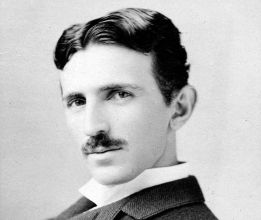
Image result for nikola tesla“When wireless is perfectly applied the whole earth will be converted into a huge brain, which in fact it is, all things being particles of a real and rhythmic whole. We shall be able to communicate with one another instantly, irrespective of distance. Not only this, but through television and telephony we shall see and hear one another as perfectly as though we were face to face, despite intervening distances of thousands of miles; and the instruments through which we shall be able to do his will be amazingly simple compared with our present telephone. A man will be able to carry one in his vest pocket.” —Nikola Tesla, 1926

While connecting to the brains of others is older than history, important changes started in the late 19th and early 20th centuries. We started to extend our reach to the brains of others in ways prehistoric humans could probably not imagine. Telegraphs, telephones, and radio made these long-distance communications instant where letters and books took time to send and read.

This is the point where we began to be cyborgs, but it was just the beginning. Telephones, radios and telegraphs only relay information. They don’t add anything to the conversation or help organize the communication between humans. As computers got better and better during the 20th century, we became more and more cybernetic. The role of the machines went from strictly passing information to contributing, organizing, helping, and more recently, directing us.

This is the point where we can get back to Elon Musk’s concept of “cybernetic collectives” and make more sense of it. He’s discussed it in a number of interviews, but the segment of the interview with Joe Rogan might be the most clear and easy to follow.

In short, nearly any present-day group of people is a cybernetic collective. At work, computers assist us with many tasks, and help us communicate with our coworkers. The tools we use do more and more with less and less of our input. We go to and from places where we work with complex machines. We use smartphones to perform an increasing number of tasks at work, for play, and in our families. Social networks connect us to people we know in real life and to people we’ve never met, help us find people to connect to, and decide what we see when we open the apps/websites.

Some collectives are better than others at collecting humans. While the human brain is great at many analytical tasks, we tend to use almost all of that brain power to keep the “lower mammal” limbic system happy. Most users of social networks, “gig economy” apps, and other similar things aren’t aware that there are literally teams of psychologists behind the most successful networks trying to get people to engage with it in ways that best suit those who run the network.

The thing is, though, that this isn’t a dastardly scheme for mind control. Social networks are just following the same path our brain did during its development. These new extensions of our brains are evolving to best suit their survival needs. Those that “resonate” with our limbic system survive better than others that do not. The successful ones develop to service our basic mammalian needs and work well with our “higher mammal” neocortex. They are quickly becoming a fourth layer of our brain, for better or worse.

The only reason we are suddenly noticing the rapid changes now is that we are approaching a tipping point where the contributions of the machines in our cybernetic collectives are rapidly growing, while our contributions aren’t changing much. We are even seeing the machines in our cybernetic collectives contribute more than we do in some cases, and even start to replace some of the humans involved.

What Happens Next?

The obvious question now is what will happen to us now that the machines are starting to outperform us within our cybernetic collectives. While we can’t predict the future, we can make educated guesses. Hopefully with the background provided in this article, our guesses will be a little more educated.

Elon Musk made several educated guesses, and did it in the fashion of the typical futurist. In the worst case, we are completely replaced by the machines and possibly are even destroyed by them. One better but still not great outcome would be the rule by benign superintelligent machines, or, in other words, we become “pets” to the AI, who treat us well. One better outcome might be that we “merge” with the superintelligent AI machines and grow with them into the future.

The fact that we are already in cybernetic collectives makes this look more likely, but we have a big problem with bandwidth. We simply can’t communicate with them anywhere nearly as quickly as they can communicate with each other. I am typing this paper at approximately 80 words per minute. When you use a phone or tablet, you are far slower at data input than that (as am I). We can read and perceive pictures and video to bring data into our brains pretty fast, but there are still limits on both the upload and the download speeds.

Elon Musk proposes we solve this problem and improve the chances of human survival by implanting devices in our brains to provide high-speed data transfer between us and the machines. For that reason, he founded a company: Neuralink.

But does this theory pan out in the real world? Let’s look at one example and try it out.

One Example: Trucking
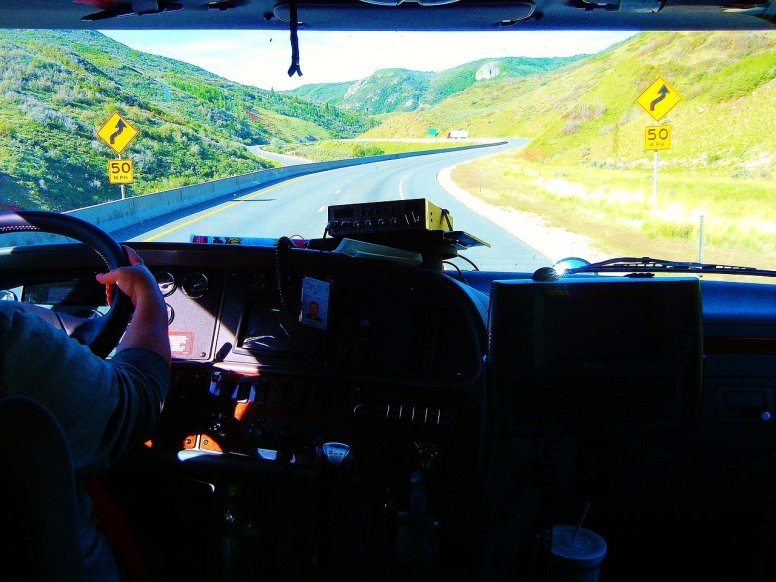
Image by leestilltaolcom on Pixabay

Both within the trucking industry and outside of it, few professions have the mythical quality that truck driving does. Movies like Convoy and Smokey and the Bandit portray the job as one of rugged individualism, with plenty of hard work and freedom for every mile. For those of us who haven’t been around truck stops much, it’s probably hard to not think of the industry as one that hasn’t changed much in decades.

When it comes to “robot trucking”, many probably envision a trucker from the 1970s, dressed in cowboy clothes, being ordered out of the cab by an emotionless Terminatorcyborg from the future. In short, it’s tempting (and perhaps cinematic) to skip from the mid 20th century to the mid 21st century, while ignoring what came before and during the change.

If we treat this issue like something so simple, we risk completely mishandling it and leaving displaced truckers worse off than if we had done nothing at all. But, if you’ve read this far, you know that it doesn’t work like that. The transition is already underway, and the obvious changes are afoot only now.

Image by FrankMagdelyns1 on Pixabay

If we look at things like Elon Musk does, truckers really started becoming cyborgs with CB radio. Not only were they able to talk short range to other truckers, but they also got information about road conditions far ahead, had conversations to pass the time, and warned each other about “bears” ahead on the road — the cops trying to write them tickets. This basically turned trucking into a big, and somewhat short range, cybernetic collective.

It should be no surprise that truckers would often add linear amplifiers or use Amateur Radio gear to go far, far beyond the 4 watt limit imposed by the FCC. Sometimes truckers would transmit using over a kilowatt of power. When conditions were right, 27-28 MHz signals would “skip” over the horizon by bouncing off of the earth’s ionosphere, allowing the truckers to talk to others hundreds or even thousands of miles away.

Even seemingly primitive cybernetic collectives give the individual such an advantage that they’re willing to risk multi-thousand dollar fines from the FCC to enlarge the number of other connected individuals. If you think about it, this gave them superhuman abilities compared to people just 50 years earlier. In Brazil, truckers in areas with no cell phone coverage use modified radios to use older, unencrypted U.S. Navy satellites to get coverage across South America. Despite repeated raids and mass arrests, Brazilians continue to use the satellites illegally.
Two-way voice radio wasn’t the end of it. As technology improved and dropped in price, truckers and trucking companies expanded the abilities of truck drivers. Satellite tracking, GPS, cellular phones, and other communications technologies were often adopted early by truckers. Larger companies even use GPS technology to get automated warnings when trucks go into higher crime areas and places with a history of load theft.

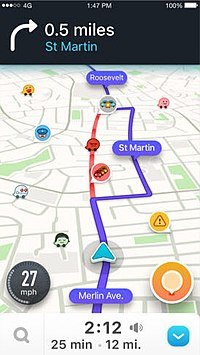
As computing power advanced and became smaller, Truckers got smartphones like everybody else. And, like any big group of people, applications came along that cateredto their differing needs. While not specifically made for truckers, the Waze app is popular in the business. Like CB radio, the app lets drivers leave warnings and information behind on the map, report and correct map errors, and do other limited things while driving. The app itself uses GPS reports from both itself and Google Maps to detect traffic jams, and report those to drivers, and even tries to route drivers around them.

In other words, we are starting to see the contribution of the machines increase, and not just pass information between humans.

But where is this going?

What happens next in the trucking industry is a big issue. There are 3.5 million truck drivers, and it’s the most common job in 29 states. And that’s just those doing the driving. There are over 7 million others working in support positions, at truck stops, and at trucking facilities. Handling this problem wrong can have major bad consequences for the entire economy.

This is a big enough issue that 2020 presidential candidate Andrew Yang has made it an important component in his campaign and a common example in his stumping so far. He points out that automation is already killing jobs by the millions in swing states, and that ignoring the impact of job losses to automation could have been an important factor in Donald Trump’s 2016 election victory.

Yang, and many others, predict that the role of machines in the truck-driving cybernetic collective will increase until the machines are doing the driving and millions are left out of a job. Yang proposes a $1,000 monthly “universal basic income” for all U.S. citizens over the age of 18 to help cushion the landing for people falling out of employment as more jobs in more industries are lost.

If Musk is right about the evolution of cybernetic collectives coming before job replacement and after it, then we should be seeing some moves toward partial replacement. And, we are seeing that. Autonomous trucks are getting good enough to safely drive in rural areas with low traffic in good conditions, and on the highways within cities in many cases, but that doesn’t mean that the driver can be safely removed from the cab, because the difficult situations will still require a human driver.

To get over this challenge, some of the companies developing autonomous trucks are installing a suite of cameras and sensors to allow remote piloting of the vehicles. Truck drivers will be on standby ready to take over when an autonomous truck has a “disengagement” and can no longer safely operate the truck by itself. Using a big array of screens and video game-like controls, the trucker can operate the vehicle remotely through 5G data connections until the vehicle can safely take over again.

The virtual cab isn’t the end of human involvement, but what place have beyond that will be is harder to predict. Some think that computers will not be able to ever achieve 100% self driving of vehicles, for a variety of reasons. Many others, especially those working on the technology, think it’s not only possible, but will happen sooner than we think.

If autonomous vehicles do get to the point where they don’t need human assistance, even remotely, then the number of human backup drivers would reduce slowly until there are few, if any, left. At that point, would something like Neuralink work to help us be smart enough to compete in the new superintelligent job market? Or will humans all need to be put on disability in the form of universal basic income to survive? Or will someone come up with a better solution?

Up to now, Elon Musk’s paradigm of “cybernetic collectives” does seem to check out, but the future is much harder to predict. What do you think we will need to do to survive and thrive in a vastly changed economy? Let’s keep this discussion going in the comments and on social media!

Tags: , , , 

About the Author

 Jennifer Sensiba is a long time efficient vehicle enthusiast, writer, and photographer. She grew up around a transmission shop, and has been experimenting with vehicle efficiency since she was 16 and drove a Pontiac Fiero. She likes to explore the Southwest US with her partner, kids, and animals.

Will Robots Change Human Relationships?

cxdig's avatarComplexity Digest

But adding artificial intelligence to our midst could be much more disruptive. Especially as machines are made to look and act like us and to insinuate themselves deeply into our lives, they may change how loving or friendly or kind we are—not just in our direct interactions with the machines in question, but in our interactions with one another.

[…]

The bots thus converted a group of generous people into selfish jerks.

Source: www.theatlantic.com

View original post

Complex Thinking, Complex Practice: The Case for a Narrative Approach to Organizational Complexity – Tsoukas and Hatch, 2001

Source: Complex Thinking, Complex Practice: The Case for a Narrative Approach to Organizational Complexity

Complex Thinking, Complex Practice: The Case for a Narrative Approach to Organizational Complexity

  • August 2001
  • Human Relations 54(8)
  • DOI: 10.1177/0018726701548001
Abstract
Complexity is not only a feature of the systems we study, it is also a matter of the way in which we organize our thinking about those systems. This second-order complexity invites consideration of the modes of thinking we use to theorize about complexity, and in this article we develop the idea of second-order complexity using Jerome Bruner’s contrast between logico-scientific and narrative modes of thinking. Using Bruner’s framework, we examine and critique domi-nant forms of thinking about organizational complexity that are rooted in the logico-scientific mode, and suggest alternatives based in the narrative mode. Our evidence for the value of doing this comes from the logic of complexity theory itself, which we claim indi-cates and supports the use of the narrative mode. The potential con-tribution of the narrative approach to developing second-order thinking about organizational complexity is demonstrated by taking a narrative approach to the matter of recursiveness. By extension, similar insights are indicated for other features that logico-scientific thinkers commonly attribute to complex systems, including, non-linearity, indeterminacy, unpredictability and emergence.

perceiving a complex whole

Animate Arts's avatarNavigating Complexity

Image by Jip Bosch, CC BY-SA 3.0 nl
https://commons.wikimedia.org/w/index.php?curid=33675607

comprehensive ways of knowing

How can we understand a complex whole when it is more than the sum of it’s parts? I would say this calls for a comprehensive way of seeing, but you could also call it holistic. Most people think this involves understanding all aspects of something (in the example of healthcare, people think of not only physical, but also emotional and spiritual aspects of a person’s health). Many people also think of an understanding that includes the context that the thing is in (the person’s environment in the case of healthcare). However, not many people think in the Goethean sense of holism where you are looking to also become aware of the potential that an entity has in how it can respond in different contexts by getting a sense of it’s core essence. The Goethean method may seem…

View original post 601 more words

Self-Organisation and Kyocera’s Amoeba Management System

Simon's avatarTransition Consciousness

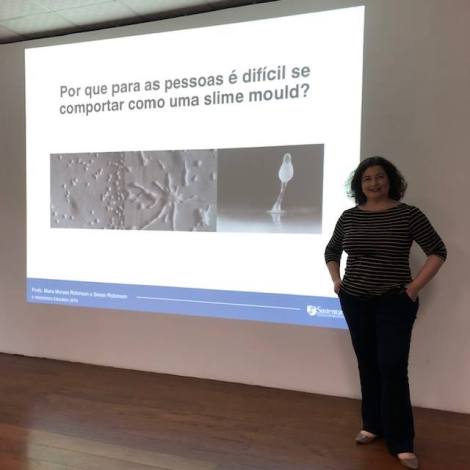
A couple of weeks ago Maria and I ran a two-day international seminar on Customer Experiences with Soul at Sustentare Business School in Joinville in the south of Brazil. We love teaching there and we always love discussing Holonomics with the students.

Source: Pixabay

When we discuss cultural transformation, new ways of working, and the evolution of business from command-and-control to more agile ways of working, we always discuss the way in which we can be inspired by the systems we find in nature, one in particular being slime mould.

The picture of Maria above is one of the slides from our seminars, and it asks the question “Why is it that people have so much difficulty behaving like slime mould?”

Slime mould is a fascinating organism to study, since it has two distinctive phases in its lifecycle. When food is plentiful, in the form of bacteria, this species exists…

View original post 836 more words

Expanded understandings of place making through genre painting : a heuristic study in the Mid North of South Australia – Susan Mary Michael – University of South Australia

Source: Expanded understandings of place making through genre painting : a heuristic study in the Mid North of South Australia – University of South Australia

THESIS

Expanded understandings of place making through genre painting : a heuristic study in the Mid North of South Australia

Susan Mary Michael ; University of South Australia. School of Art, Architecture and Design. ; 2018
OPEN ACCESS – full text available at link

Details

Title
Expanded understandings of place making through genre painting : a heuristic study in the Mid North of South Australia
Abstract
The poorly understood but often used term ‘place’ refers to a location where meaning has been ascribed, and in visual art has commonly been associated with landscape painters’ subjective impressions of a location. To broaden painting’s capability to explicate aspects of place, this research has aligned with humanistic geography, whose main focus is place and space (where meaning has not been attributed). The formation of the artist-as-geographer has thus been facilitated in this research by using genre paintings of often elusive and under-examined aspects of domestic life. The Mid North of South Australia was selected for documenting the long-observed place making attributes, the researcher’s family having lived in the region since colonial times. In order to avoid a reliance on childhood memories alone, wider understandings of place were sought from the array of entry points, perceived characteristics and complexities of place. Painted canvases of architecture, gardens and home decor were used as the eminent theme, thus looking obliquely at people’s adaptions to, and the meanings within, their rural location
Terms of Use
Copyright 2018 Susan Mary Michael..
Course/Series
Series: School of Art, Architecture and Design.
Publisher
Thesis (PhD(Visual Arts))–University of South Australia, 2018.
Creation Date
2018
Format
1 ethesis (ix, 157 pages) : colour illustrations, colour maps, photographs (mostly colour).
Identifier
Handle : https://hdl.handle.net/11541.2/133151
Bibliographic Id
9916222306601831

Modeling cocaine traffickers and counterdrug interdiction forces as a complex adaptive system

cxdig's avatarComplexity Digest

The US government’s cocaine interdiction mission in the transit zone of Central America is now in its fifth decade despite its long-demonstrated ineffectiveness, both in cost and results. We developed a model that builds an interdisciplinary understanding of the structure and function of narco-trafficking networks and their coevolution with interdiction efforts as a complex adaptive system. The model produced realistic predictions of where and when narco-traffickers move in and around Central America in response to interdiction. The model demonstrated that narco-trafficking is as widespread and difficult to eradicate as it is because of interdiction, and increased interdiction will continue to spread traffickers into new areas, allowing them to continue to move drugs north.


Modeling cocaine traffickers and counterdrug interdiction forces as a complex adaptive system

Nicholas R. Magliocca, Kendra McSweeney, Steven E. Sesnie, Elizabeth Tellman, Jennifer A. Devine, Erik A. Nielsen, Zoe Pearson, and David J. Wrathall
PNAS published…

View original post 10 more words

Organisational Maturity Model | SCiO

A VSM-based diagnostic model


Source: Organisational Maturity Model | SCiO

Organisational Maturity Model

The SCiO Organisational Maturity Model

The Organisational Maturity Model (OMM) has been developed by SCiO. It is driven by a questionnaire and is designed to show the structural integrity of your organisation (currently from a single user perspective). The OMM allows managers to improve the capability of their organisation to operate more effectively and adapt to change. It does this by providing a framework to develop the structural integrity of the organisation. For an individual having an explanation of the systemic causes of the problems faced can suggest alternative ways forward. The OMM provides reassurance about aspects of the organisation that are working well and insights into those aspects of your working life that are caused by the system rather than individuals.

Who should use this?

  • If you want to assess the strengths and weaknesses in your organisation’s structure
  • If you sense your organisation is not running as effectively as it might
  • If you are concerned about the long term viability of your organisation
  • If you sense that actions being taken are ‘treating’ symptoms rather than the underlying causes

. . . . . then you will find The Organisational Maturity Model useful. The Organisational Maturity Model is based on the Viable Systems Model. This first release is limited to a single user version with 24 questions available as a web based or paper versions for you to choose from (see below). An enterprise version for multiple users with an extended and more detailed questionnaire is planned, but the current OMM has proved remarkably powerful in initial testing, despite the 24 question limitation.

Click here to launch the Interactive Questionnaire (OMM Homepage)

Team Cognition as Interaction – Nancy J. Cooke, 2015

Via Arthur Battram

Source: Team Cognition as Interaction – Nancy J. Cooke, 2015

pdf: https://drive.google.com/file/d/1X05ahHdLhqtZbc0-_bOGV2mVscXc4PLZ/view


Teams perform cognitive activities such as making decisions and assessing situations as a unit. The team cognition behind these activities has traditionally been linked to individual knowledge and its distribution across team members. The theory of interactive team cognition instead argues that team cognition resides in team interactions and that it is an activity that takes place in a rich context that needs to be measured at the team level. This article describes this dynamic perspective on team cognition, some research that supports it, and the implications for measuring, understanding, and improving team cognition.

System Safety: Seven Friends of Intervention – Steven Shorrock

Really good safety thinking has always encompassed sensemaking and systems thinking – and Steven Shorrock is a good example of this.

https://humanisticsystems.com/2019/04/04/system-safety-seven-friends-of-intervention/

Steven Shorrock's avatarHumanistic Systems

In this short series, I highlight seven foes and seven friends of system safety, both for explanation and intervention. Each is a concept, meme, or device used in thinking, language, and intervention (reinforced by more fundamental foes that act as barriers to thinking).  They are not the only foes or friends, of course, but they are significant ones that either crop up regularly in discussions and writings about safety, or else – in the case of friends – should do.

In this post, I outline seven friends of intervention. To keep it short (because I usually intend that, but rarely succeed), I limit each explanation to an arbitrary limit of 100 words.

In this series:

  1. Seven foes of explanation in system safety
  2. Seven foes of intervention in system safety
  3. Seven friends of explanation in system safety
  4. Seven friends of intervention in system safety (this post)

18267051428_d56207dd78_k whereisemil CC BY-NC-ND 2.0 https://flic.kr/p/tQcpYy
1. Acceptance of uncertainty

Whether one…

View original post 780 more words

Toolkit: Systems Thinking for Safety: Ten Principles – SKYbrary Aviation Safety

Source: Toolkit:Systems Thinking for Safety: Ten Principles – SKYbrary Aviation Safety


If you wish to contribute or participate in the discussions about articles you are invited to join SKYbrary as a registered user

 Actions

Toolkit

Systems Thinking for Safety: Ten Principles

Toolkit Navigation

Executive Summary

System Focus

“To understand and improve the way that organisations work, we must think in systems.” Image: NATS Press Office CC BY-NC-ND 2.0

To understand and improve the way that organisations work, we must think in systems. This means considering the interactions between the parts of the system (human, social, technical, information, political, economic and organisational) in light of system goals. There are concepts, theories and methods to help do this, but they are often not used in practice. We therefore continue to rely on outdated ways of thinking in our attempts to understand and influence how sociotechnical systems work. This White Paper distills some useful concepts as principles to encourage a ‘systems thinking’ approach to help make sense of – and improve – system performance. It is hoped that these will give new ways of thinking about systems, work and safety, and help to translate theory into practice.

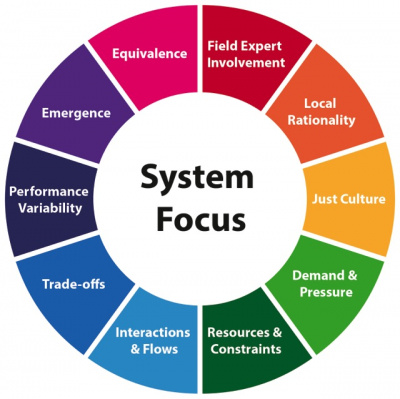
Principles 1, 2 and 3 relate to the view of people within systems – our view from the outside and their view from the inside. To understand and design systems, we need to understand work-as-done. This requires the involvement of those who do the work in question – the field experts. (Principle 1. Involvement of Field Experts). It follows that our understanding of work-as-done – past, present and future – must assimilate the multiple perspectives of those who do the work. This includes their goals, knowledge, understanding of the situation and focus of attention situated at the time of performance (Principle 2. Local Rationality). We must also assume that people set out to do their best – they act with good intent. Organisations and individuals must therefore adopt a mindset of openness, trust and fairness (Principle 3. Just Culture).

Principles 4 and 5 relate to the system conditions and context that affect work. Understanding demand is critical to understanding system performance. Changes in demands and pressure relating to efficiency and capacity, from inside or outside the organisation, have a fundamental effect on performance. (Principle 4. Demand and Pressure). This has implications for the utilisation of resources (e.g. staffing, competency, equipment) and constraints (e.g. rules and regulations) (Principle 5. Resources and Constraints), which can increase or restrict the ability to meet demand.

Principles 6, 7 and 8 concern the nature of system behaviour. When we look back at work, we tend to see discrete activities or events, and we consider these independently. But work-as-done progresses in a flow of interrelated and interacting activities (Principle 6. Interactions and Flows). Interactions (e.g. between people, equipment, procedures) and the flow of work through the system are key to the design and management of systems. The context of work requires that people make trade-offs to resolve goal conflicts and cope with complexity and uncertainty (Principle 7. Trade-offs). Finally, continual adjustments are necessary to cope with variability in system conditions. Performance of the same task or activity will and must vary. Understanding the nature and sources of variability is vital to understanding system performance (Principle 8. Performance Variability).

Principles 9 and 10 also relate to system behaviour, in the context of system outcomes. In complex systems, outcomes are often emergent and not simply a result of the performance of individual system components (Principle 9. Emergence). Hence, system behaviour is hard to understand and often not as expected. Finally, success and failure are equivalent in the sense that they come from the same source – everyday work, and performance variability in particular (Principle 10. Equivalence). We must therefore focus our attention on work-as-done and the system-as-found.

Each principle is explained briefly in this White Paper, along with ‘views from the field’ from frontline operational staff, senior managers and safety practitioners. While we are particularly interested in safety (ensuring that things go right), the principles apply to all system goals, relating to both performance and wellbeing. It is expected that the principles will be relevant to anyone who contributes to, or benefits from, the performance of a system: front-line staff and service users; managers and supervisors; CEOs and company directors; specialist and support staff. All have a need to understand and improve organisations and related systems

Systems Thinking for Safety: Ten Principles.

Source: Systems Thinking for Safety: Ten Principles. A White Paper. Moving towards Safety-II, EUROCONTROL, 2014.

The following Systems Thinking Learning Cards: Moving towards Safety-II can be used in workshops, to discuss the principles and interactions between them for specific systems, situations or cases.

From networks to optimal higher-order models of complex systems

I’m trying to get access to this article… seems on the face of it to be a rediscovery of emergence?

cxdig's avatarComplexity Digest

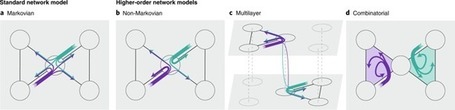
Rich data are revealing that complex dependencies between the nodes of a network may not be captured by models based on pairwise interactions. Higher-order network models go beyond these limitations, offering new perspectives for understanding complex systems.


From networks to optimal higher-order models of complex systems
Renaud Lambiotte, Martin Rosvall & Ingo Scholtes
Nature Physics volume 15, pages 313–320 (2019)

Source: www.nature.com

aka hypergraphs

View original post

Best of Ourselves Podcast – Barry Oshry on Encounters with Others

I had no idea Marcia Hyatt, a stalwart of the power+systems community (and otherwise all-round expert and experience OD type) had a podcast which has nearly reach 200 episodes! This one with Barry Oshry, the originator of power+systems, will be good.

Source: BOO192 – Encounters with Others | Best of Ourselves Podcast


BOO192 – Encounters with Others
Play

In Barry Oshry’s latest book, Encounters with the “Others”, he succinctly shows how we get into trouble and can do great harm. Seeing patterns helps us see our choices. Then the challenge is learning how to navigate the tensions.

Resources

Encounter with the “Others”

Barry Oshry’s Blog

Interview with Barry Oshry on Systems Thinking

Interview with Adam Kahane about Power and Love