Design for a self-regenerating organisation – Geoghegan and Pangaro (Semantic Scholar)

Design for a self-regenerating organisation

Ashby’s 1952 work Design for a Brain comprises a formal description of the necessary and sufficient conditions for a system to act ‘like a brain,’ that is, to learn in order to remain viable in a changing environment, and to ‘get what it wants’. Remarkably, Ashby gives a complete, formal specification of such a system without any dependency on how the system is implemented. Here the authors argue how Ashby’s formalisms can be applied to human organizations. In business terms, this provides the ability to initiate specific investments and to track convergence on desired business outcomes. No other methodology for organizational change known to the authors has the formal logic or prescriptive power as this application of Ashby’s work. Through such interpretations—as rigorous as the application of Design for a Brain to mechanical systems—Ashby’s formalism enables the derivation of the necessary and sufficient conditions for a corporation to remain viable in a changing market. The authors claim that the only means for an organization to change from the inside and by design is through the creation and protection of processes that recognize the limits of present language and engender the continual introduction of new ones

Source: Design for a self-regenerating organisation – Semantic Scholar

Complexity Theory and Organization Science – Semantic Scholar

Complexity Theory and Organization Science

Complex organizations exhibit surprising, nonlinear behavior. Although organization scientists have studied complex organizations for many years, a developing set of conceptual and computational tools makes possible new approaches to modeling nonlinear interactions within and between organizations. Complex adaptive system models represent a genuinely new way of simplifying the complex. They are characterized by four key elements: agents with schemata, self-organizing networks sustained by importing energy, coevolution to the edge of chaos, and system evolution based on recombination. New types of models that incorporate these elements will push organization science forward by merging empirical observation with computational agent-based simulation. Applying complex adaptive systems models to strategic management leads to an emphasis on building systems that can rapidly evolve effective adaptive solutions. Strategic direction of complex organizations consists of establishing and modifying environments within which effective, improvised, self-organized solutions can evolve. Managers influence strategic behavior by altering the fitness landscape for local agents and reconfiguring the organizational architecture within which agents adapt. (Complexity Theory; Organizational Evolution; Strategic Management) Since the open-systems view of organizations began to diffuse in the 1960s, comnplexity has been a central construct in the vocabulary of organization scientists. Open systems are open because they exchange resources with the environment, and they are systems because they consist of interconnected components that work together. In his classic discussion of hierarchy in 1962, Simon defined a complex system as one made up of a large number of parts that have many interactions (Simon 1996). Thompson (1967, p. 6) described a complex organization as a set of interdependent parts, which together make up a whole that is interdependent with some larger environment. Organization theory has treated complexity as a structural variable that characterizes both organizations and their environments. With respect to organizations, Daft (1992, p. 15) equates complexity with the number of activities or subsystems within the organization, noting that it can be measured along three dimensions. Vertical complexity is the number of levels in an organizational hierarchy, horizontal complexity is the number of job titles or departments across the organization, and spatial complexity is the number of geographical locations. With respect to environments, complexity is equated with the number of different items or elements that must be dealt with simultaneously by the organization (Scott 1992, p. 230). Organization design tries to match the complexity of an organization’s structure with the complexity of its environment and technology (Galbraith 1982). The very first article ever published in Organization Science suggested that it is inappropriate for organization studies to settle prematurely into a normal science mindset, because organizations are enormously complex (Daft and Lewin 1990). What Daft and Lewin meant is that the behavior of complex systems is surprising and is hard to 1047-7039/99/1003/0216/$05.OO ORGANIZATION SCIENCE/Vol. 10, No. 3, May-June 1999 Copyright ? 1999, Institute for Operations Research pp. 216-232 and the Management Sciences PHILIP ANDERSON Complexity Theory and Organization Science predict, because it is nonlinear (Casti 1994). In nonlinear systems, intervening to change one or two parameters a small amount can drastically change the behavior of the whole system, and the whole can be very different from the sum of the parts. Complex systems change inputs to outputs in a nonlinear way because their components interact with one another via a web of feedback loops. Gell-Mann (1994a) defines complexity as the length of the schema needed to describe and predict the properties of an incoming data stream by identifying its regularities. Nonlinear systems can difficult to compress into a parsimonious description: this is what makes them complex (Casti 1994). According to Simon (1996, p. 1), the central task of a natural science is to show that complexity, correctly viewed, is only a mask for simplicity. Both social scientists and people in organizations reduce a complex description of a system to a simpler one by abstracting out what is unnecessary or minor. To build a model is to encode a natural system into a formal system, compressing a longer description into a shorter one that is easier to grasp. Modeling the nonlinear outcomes of many interacting components has been so difficult that both social and natural scientists have tended to select more analytically tractable problems (Casti 1994). Simple boxes-andarrows causal models are inadequate for modeling systems with complex interconnections and feedback loops, even when nonlinear relations between dependent and independent variables are introduced by means of exponents, logarithms, or interaction terms. How else might we compress complex behavior so we can comprehend it? For Perrow (1967), the more complex an organization is, the less knowable it is and the more deeply ambiguous is its operation. Modem complexity theory suggests that some systems with many interactions among highly differentiated parts can produce surprisingly simple, predictable behavior, while others generate behavior that is impossible to forecast, though they feature simple laws and few actors. As Cohen and Stewart (1994) point out, normal science shows how complex effects can be understood from simple laws; chaos theory demonstrates that simple laws can have complicated, unpredictable consequences; and complexity theory describes how complex causes can produce simple effects. Since the mid-1980s, new approaches to modeling complex systems have been emerging from an interdisciplinary invisible college, anchored on the Santa Fe Institute (see Waldrop 1992 for a historical perspective). The agenda of these scholars includes identifying deep principles underlying a wide variety of complex systems, be they physical, biological, or social (Fontana and Ballati 1999). Despite somewhat frequent declarations that a new paradigm has emerged, it is still premature to declare that a science of complexity, or even a unified theory of complex systems, exists (Horgan 1995). Holland and Miller (1991) have likened the present situation to that of evolutionary theory before Fisher developed a mathematical theory of genetic selection. This essay is not a review of the emerging body of research in complex systems, because that has been ably reviewed many times, in ways accessible to both scholars and managers. Table 1 describes a number of recent, prominent books and articles that inform this literature; Heylighen (1997) provides an excellent introductory bibliography, with a more comprehensive version available on the Internet at http://pespmcl.vub.ac.be/ Evocobib. html. Organization science has passed the point where we can regard as novel a summary of these ideas or an assertion that an empirical phenomenon is consistent with them (see Browning et al. 1995 for a pathbreaking example). Six important insights, explained at length in the works cited in Table 1, should be regarded as well-established scientifically. First, many dynamical systems (whose state at time t determines their state at time t + 1) do not reach either a fixed-point or a cyclical equilibrium (see Dooley and Van de Ven’s paper in this issue). Second, processes that appear to be random may be chaotic, revolving around identifiable types of attractors in a deterministic way that seldom if ever return to the same state. An attractor is a limited area in a system’s state space that it never departs. Chaotic systems revolve around “strange attractors,” fractal objects that constrain the system to a small area of its state space, which it explores in a neverending series that does not repeat in a finite amount of time. Tests exist that can establish whether a given process is random or chaotic (Koput 1997, Ott 1993). Similarly, time series that appear to be random walks may actually be fractals with self-reinforcing trends (Bar-Yam 1997). Third, the behavior of complex processes can be quite sensitive to small differences in initial conditions, so that two entities with very similar initial states can follow radically divergent paths over time. Consequently, historical accidents may “tip” outcomes strongly in a particular direction (Arthur 1989). Fourth, complex systems resist simple reductionist analyses, because interconnections and feedback loops preclude holding some subsystems constant in order to study others in isolation. Because descriptions at multiple scales are necessary to identify how emergent properties are produced (Bar-Yam 1997), reductionism and holism are complementary strategies in analyzing such systems (Fontana and Ballati ORGANIZATION SCIENCE/Vol. 10, No. 3, May-June 1999 217 PHILIP ANDERSON Complexity Theory and Organization Science Table 1 Selected Resources that Provide an Overview of Complexity Theory Allison and Kelly, 1999 Written for managers, this book provides an overview of major themes in complexity theory and discusses practical applications rooted in-experiences at firms such as Citicorp. Bar-Yam, 1997 A very comprehensive introduction for mathematically sophisticated readers, the book discusses the major computational techniques used to analyze complex systems, including spin-glass models, cellular automata, simulation methodologies, and fractal analysis. Models are developed to describe neural networks, protein folding, developmental biology, and the evolution of human civilization…

Source: Complexity Theory and Organization Science – Semantic Scholar

Cybernetics and Second-Order Cybernetics – Francis Heylighen (Semantic Scholar)

Cybernetics and Second-Order Cybernetics

It seems ‘semantic scholar’ is a bit of a treasure trove – full pdfs available

Source: Cybernetics and Second-Order Cybernetics – Semantic Scholar

Adaptation , Learning , and the Art of War : a Cybernetic Perspective – Sung Kato (Semantic Scholar)

Adaptation , Learning , and the Art of War : a Cybernetic Perspective

  • Sung K. Kato
  • Published 2014
ADAPTATION, LEARNING, AND THE ART OF WAR: A CYBERNETIC PERSPECTIVE, by LTC Sung K. Kato, 55 pages. The purpose of this study is to research and examine the processes of living complex adaptive systems in the context of an uncertain and ever-changing environment. Drawing from the works of William Ross Ashby and contemporary cybernetic thought, the study modeled the adaptive systems as control loops and the processes of adaptive systems as a Markov process. Using this model, the study concluded that systems would return to the same relative equilibrium point, expressed in terms of requisite variety, with their environment unless they changed the rate of relative adaptation into their favor by creating asymmetry in their control loops. This means, the system had to affect the environment more than the environment could affect it. The study found that a system’s representation of their external situation determines their ability to learn. Learning then determines the ability of the system to adapt and adjust their structures to achieve asymmetry in their control loops and a position of relative advantage at equilibrium. The study also found a system can achieve regulation by adapting its goals and changing the variables considered essential, thereby achieving asymmetry by assuming a state that potentially resets the selection criteria for fitness

Source: Adaptation , Learning , and the Art of War : a Cybernetic Perspective – Semantic Scholar

A Grammar of Systems (series, 2015-2017) – YouTube

via Peter Jones

playlist (deliberately broken link otherwise it posts the video):

https://www.youtube.com/

playlist?list=PLT-vY3f9uw3DeVTbNWmRuovh00appA-la

channel:

https://www.youtube.com/channel/UCMFRHxffBlmapWkdvI2RpEg

Home – EJOR Special Issue on Community Operational Research – Research Guides at University of Massachusetts Boston

EJOR Special Issue on Community Operational Research: Home

Special Issue of the European Journal of Operational Research
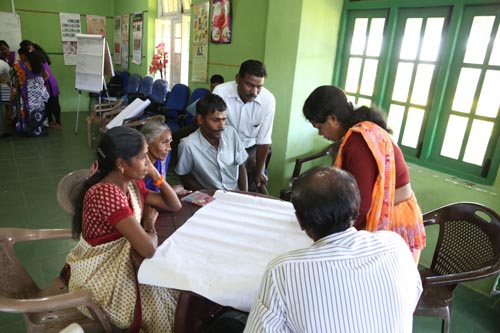
image #1

Community Operational Research (COR) is based on meaningful engagement with communities to bring about transformational research and practice along with community empowerment and social change. We work directly with communities to identify, formulate, model and solve problems in which decisions and choices are the core focus. Our training and practice cross disciplinary, application and methodological boundaries: we are planners, engineers, management scholars, policy analysts and many others. The purpose of this website is to introduce you to a special issue of European Journal of Operational Research titled “Community Operational Research: Innovations, Internationalization and Agenda-Setting Applications” which has appeared in August 2018. The 31 papers in this special issue address issues in rural development, theory and methodology, working with youth, urban planning and many other areas. They represent applications of decision modeling that are more familiar to persons with traditional training in operations research and the management sciences, as well as those that reflect progressive notions of how qualitative analysis and a systems view can support positive community change.

Sometimes the perspective of authors in this special issue is on what decisions to make to achieve particular outcomes: How can we design design an energy generation strategy for a small town that balances environmental sustainability, economic sustainability and local energy autonomy? What are new ways to ensure access to nutritious and affordable food in lower-income, primarily immigrant communities that combines behavior changes by residents with new services by stores and government agencies? How can we develop a peace education program in an area rife with political and other violence in which young people learn of alternatives to violence to solve conflicts?

Other times the authors in this special issue seek to examine events that have already occurred to learn how a community-engaged decision modeling perspective can explain what we have observed: If co-production of health care through community engagement and shared responsibility for health care fail in one place after succeeding in another place, could a better understanding of doctors’ professional identities combined with putting key stakeholders at the center of system redesign result in improved outcomes in the future? In the wake of a destructive tsunami and subsequent rebuilding, how can an arts-based methodology help us understand how a community in crisis draws on social networks, cultural practices and collective interventions to build from within?

The goal of this website is to provide convenient information on the articles and the authors so that visitors can make connections between diverse topics, methodologies, analytic methods and application domains and become an active participant in the COR community of practice. We do so by enabling visitors to learn about the subjects, topic themes, keywords, authors and key resources related to community operational research as it is currently theorized and practiced. The website has the following sections:

  • Biographical information for the editorial team and manuscript lead authors;
  • Information on manuscripts based on title, theme as described in editorial, country of focus of study, primary methodology/analytics classification and keywords, including links to manuscripts in the special issue;
  • COR resources, with links to important books, research articles and key publication outlets related to community operational research and related fields.

We hope that this special issue inspires new practitioners to take up the banner of Community OR and make their own contributions, right across the world. If you personally are inspired, do not hesitate to get involved with the community concerns that matter to you most. Importantly, please write up your experiences for publication, and not just for scholarly outlets such as this one. Let us make sure the dialogue on Community OR continues to thrive!

We invite you to learn more about this Special Issue by reading the editorial. The Elsevier website for the Special Issue is here.

Sincerely,

The Editorial Team

Source: Home – EJOR Special Issue on Community Operational Research – Research Guides at University of Massachusetts Boston

Embracing Emergence: Problem Solving on Complex Projects | UTS ePRESS

Embracing Emergence: Problem Solving on Complex Projects

International Research Network on Organizing by Projects (IRNOP) 2017, 11-14 June 2017
Published by UTS ePRESS | http://pmrp.epress.lib.uts.edu.au


CONFERENCE PAPER

Gina Bowman1*, Lynn Crawford2

1 Director, Australia, Gedeth Network. gina.bowman@gedeth.com

2 Director, Project Management Program, University of Sydney, Adjunct Professor, Bond University; Visiting Professor, Cranfield University School of Management; Professor of Systemic Management, ISCE. lynn.crawford@sydney.edu.au

*Corresponding author: Gina Bowman. Gedeth Network. gina.bowman@gedeth.com

Name: International Research Network on Organizing by Projects (IRNOP) 2017

Location: Boston University, United States

Dates: 11-14 June 2017

Host Organisation: Metropolitan College at Boston University

DOI: https://doi.org/10.5130/pmrp.irnop2017.5698

Published: 07/06/2018

Citation: Bowman, G. and Crawford, L. 2017. Embracing emergence: problem solving on complex projects. International Research Network on Organizing by Projects (IRNOP) 2017, UTS ePRESS, Sydney: NSW, pp. 1-27. https://doi.org/10.5130/pmrp.irnop2017.5698

© 2018 by the author(s). This is an Open Access article distributed under the terms of the Creative Commons Attribution 4.0 International (CC BY 4.0) License (https://creativecommons.org/licenses/by/4.0/), allowing third parties to copy and redistribute the material in any medium or format and to remix, transform, and build upon the material for any purpose, even commercially, provided the original work is properly cited and states its license.


Synopsis

Managing within the unpredictable and complex environments of today’s projects calls for new competencies to help interpret and respond to problems. Quantum storytelling can play a powerful role in reinterpreting project concepts such as risks, and their resulting problems, by harnessing the properties of emergence. The reframing of problems is explored through a complexity lens and underpinned by stories from the international development sector.

Research design

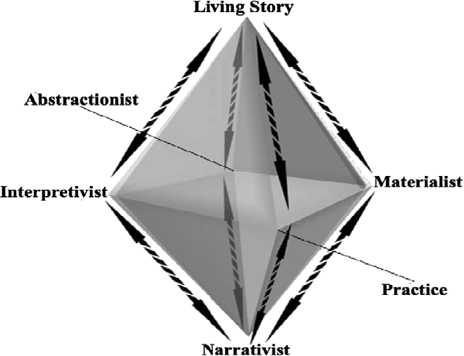
Actuality research, with its focus on the lived experience, provided the foundation for a research study exploring how project managers currently interpret problems on complex projects. Application of the storytelling diamond model supported methodology choice, and in-depth interviews were undertaken with six project managers from two organizations managing complex projects.

Relevance for practice

We believe that developing an understanding of quantum storytelling and its potential application to managing projects has the capacity to assist project teams to make sense of the emergent nature of complex projects and to consider alternative approaches to solving problems.

Main Findings

The findings provide insight into how the project managers interviewed currently interpret problems and the resulting approaches to solving them. Their stories outline the themes that populate both the organizational and sectorial narrative of their projects.

We argue that traditional project methods apply control frames and behaviours through which to interpret concepts like problems, but in the real world, adaptable and flexible behaviours are required to tackle them as they evolve in the field. We determine that the traditional “plan and manage” contingency approach is not delivering to these project managers the competencies required to manage their projects.

Research implications

Our paper illustrates how a storytelling methodology can be used to explore problems and identifies the potential to further develop storytelling competency through adopting a complexity mindset with its inherent understanding of the property of emergence.

Keywords

Complex Projects, Problems, Storytelling, Complexity, Emergence

Source: Embracing Emergence: Problem Solving on Complex Projects | UTS ePRESS

Principles of Chaos Engineering

PRINCIPLES OF CHAOS ENGINEERING

Last Update: 2018 May

Chaos Engineering is the discipline of experimenting on a distributed system
in order to build confidence in the system’s capability
to withstand turbulent conditions in production.

Advances in large-scale, distributed software systems are changing the game for software engineering.  As an industry, we are quick to adopt practices that increase flexibility of development and velocity of deployment.  An urgent question follows on the heels of these benefits: How much confidence we can have in the complex systems that we put into production?

Even when all of the individual services in a distributed system are functioning properly, the interactions between those services can cause unpredictable outcomes.  Unpredictable outcomes, compounded by rare but disruptive real-world events that affect production environments, make these distributed systems inherently chaotic.

We need to identify weaknesses before they manifest in system-wide, aberrant behaviors.  Systemic weaknesses could take the form of: improper fallback settings when a service is unavailable; retry storms from improperly tuned timeouts; outages when a downstream dependency receives too much traffic; cascading failures when a single point of failure crashes; etc.  We must address the most significant weaknesses proactively, before they affect our customers in production.  We need a way to manage the chaos inherent in these systems, take advantage of increasing flexibility and velocity, and have confidence in our production deployments despite the complexity that they represent.

An empirical, systems-based approach addresses the chaos in distributed systems at scale and builds confidence in the ability of those systems to withstand realistic conditions.  We learn about the behavior of a distributed system by observing it during a controlled experiment.  We call this Chaos Engineering.

CHAOS IN PRACTICE

To specifically address the uncertainty of distributed systems at scale, Chaos Engineering can be thought of as the facilitation of experiments to uncover systemic weaknesses.  These experiments follow four steps:

  1. Start by defining ‘steady state’ as some measurable output of a system that indicates normal behavior.
  2. Hypothesize that this steady state will continue in both the control group and the experimental group.
  3. Introduce variables that reflect real world events like servers that crash, hard drives that malfunction, network connections that are severed, etc.
  4. Try to disprove the hypothesis by looking for a difference in steady state between the control group and the experimental group.

The harder it is to disrupt the steady state, the more confidence we have in the behavior of the system.  If a weakness is uncovered, we now have a target for improvement before that behavior manifests in the system at large.

ADVANCED PRINCIPLES

The following principles describe an ideal application of Chaos Engineering, applied to the processes of experimentation described above.  The degree to which these principles are pursued strongly correlates to the confidence we can have in a distributed system at scale.

Build a Hypothesis around Steady State Behavior

Focus on the measurable output of a system, rather than internal attributes of the system.  Measurements of that output over a short period of time constitute a proxy for the system’s steady state.  The overall system’s throughput, error rates, latency percentiles, etc. could all be metrics of interest representing steady state behavior.  By focusing on systemic behavior patterns during experiments, Chaos verifies that the system does work, rather than trying to validate how it works.

Vary Real-world Events

Chaos variables reflect real-world events.  Prioritize events either by potential impact or estimated frequency.  Consider events that correspond to hardware failures like servers dying,software failures like malformed responses, and non-failure events like a spike in traffic or a scaling event.  Any event capable of disrupting steady state is a potential variable in a Chaos experiment.

Run Experiments in Production

Systems behave differently depending on environment and traffic patterns.  Since the behavior of utilization can change at any time, sampling real traffic is the only way to reliably capture the request path.  To guarantee both authenticity of the way in which the system is exercised and relevance to the current deployed system, Chaos strongly prefers to experiment directly on production traffic.

Automate Experiments to Run Continuously

Running experiments manually is labor-intensive and ultimately unsustainable.  Automate experiments and run them continuously.  Chaos Engineering builds automation into the system to drive both orchestration and analysis.

Minimize Blast Radius

Experimenting in production has the potential to cause unnecessary customer pain. While there must be an allowance for some short-term negative impact, it is the responsibility and obligation of the Chaos Engineer to ensure the fallout from experiments are minimized and contained.

Chaos Engineering is a powerful practice that is already changing how software is designed and engineered at some of the largest-scale operations in the world.  Where other practices address velocity and flexibility, Chaos specifically tackles systemic uncertainty in these distributed systems.  The Principles of Chaos provide confidence to innovate quickly at massive scales and give customers the high quality experiences they deserve.

Join the ongoing discussion of the Principles of Chaos and their application in the Chaos Community Google Group.

Translations: FR | RU | 中文 (简体) | 한국어 | Spanish | TR | PT-BR | العَرَبِيَّة‎ | 日本語
If you want to add your translation, please submit a pull request against the Github repository.

Source: Principles of Chaos Engineering


Cheat sheet: https://www.techrepublic.com/article/chaos-engineering-a-cheat-sheet/


The rise of: https://techcrunch.com/2018/02/04/the-rise-of-chaos-engineering/


History, practices, principles: https://www.gremlin.com/community/tutorials/chaos-engineering-the-history-principles-and-practice/

2003/07 Governance and the Practice of Management in Long-Term Inter-Organizational Relations | Coevolving Innovations

2003/07 Governance and the Practice of Management in Long-Term Inter-Organizational Relations

Authors

David Ing, David Hawk, Ian Simmonds, and Marianne Kosits

Abstract

Outsourcing, strategic alliances and joint ventures are dominant forms of extending organizational reach. The scope and direction of these associations is set through management and governance of the inter-organizational relation. Yet, an understanding of the distinctions between management and government are often missing, both for those who initiate and for those who operate within a joint initiative.

This article reviews the concepts of management and governance in an inter-organizational context from the foundations of general systems and social theory. The motivations of efficiency and synergy are compared. Choices made about long-term alliances are highlighted in distinctions between designs that are complicated and designs that are complex, and between interactions that are loosely coupled and interactions that are tightly coupled. The influences of management and governance are considered in the cybernetic frame that distinguishes between external control and self-control.

Recommendations for business include considering of multiple lines of authority, as heterarchy; and the adoption of a social practice perspective that can include aspects of solidarity and style, uncovered in the disclosing of new worlds.

Citation

David Ing, David Hawk, Ian Simmonds, and Marianne Kosits, “Governance and the Practice of Management in Long-Term Inter-Organizational Relations”, Proceedings of the 47th Annual Meeting of the International Society for the System Sciences, at Hersonissos, Crete, July 7-11, 2003.

Content

Source: 2003/07 Governance and the Practice of Management in Long-Term Inter-Organizational Relations | Coevolving Innovations

Social interactions shape individual and collective personality in social spiders

cxdig's avatarComplexity Digest

The behavioural composition of a group and the dynamics of social interactions can both influence how social animals work collectively. For example, individuals exhibiting certain behavioural tendencies may have a disproportionately large impact on the group, and so are referred to as keystone individuals, while interactions between individuals can facilitate information transmission about resources. Despite the potential impact of both behavioural composition and interactions on collective behaviour, the relationship between consistent behaviours (also known as personalities) and social interactions remains poorly understood. Here, we use stochastic actor-oriented models to uncover the interdependencies between boldness and social interactions in the social spider Stegodyphus dumicola. We find that boldness has no effect on the likelihood of forming social interactions, but interactions do affect boldness, and lead to an increase in the boldness of the shyer individual. Furthermore, spiders tend to interact with the same individuals as their neighbours. In general, boldness decreases…

View original post 117 more words

Systems practice – unpacking the juggler metaphor | OpenLearn

From the Open University, excerpted from a free course on “Managing Complexity: A Systems Approach”:

Many well-known systems thinkers had particular experiences, which led them to devote their lives to their particular forms of systems practice. So, within Systems thinking and practice, just as in juggling, there are different traditions, which are perpetuated through lineages (see Figure 7).

A model of different influences that have shaped contemporary systems approaches

Figure 7: A model of different influences that have shaped contemporary systems approaches

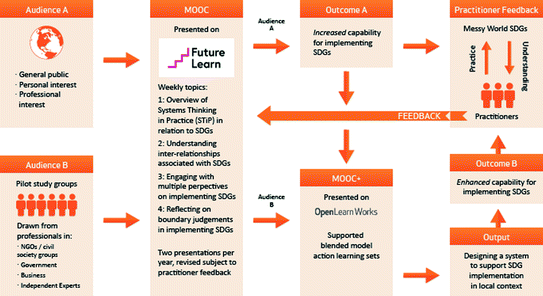
The OpenLearn course was surfaced on reading “The Role of Systems Thinking in the Practice of Implementing Sustainable Development Goals” | Martin Reynolds, Christine Blackmore, Ray Ison, Rupesh Shah, Elaine Wedlock | 2017 | Handbook of Sustainability Science and Research at http://doi.org/10.1007/978-3-319-63007-6_42 .

Praxis support for implementing sustainable development goals (SDGs) based on systems thinking in practice at The Open University.

Praxis support for implementing sustainable development goals (SDGs) based on systems thinking in practice at The Open University. Source Reynolds et al. (2017). © 2017 The Open University

A complementary presentation was made by Martin Reynolds at the World Symposium on Sustainability Science and Research, Manchester, UK, April 5-7, 2007.
World Symposium on Sustainability Science and Research

Martin Reynolds is in the Applied Systems Thinking in Practice group in the School of Engineering and Innovation, at The Open University.

There are a variety courses when searching on “Systems Thinking” in OpenLearn.


#mooc, #open-university, #systems-thinking

Reflections on the paradigm of Ecological Economics for Environmental Management | Maurício Fuks | 2012

A concise history of ecological economics via Nicholas Georgescu-Roegen and Kenneth E. Boulding laying down foundations in the systems sciences, and their influence on Herman Daly and Robert Costanza.

Georgescu-Roegen (1971) pointed out that, according to the first law of thermodynamics we can neither create nor destroy matter or energy (Principle of Conservation of Matter and Energy) and consequently asked: What, then, does the economic process do? The answer is: it absorbs, qualitatively transforms low entropy and releases it outside the economic system in the form of high entropy.3 That is, the economic system is a subsystem of the finite global ecosystem, on which it depends to both extract low entropy and, when using it, release it in the form of high entropy (Ayres, Nair, 1984, Constanza et al 1997).

Figure 1 - Matter and energy flows through the economic system

This entropic perspective of the economic process is the opposite of the mechanistic view addopted by standard economic theory. Unlike the Newtonian worldview – in which a system is time reversible, remaining identical -, the second law of entropy indicates an irreversible and unidirectional qualitative change: The amount of bound (or unavailable) energy in a closed system increases continuously. To decrease the entropy of a system, we need to obtain energy from outside the system, which means increasing the global entropic deficit.

Living organisms are no exception to the second law of thermodynamics, since they survive by absorbing low entropy from the environment to offset the increase in entropy to which they are subject. Thus, although living organisms temporarily avoid dissipation, they increase the entropy of the system as a whole, i.e., of the environment in which they exist. In other words, the presence of life speeds up the entropic process (Georgescu-Roegen, 1971, 1993).

[….]

Kenneth Boulding, another thinker of huge influence in Ecological Economics was also adamant about the need for changing the economic behavior of humanity.5

  • Although Georgescu-Roegen and Boulding disagreed about the concept of entropy, the congruence between the works of these two thinkers is evident. The sharpest disagreement lies in that Boulding advocates the possibility of a closed system for matter without its dissipation and powered by solar energy. This difference makes Boulding’s view (potentially) less tragic than Georgescu-Roegen’s (see Cechin & Eli da Veiga, 2010; Cleveland, 1999; and Fuks, 1992, 1994).

“Reflections on the paradigm of Ecological Economics for Environmental Management” | Maurício Fuks | Estudos Avançados | vol.26 no.74 São Paulo 2012 at http://dx.doi.org/10.1590/S0103-40142012000100008 , CC-BY-NC at http://www.scielo.br/scielo.php?pid=S0103-40142012000100008&script=sci_arttext&tlng=en


#ecological-economics, #kenneth-boulding, #nicholas-georgescu-roegen

Entropy | Special Issue : Information Theory in Complex Systems

cxdig's avatarComplexity Digest

Complex systems are ubiquitous in the natural and engineered worlds. Examples are self-assembling materials, the Earth’s climate, single- and multi-cellular organisms, the brain, and coupled socio-economic and socio-technical systems, to mention a few canonical examples. The use of Shannon information theory to study the behavior of such systems, and to explain and predict their dynamics, has gained significant attention, both from a theoretical and from an experimental viewpoint. There have been many advances in applying Shannon theory to complex systems, including correlation analyses for spatial and temporal data and construction and clustering techniques for complex networks. Progress has often been driven by the application areas, such as genetics, neurosciences, and the Earth sciences.

The application of Shannon theory to data of real-world complex systems are often hindered by the frequent lack of stationarity and sufficient statistics. Further progress on this front call for new statistical techniques based on Shannon information…

View original post 87 more words

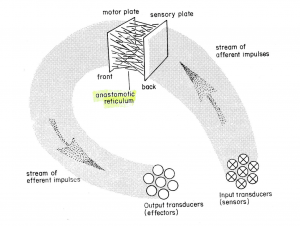
The Anastomotic Reticulum (Stafford Beer) – an incomplete note in search of further elucidation

This is an incomplete note about an important and interesting concept, in the hope that it will create an attractor for more explanation!

Image from this weird notes page (incomplete): Norm-Critical Innovation | Knowledge Management Research Group


I came across this in https://medium.com/@aidan.ward.antelope/of-bullshit-anastomosis-767bc0fc4e57

The detection of bullshit is a crucial feature of our lives: we are, after all, drowning in it. If you think anastomosis probably IS bullshit, go to the bottom of the class. Anastomosis seems to be little known about but is a crucial structure for bullshit filtering. Nassim Taleb, in his latest popular book, Skin in the Game, says his whole series of books including the Black Swan and Antifragile amount to a life project of bullshit detection. Spoiler alert: he finds no shortage of BS, especially in government functions.

Anastomosis? I have three pillars. Stafford Beer, whose Viable Systems Model I have used extensively, describes the cybernetic function of our brains as an anastomotic reticulum. Alan Rayner, in The Origin of Life Patterns, has anastomotic flow forms as how reality happens. And in a recent article which we will explore a little, Wired into Pain, Tom Jesson explains how our nervous system uses anastomotic patterns to separate the pain we need to pay attention to from all the other signals that are not as significant in preserving our life. Yes, our pain has bullshit filtering built in.

In James Scott’s wonderful new book Against the Grain, it seems that the cradle of civilisation itself was the system of marshes and braided distributory channels in lower Mesopotamia (Greek — between the rivers). Our very being is anastomotic whether we know it or not. The complex ecologies that surged back and forth, our ability to partake of multiple food webs, the social structures that were played with and developed. How far we have fallen.


This article gives part of an explanation (pdf):

Click to access 10.1007%2F978-3-642-15509-3_14.pdf


Wikipedia https://en.wikipedia.org/wiki/Anastomosis:

An anastomosis (plural anastomoses) is a connection or opening between two things (especially cavities or passages) that are normally diverging or branching, such as between blood vesselsleaf veins, or streams. Such a connection may be normal (such as the foramen ovale in a fetus’s heart) or abnormal (such as the patent foramen ovale in an adult’s heart); it may be acquired (such as an arteriovenous fistula) or innate (such as the arteriovenous shunt of a metarteriole); and it may be natural (such as the aforementioned examples) or artificial (such as a surgical anastomosis).

Open Systems Thinking, Online Discussion, Governance

Should an open (public) online discussion group espousing systems thinking be governed through (i) an open (public) group, or (ii) a private (closed or secret) discussion group?

This is a question being debated on Facebook, about the “The Ecology of Systems Thinking” public group, with the “Systems Thinking Network Leadership Group” (closed group, proposed to becoming open), and the “EcoST Admin ADG” (secret group, which has reset to “closed”, i.e. the members are visible, but the content is not).

On August 30, I was invited into the EcoST Admin ADG, and posted:

I am signing into this group to say that I will not participate in a group that is designated as secret.

Since I have spent 3 full years writing a book called Open Innovation Learning, it would be hypocritical for me to participate in an online community that doesn’t believe in open systems thinking.

Some offline private communications ensued.  On August 31, I responded to on a personal channel:

… if the official position of that Facebook group is that’s going to be “a private working space”, then I won’t participate. However, if I was feeling sufficiently mischievous, I would then create a public link to that group, saying how open systems thinking isn’t being practiced, and ask why.

On a question about online discussion group administrator-moderators “making mistakes”, I wrote:

If we are seriously designing a system that “learns”, errors (a rephrasing of [C…’s] mistakes) are an opportunity for group learning. This is covered in the Map of Ignorance, from the University of Arizona. http://coevolving.com/blogs/index.php/archive/the-meta-design-of-dialogues-as-inquiring-systems/

The behaviour of thanking someone for pointing out an error takes some getting used to. It’s at the foundation of Ontological Design, as encouraged by Fernando Flores. https://www.strategy-business.com/article/09406

<< some messages by others are omitted >>

My understanding is that a lot of people are intimidated by meeting Fernando Flores, because he will take you at your word. I had the fortunate opportunity to schedule an appointment to speak to him directly (in his home!) and I found him rather straightforward.

<< a message by someone is omitted >>

So, to follow though on the Flores thread, communicating via social media (as well a verbally, where he does a large amount of coaching) is a SKILL that individuals should learn and improve upon. That being said, talking into a mirror (i.e. a closed system) will only allow a limited amount of learning.

As those private comments were (with my concurrence) reshared onto the EcoST Admin ADG on August 31.  Responses to the thread led me to write a long response:

On the premise of setting the EcoSt Admin ADG as secret or private Facebook group: What systems school, research of philosophy are you basing this decision? I will argue for open systems thinking (and open systems theory), and can easily draw on whole community of systems luminaries to support my position.

From a systemic perspective, the issue should be discussed as a whole. To fit within the post limits of Facebook, this issue will be broken up into this opening, five points, and a closing.

(1) An open systems approach allows boundary critique, as described by Werner Ulrich at http://wulrich.com/boundary_critique.html .

The quest for systemic thinking cannot alter the fact that all our claims remain ‘partial’ (Ulrich 1983), in the double sense of being selective with respect to relevant facts and norms and of benefiting some parties more than others. This is what boundary critique (Ulrich 1996, 2000, 2017) is all about; it aims at disclosing this inevitable partiality.

Having a Facebook administrators group as a closed system doesn’t “identify the sources of selectivity”; doesn’t “question these boundary judgements with respect to their practical and ethical implications to surface options”; and doesn’t include the ability to “challenge unqualified claims to knowledge or rationality by compelling argumentation”.

(2) An open systems approach embraces dissenting perspectives, as described by Gerald Midgley, “The Sacred and Profane in Critical Systems Thinking” | 1991 | Systems Practice at
https://doi.org/10.1007/BF01060044 , cached at https://www.researchgate.net/publication/226199755_The_Sacred_and_Profane_in_Critical_Systems_Thinking

Fuenmayor uses a metaphor of light and dark to describe this process of drawing boundaries. He asks us to remain aware that throwing light upon a system casts its ‘otherness’ into darkness. Through such an awareness we are able to retain the possibility of changing the boundaries of critique. In other words, awareness of ‘otherness’ is an effective remedy for ‘hardening of the boundaries’.

Any electronic forum that is a closed system doesn’t permit throwing light on how the boundaries are set.

(3) An open systems approach embraces fluid management (rather than solid aspects of management), as described by David Hawk | “System Cracks are Where the Light Gets In: Models and Measures of Services in the Benefit of Context” | 2001 | Proceedings of the 45th Annual Meeting of the International Society for the System Sciences, cached at http://systemicbusiness.org/pubs/2001_ISSS_45th_068_Hawk_Parhankangas_System_Cracks_Light.html

Cracks point a systems forces that were not being reconciled within the limits of the system. “Crackage” may also be a sign of systems reaching their limits. […] Such cracks can be seen as early indicators of larger problems looming for organizations.

A closed system doesn’t respond to environment, and thus doesn’t see signals of the system reaching its limits.

(4) An open systems approach embraces “unbounded systems thinking” as “the fifth way of knowing”, as described by Ian Mitroff | The Unbounded Mind | 1995 (scholarly excerpt at http://doi.org/10.1093/acprof:oso/9780195102888.003.0006 . This was originally described as a Singerian inquiring system by C. West Churchman. Here’s a quick summary by James F. Courtney, David T. Croasdell and David B. Paradice | “Inquiring Organizations” | 1998 at https://www.bauer.uh.edu/parks/fis/inqorg.htm#s2

The Singerian Inquirer
> Two basic premises guide Singerian inquiry (Churchman, 1971, pp. 189-191). The first premise establishes a system of measures that specify steps to be followed in resolving disagreements among members of a community. Measures can be transformed and compared where appropriate. The measure of performance is the degree to which differences among group member’s opinions can be resolved by the measuring system. A key feature of the measuring system is its ability to replicate its results to ensure consistency.
> The second principle guiding Singerian inquiry is the strategy of agreement (p. 199). Disagreement may occur for various reasons, including the different training and background of observers and inadequate explanatory models. When models fail to explain a phenomenon, new variables and laws are “swept in” to provide guidance and overcome inconsistencies. Yet, disagreement is encouraged in Singerian inquiry. It is through disagreement that world views come to be improved. Complacency is avoided by continuously challenging system knowledge.
> Singerian inquiry provides the capability to choose among a system of measures to create insight and build knowledge. A simplistic optimism drives the community toward continuous improvement of measures. However, the generation of knowledge can move the community away from reality and towards its own form of illusion if not carefully monitored.

An open systems approach with the fifth way of knowing allows new knowledge to be swept into the dialogue. Taking a poll is based on the second way of knowing, an analytic-deductive inquiring system.

(5) An open systems approach is a premise for Open Innovation Learning, where open sourcing WHILE private sourcing is recognized. The open access book at http://openinnovationlearning.com/online/ is based on 7 case studies of IBM between 2001-2011.

The label of open sourcing frames ongoing ways that organizations and individuals conduct themselves with others through continually sharing artifacts and practices of mutual benefit. The label of private sourcing frames the contrasting and more traditional ways that business organizations and allied partners develop and keep artifacts and practices to themselves. Many customers external to a private sourcing organization are uninterested in internal details about the whys and wherefores about how an offering comes about. Some constituents external to an organization prefer the transparency in open sourcing, both in self interests and mutual interests. [p. 5]

Those interested in an example a concrete struggle to maintain the spirit of open sourcing can refer to Appendix A.7.4 (c) “Open sourcing: Office Open XML approved as ECMA-376 on Dec. 7 2006” telling the story about Microsoft influencing industry standards organizations to endorse OOXML, and IBM threatening to exit those organizations as a result.

In this sense, I may be labelled a heretic. David Hawk writes “a heretic was one who raises questions about an entity’s most closely held beliefs. A heretic initiates institutional renewal by firming up its strengths while destabilizing its dogmas. In this way a heretic strengthens an entity”. See https://www.researchgate.net/publication/326399730_CHANGE_FROM_WITHIN_GUNNAR_AS_THE_LOYAL_HERETIC

I explicitly license the whole of these comments (i.e. the opening, 5 points and close) as Creative Commons CC-BY-ND David Ing 2018, which allows them to be reposted in whole by anyone, anywhere, as long as they are attributed to me. If you want to respond, your copyright will be preserved, but you might want to refer to “Do I Own My Photos and Posts on Facebook, Twitter, and Instagram?” | Mihir Patkar | October 2017 at https://www.makeuseof.com/tag/own-photos-facebook-twitter/

The original formation of the Systems Thinking Network Leadership group on Facebook was based on the reformation of Systems Thinking World on LinkedIn, in October-November 2015.  The ideal (but technologically immature) direction would have been to move towards a federated social web.  Benjamin Taylor had moved to the model.report platform (based on lobste.rs, now archived at https://syscoi.com/model.report/model.report/recent.html ) before moving to stream.syscoi.com in January 2018.

On September 1, Benjamin Taylor wrote on the EcoST Admin ADG:

I have a preference for what i believe David is advocating – everything should be *accessible* unless it really needs to be private. And we should keep the private to a minimum.

The purpose of this apart from the open systems principles is to allow genuine accountability – i.e. at a practical minimum, the different perspectives and arguments behind moderation decisions should be made visible.

IIRC, at the time a small group of people saved the LinkedIn group (which I had a part ownership of) and the Facebook group from [G…’s] destruction (plus the @systemsthinking twitter, which [P…] still has custody of, given we were never able to resolve what to do with it), I proposed (or supported) very open moderation, which is why I added many admin-types to the LI group, and created (or supported) the systems thinking network leadership group https://www.facebook.com/groups/1698754760335916/ as an open forum for whoever was interested to weigh in and help make decisions on any governance or emergent issues from *both* the LI and the facebook group. I stand by that decision, and would suggest that we rename that as the more humble ‘moderation’ group, agree some decision rules, and try to work there.

This led Benjamin to a Facebook poll in the EcoST Admin ADG with a description:

I’m proposing:
1- close down this group and reconvene in the STN moderation group
2- I will make clear to everyone there the intention for it to be a platform for moderators to hold governance discussions and allow 72 hours for responses or complaints (to be debated there), then:
3- I will change the group status to open
4- I will delete every non-governance-related post currently in that group
and then:
5-any mega-decisions for either group be by vote of all members in the relevant groups (STN moderation a platform for open discussions only)
6-all moderation decisions discussed in STN moderation open group, then finalised by small group of moderators using the rules we are currently agreeing in the google doc)
7-delegate authority to all moderators to do a bunch of day-to-day stuff (as being agreed in the google doc)
8-escalation route from individual moderator – STN moderation discussion and moderator decision – all member vote if needed (to be agree in the google doc)
The results of this vote not to be binding on what we agree in the google doc – items 6-8 as they relate to the google doc be advisory in that context.

I support this position, and would be active in reforming the Systems Thinking Network Leadership (closed) group on Facebook into the Systems Thinking Network Moderation (public) group.

This is not the end of the story.  It’s a partial report of activities in an online community.

The Ecology of Systems Thinking group on Facebook

#facebook, #governance, #online-communities, #open-systems-thinking, #systems-thinking