
| CECAN Webinar: Setting Boundaries in Evaluation; The role of Critical Systems Heuristics |
| Wednesday 18th October 2023, 10:00 – 11:00 BST Presenter: Bob Williams, Evaluator |
https://mailchi.mp/8e4dd1c03484/cecanwebinar-6655710?e=68c639d876
| CECAN Webinar: Setting Boundaries in Evaluation; The role of Critical Systems Heuristics |
| Wednesday 18th October 2023, 10:00 – 11:00 BST Presenter: Bob Williams, Evaluator |
https://mailchi.mp/8e4dd1c03484/cecanwebinar-6655710?e=68c639d876
Note the care in making these distinctions with awareness of the teleological fallacy and the superiority fallacy.
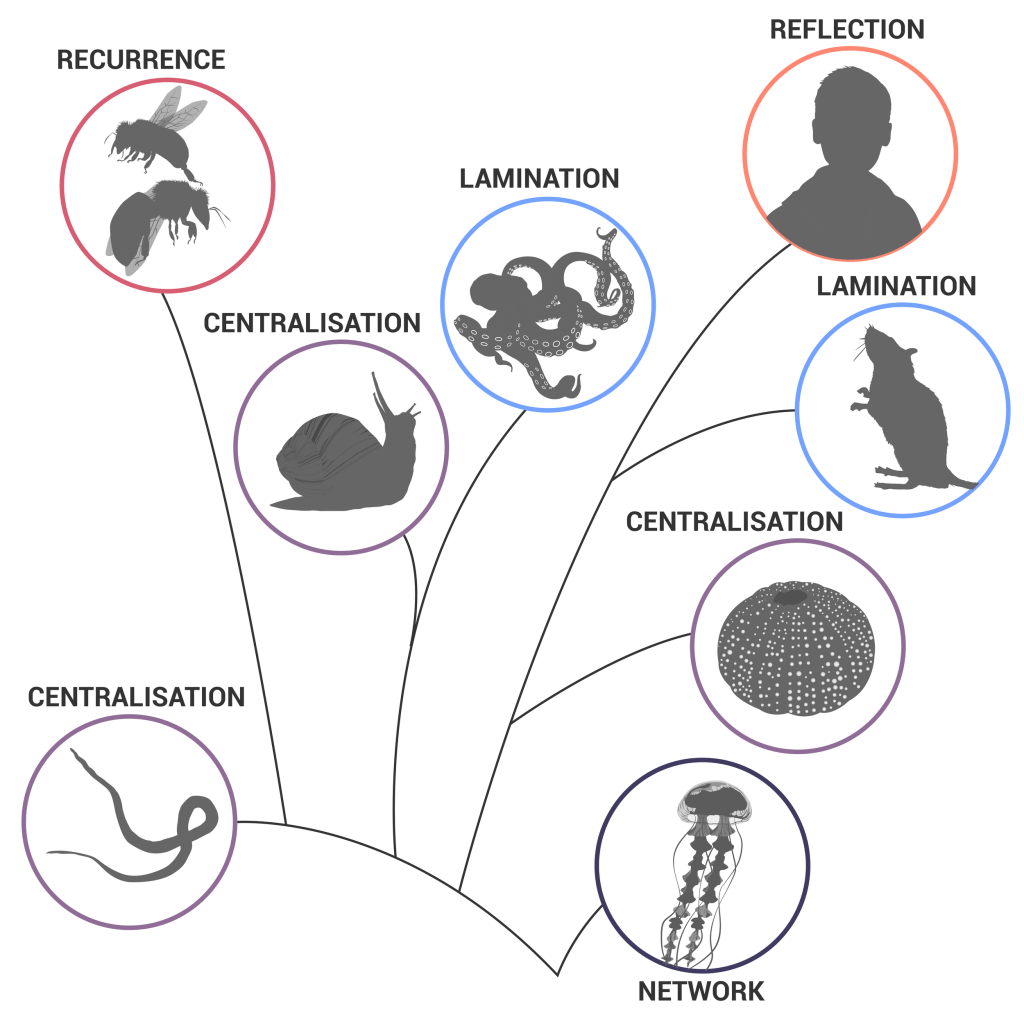
The overall project at https://www.majortransitions.org/about is fascinating from a systems | cybernetics | complexity perspective (I wonder if they have any reference to cybernetics?) in identifying possible major distinct forms of ‘intelligence’. It makes me speculate about how different forms of utopian (or merely normative) prescription for organisation might usefully be distinguished as targeting different forms of ‘cognition’ as ‘optimal’…
Episode transcript
https://drive.google.com/file/d/1b_7-I78y_wmdSK7VapX1QalXzccKDm7X/view?usp=drive_link
How hard is it to prove that problems are hard to solve? Meta-complexity theorists have been asking questions like this for decades. A string of recent results has started to deliver answers.
Complexity theorists are confronting their most puzzling problem yet: complexity theory itself.
August 17, 2023
(A bad system may beat good people, but evil people often beat even quite good systems)
http://dx.doi.org/10.1136/bmjqs-2013-002138
https://qualitysafety.bmj.com/content/22/7/528.long
Available online 4 August 2023
In Press, Corrected ProofWhat’s this?
Pamela Sydelko
Angela Espinosa
Gerald Midgley
https://www.sciencedirect.com/…/pii/S037722172300512X
Abstract
Government agencies struggle to address wicked problems because they are open-ended, highly interdependent issues that cross agency, stakeholder, jurisdictional, and geopolitical boundaries. While both quantitative modelling and qualitative problem structuring methodologies have been used to support interagency decision making in the past, co-designing an effective interagency organization to collaboratively tackle wicked problems is more challenging. Few approaches have been developed to enable such efforts. This paper explains how the viable system model (VSM) was implemented through a board game, which was employed to co-design an interagency meta-organization that would be capable of more effectively collaborating to jointly address a wicked problem: international organized drug crime and its interface with local gangs in Chicago, USA. The board game was developed to make the VSM easier for the participants to learn, given that the cybernetic language and engineering-influenced diagrams in the original literature can be off-putting to leaders and managers. The board game was used as the final stage of a multi-method, systemic approach, which involved boundary critique and problem structuring as well as deployment of the VSM. The research findings indicate that the VSM board game, used as part of a larger mixed-methods systemic intervention, contributes to building trust in the value of systems thinking amongst the participants, and sets up a rich context for collaboration on multi-agency co-design. The game therefore offers significant promise as part of the co-design of interagency responses to wicked problems because it creates an embodied process for stakeholders to learn about the VSM. It also reduces the work involved in this learning. Thus, the game enables an effective appropriation of the VSM language and criteria.
Article at https://medium.com/@chris_39461/leading-in-a-vuca-world-7a5d249bdb2, part of Taking Experience Seriously
On Twitter, Pedro Carcamo Petridis said (translated)
(Almost) sure that these notes are not published anywhere (maybe I’m wrong, but I have not found copies on the web). They are Synco project documents. I’d like to post them somewhere so they’re available. There are 8 short documents
https://twitter.com/pedrocarcamop/status/1690728311595352064?s=46&t=PsBiwVGq1KB__T4DxrBdDw
This was spotted by Jaime Alvarez, who flagged it on the Systems Change Finland (https://systemschange.fi/) Slack under a discussion on the Morozov podcasts (https://stream.syscoi.com/2023/07/22/the-santiago-boys-nine-episode-podcast-season-yevgeny-morozov-on-project-cybersyn/) where Mikael Seppala pinged me.
So here we have the eight documents from Pedro, who in an email says (paraphrased):
Here are the cybersyn project documents that I have. These belonged to my grandfather Lautaro Cárcamo, a Chilean engineer who participated as a consultant on the project and forged a close friendship with Stafford Beer. Among the documents, some in Spanish and some in English, there are texts written by Stafford, as well as others by Lautaro Cárcamo and Humberto Gabella, a partner in my grandfather’s company and also a consultant on the project. I am grateful for their publication, I believe they will be of interest to researchers.
I am currently going through archives and old documents to see if I can find anything else that might be of interest. I will let you know if I find anything. I personally have also followed cybernetics studies closely (much more on the philosophy and sociology side) so I am very grateful also for the possibility to meet people who have somehow been involved in all this.
Pedro Cárcamo Petridis
I’ve put Pedro in touch with some folks who will find the papers interesting and provide further connections (and see if these really are unpublished – I’ve found that one of these papers was referenced in a Liverpool John Moores University PhD)
15 Aug
1 hr
What does it mean to be marginalized? Does marginalization give some people more epistemic authority than others? And, if so, what should we all do with this information? In episode 84 of Overthink, Ellie and David talk about standpoint theory, its complex intellectual history, and its relationship to W. E. B. DuBois’ concept of double consciousness. They welcome an expert on the subject: Dr. Briana Toole, Assistant Professor of Philosophy at Claremont McKenna College. In their conversation, they chat about how standpoint theory makes sense of electoral politics, educational policy, bizarre reality TV, and much more. They also discuss Corrupt the Youth, a philosophy outreach program founded by Dr. Toole that brings philosophy to high schools in the U.S.
Check out this episode’s extended cut here!
Works Discussed
Briana Toole, “On Standpoint Epistemology and Epistemic Peerhood” and “Demarginalizing Standpoint Epistemology”
Kate Chopin, The Awakening
W. E. B. DuBois, The Souls of Black Folk
Jennifer Nash, Black Feminism Reimagined
Olúfẹ́mi O. Táíwò, Elite Capture
David Foster Wallace, This Is Water
Black. White. (2006)
August 14, 2023 daviding
http://coevolving.com/blogs/index.php/archive/sciencing-philosophizing-st-on-2023-07-10/
In a Facebook post, Phoebe Tickell asked
Polycrisis / metacrisis is a rediscovery of Wicked Problems (1973) and VUCA (1987). What else are these terms adding?
Phoebe Tickell https://www.facebook.com/phoebetickell/posts/pfbid02VRBbiVQPWS7bvbik6Qvjx8xhTa5Vn6ApbZQFuVF7zfAmyfcdbth9UZxypJ6K97Uyl
My answer is below
My answer:
These are all just words therefore subject to over-familiarisation, co-option by the existing paradigm and by chancers and the innocent, and general misuse and abuse.
But… it would IMO be perfectly reasonable to say:
– Wicked Problems were a way of defining specific criteria of *problems* (and problems in *planning*, originally), which involved people, politics, and which from the perspective of planning appeared irresoluble and met a clustered set of criteria, and called for a specific type of approach to them. (Not a million miles from Ackoff’s ‘messes’, of course).
– VUCA relations to *conditions* – initially on a battlefield, if I understand correctly, then in the competitive and general environment of a business. It embeds its own specific criteria and is context specific.
(There’s also TUNA from Rafael Ramirez relating specifically to scenario planning and futures – Turbulent, Uncertain, Novel, and Ambiguous – I prefer this to VUCA for a number of reasons)
– Then the ‘poly crisis’ relates to a usually non-specific set of globally interacting crises which do inter-relate in truly complex ways, with the main implication being that it seeps into all contexts and is in a sense inescapable.
There’s some implication in the polycrisis (and explicitly in the problematised ‘meta-crisis’, which I think is potentially an argument for that term being useful and making a meaningful distinction) that it brings in ‘sensemaking’ in terms of our own way of understanding and responding to all the elements of the polycrisis and to them as a whole. There’s a sensible multi-layer point to make that if *not only* are we unable to cope with the polycrisis, we’re also unable to orientate ourselves to it in any meaningful way, and our very orientation to the problem becomes a problem. That seems to me to be a meaningful distinction.
– you’ve left out ‘the World Problematique’ https://www.oxfordreference.com/display/10.1093/oi/authority.20110803124817999;jsessionid=9367733DD4AF0A3EBCF74C658ABC0522 from the Club of Rome which is a set of (fairly comprehensive) specific interlocking wicked problems which interact to form a polycrisis… though again, it might be reasonable to say that the Club of Rome occasionally veered into a mechanistic worldview or over-simplifying to try to achieve change (hence, for example, removing water cycles from the modelling of the climate crisis, leaving us with the fixation on carbon). So this seems to definitely have been an early version of the ‘polycrisis’ though it was more focused and less implying infinite ramification into all spheres including the social and mental – just total world collapse 🙂
So in my mind if we want to make a useful differentiation, we can go:
I could quibble with all of these – e.g. wicked problems do contain elements of sense-making being problematised, at the least from multiple social perspectives – but I do think these are helpful and defensible differentiations. That’s because all these definitions come with some meaningful definition of:
We are too often guilty, IMO, of using these terms and talking in general about the experience of confronting ‘complexity’ etc without explaining the factors which generate complexity, which are all due to interaction and contextualisation agent and context:
Intent, framing, perspective, interpretation, ability, learning, history, understanding etc etc.
(Which in practice usually means we have one context in mind but accidentally or intentionally are not disclosing it to others, because it’s obvious to us).
The problems with leaving these parts out are:
I once had a split with a collaborator because they insisted that, in the era of the climate crisis, *everything* just *was* a Wicked Problem. I was perfectly happy to concede that that was a valid way of looking and everything you did (in business, the unspoken, assumed context) could and probably should be related to the climate crisis, but that wasn’t enough for them… but in my opinion approaching *everything* as a wicked problem (what does that even mean?) would be a huge mistake.
As soon as you ask ‘what does that even mean?’ with regard to ‘*everything* is a wicked problem’, you get into the more useful conversation: ‘is brushing your teeth a wicked problem?’ opens up a proper conversation about relationships to contexts etc. But killing off that conversation before it even starts is, to me… a problem.
We are excited to be joined again by Evgeny Morozov, host of The Santiago Boys, a new narrative podcast series about the history of Cybersyn, the geopolitics of its creation in Cold War Latin America, and the legacy of Salvador Allende, Fernando Flores, and the man who looms largest of all: Stafford Beer. This podcast series is not like any story of Cybersyn you might have read before. Morozov has take a mountain of research — over 200 hundred original interviews, deep archival investigations, all compiled into an online resource accessible via the link below — and turned it into a thrilling narrative about a radical system that almost was, a world that could have been, and the people who fought to the end for those dreams.
••• The Santiago Boys: the-santiago-boys.com
••• Outro song: Fela Kuti – International Thief Thief (I.T.T.) www.youtube.com/watch?v=jptR_YwCs3o
Subscribe to hear more analysis and commentary in our premium episodes every week! www.patreon.com/thismachinekills
Hosted by Jathan Sadowski (www.twitter.com/jathansadowski) and Edward Ongweso Jr. (www.twitter.com/bigblackjacobin). Production / Music by Jereme Brown (www.twitter.com/braunestahl)
The purpose of the event is to stimulate exploration and learning about the breadth and depth of cybernetics in theory and practice
By Cybernetics Society and Centre for Info Mgm
The purpose of the event is to stimulate conversation, exploration and learning about the breadth and depth of cybernetics in theory and practice. This is not a conventional academic ‘conference’ but an event where attendees are encouraged to directly engage with each other and our hosts to explore how cybernetic ideas inform practice and how practice informs cybernetic ideas.
On Monday 23rd October we will be hosted by University College London Hospital and we will be considering challenges of social infrastructure in particular health and social care, education, civil administration, policing and security.
On Tuesday 24th October we will be hosted by ARUP and will be considering matters of fundamental infrastructure (energy, transport, waste, water, information technology)and engineering in particular through cross-cutting themes of Decarbonisation, Resilience and Adaptation, Digital Transitions, AI and other challenges.
We will be joined by guests from the host organizations who will join us in exploring the themes with the aim that they will share their specialist knowledge and we will contribute insights from cybernetics. The essential design for each day will be ‘World Café’ – starting with a provocation from a key speaker, followed by a series of linked discussions with participants able to contribute to each theme and coming back together towards the end of the day to share accumulated findings and, if appropriate, develop actions to be taken forward.
On Wednesday 25th, venue yet to be finalized but also in Central London, we will take more of a look at ourselves and the meta-discipline of cybernetics and picking up threads and themes unsuited to the first two days. Ideas already in train but to which we need to add include building on the great work already in course on our education and professional development as cyberneticians, our new journal, ways of developing the Society itself and hearing about the research work being undertaken by Doctoral and other students. There are at least 6 students working on doctorates rooted in cybernetics across personal health and social care, criminal justice, conflict management and transport systems embracing topics of artificial intelligence, data security, data integrity, domestic abuse and military action and governance.
A detailed programme is in development and will be published as soon as available.
About the Venue
Lunch and refreshments at each venue. Please advise us of any dietary restrictions by contacting the Cybernetics Society Secretary: secretary@cybsoc.org
Registration Information
This will be an ‘in person event’ only as participation will require presence in the physical spaces provided.
Participants may register for the 1,2 or 3 days though we encourage participation throughout as the means to both make the greatest contribution and the greatest learning.
Discounted registration rates are available to Cybernetics Society Members, Centre for Information Management (CIM) & Loughborough University Staff, as well as students (both Cybsoc members and non-members).
A bursary option is available for members or non-members who may struggle to attend for financial reasons but would like to. Please email the Cybernetics Society Secretary secretary@cybsoc.org to request permission to book this option.
About the Cybernetics Society
The Cybernetics Society promotes and offers education and research opportunities in the rich field of cybernetics.
The Cybernetics Society – http://CybSoc.org – is a specially authorised learned society regulated by the FSA and established by a 1974 Act of Parliament.
Cybernetics plays into and strongly influences many scientific and practice fields including design, epistemology, ecology, biology, psychology and living behaviour, technology and engineering, social policy, and business practice.
Cybernetics offers distinct thinking, tools and techniques to address local and global challenges of the 21st century.
Mon, 23 Oct 2023 10:00 – Wed, 25 Oct 2023 16:30 BST
https://www.eventbrite.co.uk/e/the-cybernetics-conversation-2023-tickets-691802518957
https://www.researchgate.net/publication/237290828_The_Dynamic_OODA_Loop_Amalgamating_Boyd%27s_OODA_Loop_and_the_Cybernetic_Approach_to_Command_and_Control_ASSESSMENT_TOOLS_AND_METRICS
June 22, 2023
Rockefeller Philanthropy Advisors (RPA) is pleased to announce the release of the evaluation report for its groundbreaking Shifting Systems Initiative (SSI). This work, conducted over the past seven months, aims to inform strategic discussions for the next phase of the initiative while sharing its findings to inform the broader philanthropic community working on systems change.
The evaluation report pursued five central strands of inquiry, examining the impact and effectiveness of the Shifting Systems Initiative and the sector more broadly. The primary objectives were to assess the extent to which the philanthropy sector has embraced the concept of systems change; explore the influence of the initiative on discourse and practices within philanthropy; analyze critical successes and challenges encountered by the initiative; understand effective strategies to influence philanthropic behavior; and identify opportunities for operational and governance improvements.
link https://www.rockpa.org/new-report-evaluation-of-the-shifting-systems-initiative/
youtube
See also:
Shifting the funding paradigm
https://socialchangeinnovators.com/enable/donors/shifting-the-funding-paradigm/
 Systems Community of Inquiry
You must be logged in to post a comment.