This paper addresses several issues of broad concern in the United States: population trends; the quality of urban life; national policy for urban growth; and the unexpected, ineffective, or detrimental results often generated by government programs in these areas.
The author does attempt to indicate how multiloop feed-back systems (to which our social systems belong) mislead us because our intuition and judgement have been formed to expect behavior different from that actually possessed by such systems. At times programs cause exactly the reverse of desired results.
It is now possible to explain how such contrary results can happen. There are fundamental reasons why people misjudge the behavior of social systems. There are orderly processes at work that frequently lead people to wrong decisions when faced with complex and highly interacting systems. Until we come to a much better understanding of social systems, we should expect that attempts to develop corrective programs will continue to disappoint us.
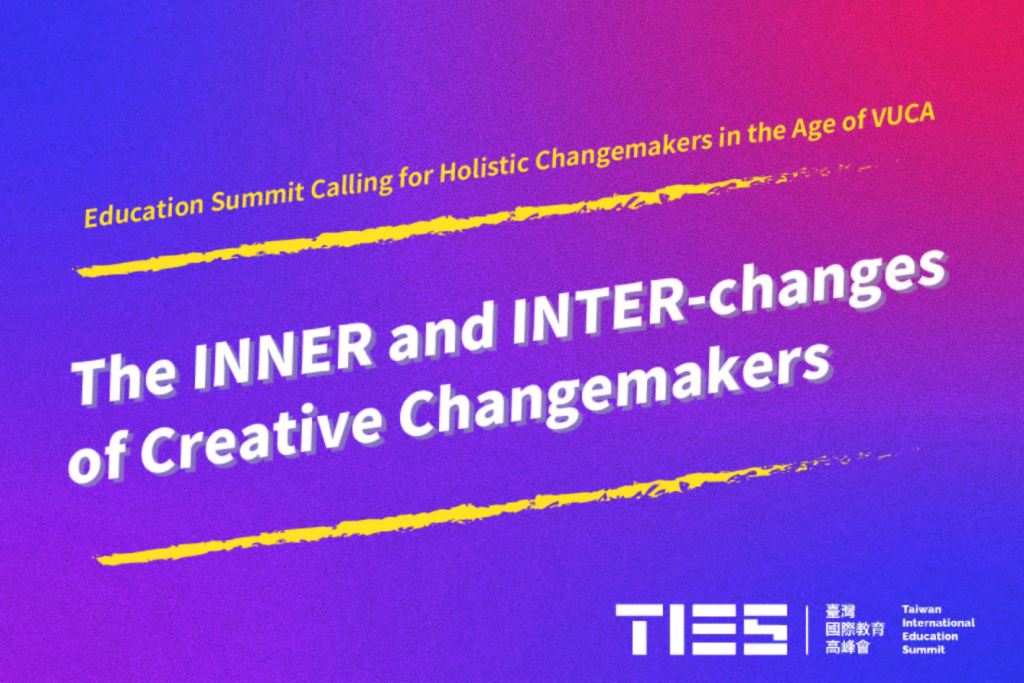
June 29-30, 2021, TAIPEI — On behalf of the Taiwan National Development Council, ZA Share is hosting the 2021 Taiwan International Education Summit (TIES) completely online from June 29 to 30. The theme of TIES this year is The INNER and INTER-changes of Creative Changemakers, with the aim to move beyond the narrow focus of the technical or financial needs of changemakers seeking the common good, to bring public and key stakeholders’ attention to the holistic needs for their nourishment and growth as “whole persons.”
Curated in the spirit of human ecology, 2021 TIES will be split into four tracks to cover the Intrapersonal, Interpersonal, Social, and Ecological Dimensions of a “Changemaker’s Journey” as a whole person, to foster interdisciplinary learning and the systemic awareness of the world’s VUCA (volatile, uncertain, complex, ambiguous) nature, as amplified by the outspread of COVID-19.
In each of the four tracks, there will be an invited expert from both the Eastern and Western countries, and a selected Open Mic Representative selected from a pool of self-nominated speakers to bring an “Intercultural Mash-up” of perspectives. The line of 12 speakers range from world-renowned Sir Geoff Mulgan, systems and collective intelligence scientist, former head of policy in the UK Prime Minister’s office, and co-founder of Social Innovation Exchange (SIX), to a group of self-nominated 7th-graders from Taoyuan Chungli Junior High School who’ve dedicated themselves to addressing the challenges arose with new immigrants in their school and communities.
The format of TIES creates a fully immersive digital bilingual learning experience, which integrates active and thematic learning from the pre-event Open Mic Speaker self-nomination challenge to the highly interactive online TIES itself, to openly demonstrate the holistic spirit of Taiwan’s National 12-Year Basic Education in a bilingual, digital, and public context. The integral design of TIES also manifests the National Development Council’s determination to bridge its bilingual nation, education innovation, digital transformation, and regional revitalization agendas.
2021 TIES is completely free to attend. The TIES Opening Ceremony/Press Conference will be held online at 14:30, June 29, 2021 (Taipei Time, UTC+8).
For more information, please visit: https://forms.gle/FdkEVXtMZkzRFA4r9 (Registration Form in English)
Participatory modeling is a purposeful learning process for action that engages the implicit and explicit knowledge of stakeholders to create formalized and shared representation(s) of reality. In this process, the participants co-formulate the problem and use modeling practices to aid in the description, solution, and decision-making actions of the group. Participatory modeling is often used in environmental and resource management contexts. It can be described as engaging non-scientists in the scientific process. The participants structure the problem, describe the system, and create a shared understanding of how the system works. This can further lead to more quantitative analyses, and may sometimes result in a computer model of the system, which is then jointly used to test policy interventions, and propose one or more solutions. Participatory modeling is often used in natural resources management,[1] such as forests[2] or water.[3][4]
There are numerous benefits from this type of modeling, including a high degree of ownership and motivation towards change for the people involved in the modeling process. It also helps to develop more acceptable solutions and often creates more consensus among the stakeholders involved.
Wikipedia isn’t great on this – the summary in this paper is better:
Participatory modelling: A review of applications in energy whole-systems modelling to support decision making – Catherine Bal
Topaasia: Systems Intelligence – Interview with Esa Saarinen and Raimo Hämäläinen
The Systems Intelligence is the result of the joint research work of the philosopher Esa Saarinen and professor emeritus Raimo Hämäläinen, which has been developed in Aalto University since 2001. The Systems Intelligence combines human sensitivity with the world changing engineering thinking. Topaasia – Systems Intelligence game is based on this research and made in collaboration with Esa and Raimo. We interviewed gentlemen about systems intelligence, applying it to the Topaasia format and how it can benefit organizations playing it.
Systems Intellect is a collection of human competencies
As a human being you are always part of a bigger whole or a system. The System Intelligence is the hallmark of man’s ability to strive for success in the systems, where he lives his life. It is human ability to improve life. People can easily see things in small sections and problems, instead of building a successful whole. Systems Intelligence gives you the tools to think about whether something should be done in a different way?
In the Systems intelligence, the talents already present in the human being is named so that people becomes more aware of them. The Glossary that is used aims to change and stimulate action. It is not a theory which, from the outside, depicts someone’s reality, which can be internalized and transferred to their own activities. Instead, systems intelligence is something that a person himself already does, but can do more or better. It’s a promise to be better at what you’ve been good in already and before. The aim of Systems intelligence is not only to understand the systems, but also to act in them. It aims to launch human growth process.
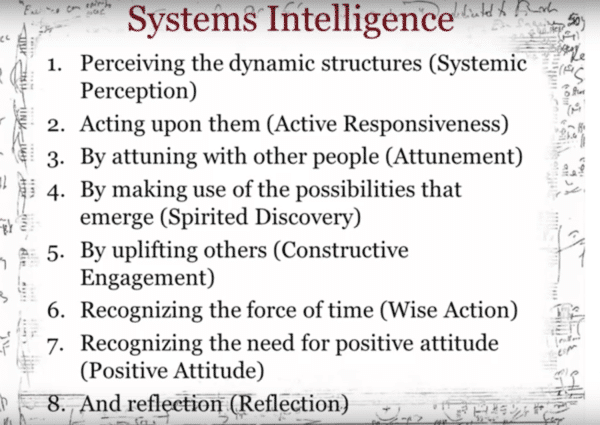
Areas of The System Intelligence. Source: Esa Saarinen The course Philosophy and systems thinking in Aalto University. Lecture 8 – The philosophy of the whole
Systems Intelligence (SI) is a concept introduced in 2004 by the principal investigators. The research group develops the conceptual basis of this competence and studies its different forms and manifestations in personal and organizational contexts. We seek to distribute knowledge and stimulate interest in Systems Intelligence in different fields including management practices, learning organizations, education, human relationships, etc.
By Systems Intelligence we mean intelligent behaviour in the context of complex systems involving interaction and feedback. A subject acting with systems intelligence engages successfully and productively with the holistic feedback mechanisms of her environment. She perceives herself as part of the whole, the influence of the whole upon herself as well as her own influence upon the whole. Observing her own interdependency with the feedback-intensive environment, she is able to act intelligently.
We have also developed a test for self-evaluation. You can take the SI-test here. If you want to use the SI-test in your own projects you can find related material and instructions here.
1. We have a new paper out in PNAS today, in which we address the harm wrought by dramatically restructuring human communication of the span of a decade, with no aim other than selling ads.
Edited by Bonnie J. McCay, Rutgers, The State University of New Jersey, New Brunswick, NJ, and approved May 17, 2021 (received for review December 14, 2020)
Collective behavior provides a framework for understanding how the actions and properties of groups emerge from the way individuals generate and share information. In humans, information flows were initially shaped by natural selection yet are increasingly structured by emerging communication technologies. Our larger, more complex social networks now transfer high-fidelity information over vast distances at low cost. The digital age and the rise of social media have accelerated changes to our social systems, with poorly understood functional consequences. This gap in our knowledge represents a principal challenge to scientific progress, democracy, and actions to address global crises. We argue that the study of collective behavior must rise to a “crisis discipline” just as medicine, conservation, and climate science have, with a focus on providing actionable insight to policymakers and regulators for the stewardship of social systems.
https://www.illuminatesystems.org/
We support the emergence of systems change practice, to advance the wellbeing of people and planet
Community on Mighty Networks
https://illuminate-community.mn.co/share/rusUsegR1_JHImme
Presentation on Illuminate: cultivating the field and practice of systems change to advance the wellbeing of people and planet
https://cocreative.app.box.com/s/jn6881l4axtdar9hc3h9yyevzc4orq9w
Survey for visualising the field and practice of systems change:
Follow-up from the event SIGNAL: Fostering the Emergence of System Leadership Worldwide session, part of the Skoll 2020 Virtual Forum.
https://docs.google.com/document/d/1ialITsj4lGKTPjdsZJcOIR-lBYIYmTvfNkx_EpRfMrM/edit#
The role of bridging in systems change
http://systemsanctuary.com/bridgers
How we generate plateaux of intensity and the race to the bottom.
Everyone has a sense of what a feedback loop is. It’s what makes the awful screeching noising on a PA or other amplified sound system system. Among other things.
Today, feedback effects are often talked about in the context of global warming and we are broadly aware of positive and negative feedback effects: the former tend to amplify small changes or differences, while the latter tend to lessen changes or differences.
See the Systems is a new education initiative aimed at bringing the value of systems action to strengthen communities around the world.
Teams will compete from schools and other associations to map systemic issues within their local communities, design / prototype proposed solutions, and validate / implement their ideas while measuring the resulting qualitative and quantitative impacts.
Participants will partner with experienced mentors, systems practitioners, and subject matter experts from organisations such as the ISSS (International Society for Systems Science), the ORS (Operational Research Society) and INCOSE (International Council for Systems Engineering) while actively sharing their learnings via social media and other platforms.
The prize structure will reward activities sustaining long term positive benefits. Entries will be judged on ingenuity, leverage, people engaged, and quality of evaluation.
Exponential is a mathematical term for a form of compound non-linear growth or decline over time. In this chart, the horizontal X axis is time and the vertical Y axis is an accumulation. The graph illustrates how exponential growth (green) eventually surpasses both linear (red) and cubic (blue) growth. However, at first this is not apparent.
See the Systems aims to empower young people with the tools and agency to make a real difference to their world.





You must be logged in to post a comment.