Recent Updates Page 287

Modelling ‘flattening the curve’ – links #COVID19 #FlattenTheCurve #coronavirus
Hull, UK, 27 April 2020 – Peter Senge at the Centre for Systems Studies 2020 annual Mike Jackson lecture on Systems Thinking, and SCiO open event
During the day, there is an open day from SCiO (systems and complexity in organisation – the systems practitioner organisation) with a number of excellent speakers, plus m’good self – http://systemspractice.org/events
- Tony Korycki: Introducing Critical Systems Heuristics
- Ray Ison & Ed Straw: The Hidden Power of Systems Thinking – Governance in a climate emergency
- Patrick Hoverstadt: Buried treasure – using systems laws and principles
- Steve Whittla – title tba
- Benjamin Taylor: The ‘four quadrants of thinking threats’
(And on Sunday, if you join SCiO, there’s a collaborative, open agenda Development Day – see www.systemspractice.org for more)
Then in the early evening, the Mike Jackson lecture with special guest Peter Senge:
via THE CENTRE FOR SYSTEMS STUDIES 2020 ANNUAL MIKE JACKSON LECTURE ON SYSTEMS THINKING | CultureNet
Lecture
Join us for an evening with Dr Peter Senge, named as one of the world’s top management gurus by the Financial Times and BusinessWeek, and by the Schwab Foundation as one of the Global Thought Leaders in Social Innovation.
We live in a world of increasingly complex and intractable problems. The Industrial Age model of progress harvesting social and natural capital to produce financial capital is not sustainable. In a refreshingly non-dystopian analysis, Dr Peter Senge uses Systems Thinking to make visible a different, viable, future that is already emerging today: as they say in traditional Chinese culture, “You cannot move the river; dig a channel and the river moves itself.”
THE TALK: For over two hundred years, we have been harvesting social and natural capital to produce financial capital. This is not sustainable, as we are reminded by the global youth climate change movement. But climate change is more symptom than cause. The destruction of ecosystems and the disproportionate effects that growing scarcities of natural resources are having on the poor of the world, all call for a shift in how we perceive human progress. The still dominant Industrial Age model of progress has morphed into today’s obsession with technology, social media, and divisive politics – making the world an increasingly unhappy place.
The essence of systems thinking is to look beyond problem symptoms and better understand the forces that keep problems in place and how these can be shifted. In this Lecture Dr Senge takes us through the trajectory of his thinking, from the sensational success of his best-selling book The Fifth Discipline to his current focus on basic innovation in education, embodied in the ‘compassionate systems’ perspective being developed in schools around the world. While we face a short-term mandate to listen to one another and find pathways to moderation, this is unlikely to happen without a compelling image of ways of living that can build a future viable for our children and the living systems upon which we all depend. Rather than a utopian vision, such a future is already emerging today and will grow to the extent we cultivate ways of seeing it. In traditional Chinese culture they say, “You cannot move the river; dig a channel and the river moves itself.”
The Annual Mike Jackson lecture has been made possible by the support of University of Hull honorary graduate, Dr Andrew Chen, and is in recognition of the work of Professor Mike Jackson, former Dean of Hull University Business School and world-renowned academic in the field of systems thinking.
THE SPEAKER
Dr. Peter Senge is senior lecturer at the MIT Sloan School of Management and the founding chair of the Society for Organizational Learning (SoL), a global community of corporations, researchers, and consultants dedicated to the “interdependent development of people and their institutions.” He was named as one of the world’s top management gurus by the Financial Times and BusinessWeek, and by the Schwab Foundation as one of the Global Thought Leaders in Social Innovation. His 1990 book, The Fifth Discipline: The Art and Practice of the Learning Organization sold over a million copies worldwide, acclaimed by the Harvard Business Review in 1997 as one of the seminal management books of the past 75 years.
Dr Senge has lectured extensively throughout the world, translating the abstract ideas of systems theory into tools for the better understanding of economic and organizational change. Leading business periodicals including BusinessWeek, Fortune, Fast Company, and Sloan Management Review, have featured his work with colleagues at MIT and SoL. His work articulates a cornerstone position of human values in the workplace; namely, that vision, purpose, reflectiveness, and systems thinking are essential if organizations are to realize their potential.
ABOUT THE CENTRE FOR SYSTEMS STUDIES
The Centre for Systems Studies is an international centre of excellence for ground breaking research on systems thinking and practice. Today’s interconnected world presents novel challenges and opportunities for business and society. The interplay of social, technological, environmental and geo-political factors confronts decision makers with unprecedented complexity. Our challenge is to develop the new concepts and methodological approaches needed to address that complexity. Our research is concerned with advancing the understanding of complex phenomena– from the emergence of local community action and business ecosystems through to the impact of global policy interventions and climate change. We work in trans-disciplinary teams, collaborating with practitioners in public, private and third-sector organisations, and our ideas and methods are tested and refined in a broad range of application areas. Current collaborations include projects in health, policy analysis, development, resilience and sustainability of socio-economic systems and the environment, the digital economy and society, food security, cybersecurity, the low-carbon economy, radicalisation and marginalisation, innovation and community operational research
via THE CENTRE FOR SYSTEMS STUDIES 2020 ANNUAL MIKE JACKSON LECTURE ON SYSTEMS THINKING | CultureNet
Sensemaking and portfolios – two important concepts when facing wicked and complex problems | Marcus Jenal

Sensemaking and portfolios – two important concepts when facing wicked and complex problems
Leave a reply
In 2013, Richard Hummelbrunner and Harry Jones asked: “How can policy makers, managers and practitioners best plan in the face of complexity?”
Seven years later the search for answers to that question continues through different initiatives and programmes. For example, the Doing Development Differently Manifesto was published at the end of 2014. Matt Andrews and his colleagues at the Building State Capability programlaunched a successful online course on Problem Driven Iterative Adaptation and published a book in 2017. David Booth has written extensively about the adaptive and iterative approach of the Coalitions For Change programme of The Asia Foundation in The Philippines.
So, where are we in this discussion? What are the challenges around transitioning ideas from complexity into projects and programmes? To answer these questions I have reached out to Arnaldo Pellini, founder of Capability, to hear about his experiences working with development initiatives and discuss some of the open questions we are yet to answer.
Continued in source: Sensemaking and portfolios – two important concepts when facing wicked and complex problems | Marcus Jenal
Taking back control – GentlySerious – Medium
via Taking back control – GentlySerious – Medium
Taking back control
Mar 9 · 9 min read

A key move in living your own life is grasping what is true for you. We have been schooled and sanctioned to believe that truth is external, out there, and the same for everybody. But the most important things in our lives are what we truly understand because we live them; they are an integral part of our bodies and the way our bodies experience the world. In fact, we can only understand our environment as our environment and in that sense the world is the world we see.
What phenomenology and the enactive turn in philosophy tell us is that our freedom and autonomy is to direct our attention. When we do so, we act differently and notice different things. We cannot step outside our environment to decide what to pay attention to. We can, to some degree, empathically understand that other people are directing their attention differently and seeing and experiencing different things as a result.
Continues in source: Taking back control – GentlySerious – Medium
Sociopathy and myopia – GentlySerious – Medium
via Sociopathy and myopia – GentlySerious – Medium
Sociopathy and myopia
Aidan Ward
Oct 21, 2019 · 9 min read

Objectivity is a subject’s delusion that observing can be done without him (sic). Invoking objectivity is abrogating responsibility — hence its popularity. Heinz von Foerster
I have been taxed recently by the sheer weight and volume of simple, linear explanations that are no such thing – not explanations at all — and I have been vexed by the popularity of the nonsense. The popularity distorts the democratic process — if enough people believe passionately in something that cannot possibly be true, it enters some twilight zone where it has to be dealt with. For instance, if enough people think the death penalty will reduce crime, it becomes a political factor that will tempt politicians to pander to it.
None of this is say that I know better. I am with von Foerster here: I am paying attention to the connection between the style of the claims made and the lack of responsibility taken for the outcomes.
Continues in source Sociopathy and myopia – GentlySerious – Medium
‘Systems Thinking’ Fires Up Your Brain’s Ability to Problem-Solve. Here’s How to Do It.
(Rather an example of oversimplifying systems thinking, I fear)
via ‘Systems Thinking’ Fires Up Your Brain’s Ability to Problem-Solve. Here’s How to Do It.
‘Systems Thinking’ Fires Up Your Brain’s Ability to Problem-Solve. Here’s How to Do It.
Systems thinking can help you manage and solve problems big and small.

Image credit: 10’000 Hours | Getty Images

Aytekin Tank
VIP CONTRIBUTOR
Entrepreneur; Founder and CEO, JotForm
Guidelines for the Governance of Systemic Risks – IRGC
via Guidelines for the Governance of Systemic Risks – IRGC
Complex systemic risks are fundamentally different from conventional risks, and traditional risk management practices are not sufficient for dealing with them. Elaborating on previous IRGC work, IRGC’s guidelines for the governance of systemic risks address the question of how to deal with systemic risks in the context of transitions, i.e. in situations that require adaptation to new context conditions or transformation. Examples include desertification processes, fisheries depletion, transformation of energy systems or new transportation systems and even mobility patterns.
The guidelines have the following objectives:
- Provide guidance to organisations in their initiatives to understanding complex system dynamics and reflecting upon their own position within these dynamics.
- Help actors in a system to either prevent the shift of the system within which the organisation operates to an undesirable regime, or trigger and facilitate the transition of the respective system to a preferable regime, considering changes in underlying context conditions or proximity to a tipping point that may trigger a regime shift.
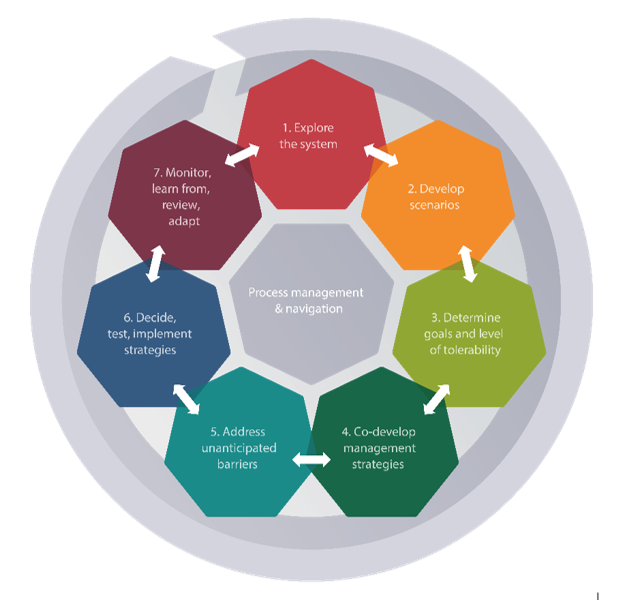
The guidelines comprise seven interlinked steps to:
- Step 1 Explore the system in which the organisation operates; define the boundaries of the system and the organisation’s position in a dynamic environment.
- Step 2 Develop scenarios, considering ongoing and potential future transitions.
- Step 3 Determine goals and the level of tolerability for risk and uncertainty.
- Step 4 Co-develop management strategies to deal with each scenario and the systemic risks that affect or may affect the organisation, and to navigate the transition.
- Step 5 Address unanticipated barriers and sudden critical shifts that may come up during the process.
- Step 6 Decide, test and implement strategies.
- Step 7 Monitor, learn from, review and adapt.
In the face of many unknowns, increasing the overall resilience of an organisation can be a way to prepare for and better deal with the shocks and stresses arising from systemic risks. In line with mainstream recommendations for resilience building, the IRGC suggests three main strategic approaches for governing systemic risks in the context of transitions:
- Support and strengthen the ability of a system to self-organise and self-control
- Engage in pro-active intervention strategies:
– Prevention
– Mitigation
– Adaptation
– Transformation - Prepare for disruptions, accidents and crises
These strategies can be combined or implemented successively if proximity to a regime shift seems to increase.
There must be iteration between the steps, orchestrated by a facilitator. At all stages, communication, openness and transparency are key to ensure smooth proceedings. Collaboration, learning together and experimentation are essential for improving an organisation’s capacity to deal with systemic risks. This can be organised by a ‘navigator’, who also has the task of organising some form of ownership for systemic risks.
Paul Pangaro’s description of CLEAT, as a conversation model of Gordon Pask’s Conversation Theory – via Steve Hertzberg on LinkedIn
See the discussion on LinkedIn – and Paul’s further links etc.
Steven Hertzberg
A video we share & discuss with every new team member. Paul Pangaro’s description of CLEAT, as a conversation model of Gordon Pask’s Conversation Theory, is an essential foundation for collaborating with Grey Swan Digital.hashtag#cybernetics hashtag#complexity
via LinkedIn
The Art of Navigating Complexity – The Garfield Foundation – Medium
via The Art of Navigating Complexity – The Garfield Foundation – Medium
The Art of Navigating Complexity
Designing change in our complex world

Sep 17, 2019 · 8 min read
“An Approach for the Development of Complex Systems Archetypes” by Walter Lee Akers (2015)
via “An Approach for the Development of Complex Systems Archetypes” by Walter Lee Akers
Date of Award
Fall 2015
Document Type
Dissertation
Degree Name
Doctor of Philosophy (PhD)
Department
Engineering Management
Committee Director
Charles B. Keating
Committee Member
Adrian Gheorghe
Committee Member
Andres Sousa-Poza
Committee Member
Andrew Hutton
Abstract
The purpose of this research is to explore the principles and concepts of systems theory in pursuit of a collection of complex systems archetypes that can be used for system exploration and diagnostics. The study begins with an examination of the archetypes and classification systems that already exist in the domain of systems theory. This review includes a critique of their purpose, structure, and general applicability. The research then develops and employs a new approach to grounded theory, using a visual coding model to explore the origins, relationships, and meanings of the principles of systems theory. The goal of the visual grounded theory approach is to identity underlying, recurrent imagery in the systems literature that will form the basis for the archetypes.
Using coding models derived from the literature, the study then examines the interrelationships between system principles. These relationships are used to clearly define the environment where the archetypes are found in terms of energy, entropy and time. A collection of complex system archetypes is then derived which are firmly rooted in the literature, as well as being demonstrably manifested in the real world. The definitions of the emerging complex systems archetypes are consistent with the environmental definition and are governed by the system’s behavior related to energy collection, entropy displacement, and the pursuit of viability.
Once the archetypes have been identified, this study examines the similarities and differences that distinguish them. The individual system principles that either define or differentiate each of the archetypes are described, and real-world manifestations of the archetypes are discussed. The collection of archetypes is then examined as a continuum, where they are related to one another in terms of energy use, entropy accumulation, self-modification and external-modification.
To illustrate the applicability of these archetypes, a case study is undertaken which examines a medium-sized organization with multiple departments in an industrial setting. The individual departments are discussed in detail, and their archetypical forms are identified and described. Finally, the study examines future applications for the archetypes and other research that might enhance their utility for complex systems governance.
A Techno-Philosophical Perspective on How Acceleration Becomes Autopoietic Simplification as a Function of Technology, Liu (2019)
h/t Ivo Velitchkov
via – Philosophy Documentation Center
Techné: Research in Philosophy and Technology
ONLINE FIRST
published on September 7, 2019
Yu-cheng Liu
DOI: 10.5840/techne201993102
A Techno-Philosophical Perspective on How Acceleration Becomes Autopoietic
Simplification as a Function of Technology
This study examines mainly two subjects: “Why do we accelerate?” and “How does acceleration become autopoietic?” The answers to these questions may be derived from technical, social, or psychological approaches. However, they provide only an incomplete picture if a perspective from the philosophy of technology is not considered alongside. In addition to offering different viewpoints on the essence of technology, technics, or technē, this study will focus on the notion of distance as a key to answering the above questions. Conventionally, people usually understand that technology distances humans from nature. However, what does that mean? First of all, the idea of “nature” considered in this research refers to a distinction of non-nature/nature. A distinction implies a distance between both sides. Technology belongs to the side of non-nature, and creates a distance with the other side. The distance is getting enlarged when humans depend heavily on technology to reconnect humans to nature. In shortening or overcoming the distance, acceleration becomes autopoietic and leads to a paradox that can be unfolded only through accelerating more. In this study, technology is considered as a system functioning as simplification to create and to overcome alternately a distance with its environment, including nature. Through which technology not only acquires a tendency of acceleration, but also self-produces it. The development of writing tools from knots to tactile technology is investigated to provide a better understanding of the phenomenon of acceleration and its impact on humans and the world. In the end, it may be possible to think of a general theory of how acceleration becomes autopoietic.
Radical uncertainty – John Kay
I’m at the #undaunted conference today – https://www.eventbrite.co.uk/e/how-successful-leaders-face-wicked-challenges-avoid-predictable-surprises-tickets-89753510165 / https://159927be-a39d-4fcd-8591-21ed0d80d52b.filesusr.com/ugd/62df63_e8d641e8d07249e7a9a3b0d0c94a33e2.pdf (I’m attending because of some speakers I wanted to see, and the potential of there being a challenge to assumptions about ‘VUCA’ness and responses thereto).
John Kay is popping in to do a talk at lunch, which led me to this nice story (perhaps a myth) below – and the responses linked under. ‘Radical uncertainty’ is a new and clearer, interesting framing to me. I bet there’s a lot about it on lesswrong.com. It seems to me to be valuable at the level of thinking – perhaps leading directly to metarationality – and dangerous if it leads you to empty scepticism…
(Plus, I have an intuitive dislike of the idea of Ramsey being fundamentally wrong)
via Embrace radical uncertainty – John Kay

Embrace radical uncertainty
Between 1920 and 1950, a debate took place which defined the future of economics in the second half of the 20th century. On one side were John Maynard Keynes and Frank Knight; on the other, Frank Ramsey and Jimmie Savage.
Knight and Keynes believed in the ubiquity of “radical uncertainty”. Not only did we not know what was going to happen, we had a very limited ability to even describe the things that might happen. They distinguished risk, which could be described with the aid of probabilities, from real uncertainty—which could not. In Knight’s world, such uncertainties gave rise to the profit opportunities which were the dynamic of a capitalist economy. Keynes saw these uncertainties as at the root of the inevitable instability in such economies.
Their opponents insisted instead that all uncertainties could be described probabilistically. And their opponents won, not least because their probabilistic world was convenient: it could be described axiomatically and mathematically.
It is difficult to exaggerate the practical consequence of the outcome of that technical argument. To acknowledge the role of radical uncertainty is to knock away the foundations of finance theory and much modern macroeconomics. But the reigning consensus is beset with glaring weaknesses. Keynes and Knight were right, and their opponents wrong. And recognition of that is a necessary preliminary to the rebuilding of a more relevant economic theory.
John Kay and Mervyn King are writing a book on “radical uncertainty” to be published in 2019. Find out what another 12 leading economists think are the greatest challenges facing the discipline here.
via Embrace radical uncertainty – John Kay
Another John Kay piece:
https://www.ft.com/content/f7660898-e538-11e1-8ac0-00144feab49a
However, this piece does problematise the base position – “Keynes Presented No Concept of ‘radical Uncertainty’ in the General Theory or in Any Other Published Work in His Lifetime”
https://www.researchgate.net/publication/326027297_Keynes_Presented_No_Concept_of_’radical_Uncertainty’_in_the_General_Theory_or_in_Any_Other_Published_Work_in_His_Lifetime_”even_though_It_Be_on_Precarious_Evidencee’_Does_not_Translate_as_No_Evidence
W00t! OK, there is a lot on lesswrong (nothing on ribbonfarm) – and what is more, it’s from my hero David Chapman:
https://www.lesswrong.com/posts/MpyDtSPyhfkNHS25u/probability-and-radical-uncertainty
I’ll just say two things about this:
- the skill and practice of metarationality is holding radical uncertainty true while deciding how to act
- we have to apply radical uncertainty to itself
Systems thinking – UK central government (Cabinet Office) thing/team
Exciting stuff – there is now a team in the UK Cabinet Office / an aspiration for there to be a movement across UK public services which is roughly called ‘systems thinking’ (I understand that naming discussions are ongoing).
They have a circular logo which reads ‘the system is the solution’ or alternatively ‘the solution is the system’.
Blog homepage here: Systems thinking (you can subscribe by email)
[My interest – apart from my obsession with systems thinking and public service transformation per se – is that I run the Public Service Transformation Academy – www.publicservicetransformation.org– which delivers amongst other things the Cabinet Office Commissioning Academy on behalf of the UK government, and is dedicated to helping people find more effective ways of thinking and working where things are inherently transdisciplinary]
Folks in the team/movement reading this – please remember that nitpicking is really grooming which is an act of social contribution for we primates 😉
Content so far:
The team – https://systemsthinking.blog.gov.uk/author/the-team/ (which conspicuously doesn’t list the team)
Join the movement – https://systemsthinking.blog.gov.uk/2020/03/05/join-the-movement/ (which asks for people to get in touch and comment via the comments)
10 tips for systems leaders – https://systemsthinking.blog.gov.uk/2020/03/05/10-tips-for-systems-leaders/
My thoughts and comments, inspired by this tweet from Mikael Seppälä:
Homepage
We want to help people across the public sector apply systems thinking to complex problems. So if you want to find out more about how this approach can improve people’s lives, subscribe to our blog. (And a different logo, subtitled ‘exploring the power of systems to solve complex problems).
I think this sets a framing quite nicely. There’s a hint in the subtitle of ‘systems in the world’ being considered rather than ‘systems in the mind’ (thinking about ‘the system’), and a focus on ‘complex’ problems, and cross-public sector working.
And this is ‘helping people across the public sector’ and ‘improv[ing] people’s lives’. Interesting!
Join the movement
Government has a responsibility to help people with complex problems. Supporting people who’ve lost their ability to work due to poor health or disability, for example, is not easy.
So there is a focus here on Poor Sick Miserable People (PSMP) (individuals), and their complex problems – and the difficulty of helping them.
For someone who is struggling to make ends meet, the last thing they care about is how government is organised – they just want services to work and respond to their needs. But the way government has evolved over the years, into separate, sometimes competing departments makes using a joined-up approach to solve citizens’ problems really hard.
We need to fix this and we think now is the right time to start.
The Systems Unit helps people across the public sector apply systems thinking to complex problems.
So here is complexity on the government ‘side’, mismatching the complexity of government’s silos. Now may be the time to mention that this does appear to be a perspective that you would be likely to have if you were in departmentalised central government; government as a thing (maybe even as a system). These problems are also inherent in local policy and delivery; I just think that they would be expressed differently.
This is a bit of a needs/deficit orientation perhaps, and very much a ‘service provision’ view of government here.
A different way of thinking about complex problems
In early 2019, we started working on a different approach for delivering services that work better for citizens, called the Strategic Framework. It is an approach that puts citizens first and delivers results by creating joined-up solutions. We want to bring people together across government. We want to involve everyone, the whole system when we design solutions, with all the benefits that a diverse community of ideas can bring.
We believe systems thinking has the potential to help solve the most complex problems of our time, from healthcare to climate change. Goals like sustainability, security, prosperity and wellbeing cut across departmental boundaries and touch on the lives of every citizen. They demand a system-wide approach.
Intriguing that there is an underlying ‘approach’ being worked on here – and this nicely brings the ‘citizens first’ and joining up together. Bringing people together across government is different from ‘involving everyone’, of course, and again might tend to separate community out from ‘government’. This is consistent with government-set goals which ‘cut across departmental boundaries and touch on the lives of every citizen’.
And, again, a ‘system-wide approach’ is very systems-in-the-world, even perhaps implicitly seeing government as a system (and a whole system).
And a nod to the nice nuance of the shift in government diversity language to valuing diverse ideas.
Getting the right people in the room
For those who are leaders, through the National Leadership Centre (NLC) and the Public Sector Leadership Group (PSLG), we are developing new ways to grow cross-government collaboration at the strategic level, bringing together the diverse talents and experience of people like Perm Secs, Director Generals, Chief Constables and heads of NHS trusts.
And we’re also supporting a programme of demonstrator projects to show how solutions that cut across departmental boundaries could work. One of these looks at the experience of prison leavers and the social problems they face, such as reoffending. By getting the right people in the room, leaders, policy officials, charities, and frontline staff to hear directly from prison leavers about their experiences, we can foster a sense of shared ownership of the problem, and start to plan solutions that cut across the divisions within government.
So there is a focus on the people at the top of the hierarchy, again connecting to people with complex needs (prison leavers – though characterising reoffending as a ‘social problem faced by prison leavers’ is intriguing). A ‘whole system in the room’ perspective – but again it is those with power ‘hearing directly’ from those with the problem, in order to share the problem, and work across government to solve. Problem-solution thinking, the ownership of the problem is really with the PSMB but the powerful are able to take this problem on and solve it for them.
Help us build a movement
Systems leadership is not just for leaders. It’s about us all reimagining the way we think about government.
Help us do it. Leave a comment, share your ideas and get in touch below.
It’s interesting – this is the first time ‘systems leadership’ has been mentioned – and I must say that none of the above sounds particularly like reimagining the way we think about government. Having a movement as well as a team and a framework is really interesting and exciting – it will be interesting to see how the shared power requirements of a movement can square with the intuitive and actual centralising pull of the Cabinet Office!
10 tips for systems leaders
This is where we get to some of the exciting centre of how they see this making a difference! It’s another example of nitpicking (or perhaps nuance) which I’m inevitably indulging in here to pick up the fact that ‘systems leaders’ is the heading, not ‘systems leadership’ (or ‘leading’); I’m a bit worried that there’s a pull to senior leaders in the hierarchy…
A system is a group of individuals or an organisation working together or interacting as part of a network. We believe that everyone in the public sector should be a systems leader.
That means being a leader in a system, rather than a leader of a system. Here are ten tips to help you embrace your inner systems leader.
BUT ‘everyone should be a systems leader’ is exciting. OK – perhaps interesting that this is everyone ‘in the public sector’ – perhaps another hint that this very concrete conception of a system is ‘the public sector’. AND ‘leader in a system’ (thinking of yourself as a leader in a system) couldn’t really be better, in my opinion.
To allow my nitpicking full sway, though, the concept of ‘inner systems leader’ makes me worry about a focus on individual behaviours and capacities rather than systems impact.
1. Put the citizen at the centre
From the moment you scope out a problem to the moment you start designing a solution, you should put the citizen at the centre. It’s also important to establish collective understanding of situation, identify mutual areas of interest, and the shared vision of the outcome you want.
OK – so the problem-solving focus from problem scoping to solution design is why I said in the tweets that this looks like ‘service design writ large’ – with implications of seeing ‘the service system’ as distinct from the citizen, the citizen as a disempowered individual (not a problem-solver, not part of a community with its own strengths), of an ‘intervention’ (problem to solution, albeit with complications), not an ongoing living system with feedback loops. What citizen at the centre actually means is really critical.
Collective understanding, mutual areas of interest, and shared vision is much more of a whole-system perspective; probably reflective of ‘system in a room’ large group facilitation processes such as FutureSearch.
Mikael picked up the idea of a systems approach tending to promote ‘polycentric value’ – starting from ‘citizen value’ is, of course, the best single starting point (how it is then defined is important), but it’s interesting that when this is singled out and becomes the focus, we see the perspectives of stakeholders (2) and those with power (3-10) come in as complications to be navigated through to achieve the results determined by (1).
2. Mobilise people
Identify partners across the system and work to understand their perspectives. Challenge your assumptions on who is relevant and who isn’t. If everyone is familiar to you, then perhaps you haven’t mapped widely enough. You should encourage people in your teams to build networks too. Recognise all perspectives are valid. Look to build relationships around areas of mutual interest.
Lots of good challenges to preconceptions here! ‘All perspectives are valid’ probably requires some explanation (this is obviously a lot of work and a highly condensed list), but the polycentric value is coming in strongly here. But I can imagine (sorry!) this being though about as focused entirely on a central government set of people and stakeholders…
I’m intrigued by the implied focus on systems mapping. And the ‘encourage people in your teams to build networks too’ – this feels like adding in good thinking perhaps from a different perspective and text.
3. Keep learning
Take the time to learn about the situation. Be realistic about the time it will take to undertake the work. This may involve managing expectations of others.
Very good, of course – again from a project-based problem-solving perspective. I’d like to see the implication that this kind of approach is counter-cultural (embedded in ‘managing expectations of others’) explored more fully – in a sense, it is in all the below, but slipping into the framing of projects and business cases will always put this kind of work on the back foot; an entirely different way of thinking needs to be generated.
4. Promote collective leadership
Try to prioritise building trust and a good working relationship with people across the system. This takes time but go for informal coffees and actively listen.
Great stuff. The descent into the particular is always hard to communicate and revealing of preconceptions. People in Westminster (and around the country) go for informal coffees – people making a difference in communities might perhaps use different language.
5. Work through tension
Tension and conflict are to be expected, so try to focus on the areas of mutual interest. Identify incentives. You shouldn’t seek to change or block others plans unless they seriously undermine the collective endeavour.
I’d love to hear about the thinking behind this; this is a hugely important area, of course. The text feels like pulling away from ‘working through’ tension, into the risk of avoiding tension. Again, this seems to map well to people trying to achieve change without disruption within the civil service.
6. Navigate the politics
Do your best to navigate through the internal and national politics. It’s a worthwhile thing to do given the long term nature of systems change. Understand power structures, including where informal power lies, organisational structures, reporting lines, decision rights, accountabilities as well as culture and history.
Now the concept (and movement/methodologies) of ‘systems change’ are invoked. Brilliant to see power structures addressed (certainly from an institutional perspective), and an acknowledgement that big change in systems may take a long time. And very brave and helpful to have national (‘big P’) politics acknowledged as well. This is focused on addressing power structures as they have emerged (and perhaps concretised and fixed) from underlying systems, but the very fact that these power structures have emerged rather than being a given is important, I think.
Culture and history nicely included.
7. Be flexible. Co-create solutions
Be flexible in co-creating solutions by encouraging iteration, adaptation and evolution. Don’t start with a fixed idea of what the right answer looks like.
Absolutely splendid points to make.
8. Secure resource commitments
Secure commitments from the system. Invest in a small central secretariat function ideally staffed from different stakeholders. Get the right people in the room regardless of grade. The person with the highest grade may not be the right person.
Not to labour the point; these are civil service words. If this is the focus of ‘secure commitments from the system’, the system is too narrowly conceived.
9. Establish accountability
Work out who is accountable for what. People should have a clear mandate to operate. Agree how to monitor progress, setting appropriate targets for the stage of project.
Yes – accountability is central. People need to know their discretion of work; what is their work to do; what are the boundaries.
And no – projects and targets have implications, which are likely to undermine all this good thinking. People will say that the learning about how to work in complexity would suggest that projects with fixed plans and targets are a bad way to achieve this; I’d point out that this applies to the complicated also.
The risk is we are talking about ‘long-term underlying change with the citizen at the centre, delivered in a way which respects current paradigms and doesn’t ruffle feathers or change the current assumptions of the system’. That’s like trying to tie your shoes with one hand tied behind your back…
10. Work out the risk appetite
Work out the level of risk different stakeholders are prepared to accept. Agree a shared approach to risk across the system.
Risk awareness is obviously valuable and critical; it’s notable that risk, but not benefits, is identified here… but this is like tying the other hand behind your back if you’re not careful 😉
These top tips were developed by the Cross-government Systems Leadership and Accountability Group sponsored by Nick Dyer and Paul Kett. This group is made up of volunteers from the Department for Education (DfE), Department for International Development (DfID) and Her Majesty’s Revenue and Customs (HMRC). Thank you to everyone who helped shape and develop these tips. Particular thanks go to Karen Clark from the Organisation Development, Design and Learning Expert Service.
So I think this is a good pragmatic starting guide to ‘how to use some systems thinking tools in implementing larger-scale service design for central government to join up to provide better services for people in need’. A worthy goal indeed, and if this thinking is reflected on itself, there are perhaps some paradigm shifts well beyond this goal which could be conceived of and even achieved.
Meta-Rationality in Cognitive Science – Stanovich (2015)
via now publishers – Meta-Rationality in Cognitive Science
Meta-Rationality in Cognitive Science
Keith E. Stanovich, University of Toronto, Canada, keith.stanovich@utoronto.ca
Suggested Citation
Keith E. Stanovich (2015), “Meta-Rationality in Cognitive Science”, Journal of Marketing Behavior: Vol. 1: No. 2, pp 147-156. http://dx.doi.org/10.1561/107.00000009
Published: 21 Oct 2015
© 2015 K. E. Stanovich
Login to download a free copy
In this article:
1. Metarepresentational Issues in the Literature Under Discussion
2. Meta-Rationality and Norms
References
Abstract
The great rationality debate in cognitive science (Tetlock and Mellers 2002) has largely been conducted with a narrow view of human rationality in mind. A minority voice in the debate has been theorists who take a broader view of rationality — one that does not accept current desires and goals is given and that takes a longer view of decisions throughout a person’s life. Schwartz’s target article is clearly in the tradition of those advocating a broader view of how we conceive rationality. It has many affinities with the meta-rationality that I have previously advocated for decision science.
DOI:10.1561/107.00000009

