Hayek: The Knowledge Problem – Jeffrey A Tucker, Foundation for Economic Education

via Hayek: The Knowledge Problem – Foundation for Economic Education

Hayek: The Knowledge Problem

We must stand humble before complexity and order without planning

F.A. Hayek is an epic figure in the history of human freedom. He stood for liberty at a time when most intellectuals in the world embraced ideologies of command and control. His literary legacy continues to provide some of the most powerful arguments ever made for the depoliticization of the social order, including its commercial life.

But, in my personal experience, he can also be one of the most difficult thinkers to grasp.

After F.A. Hayek died in 1992, for example, a magazine commissioned me to do a final tribute to his life and work, summing up his main contributions. It was supposed to be for a popular audience. There’s nothing like such a writing assignment to reveal how much you actually know — or do not know — about a subject.

I thought it was going to be a snap. I covered his biography and politics just fine; I mentioned his business-cycle studies and his work on capital theory. But of course his main contribution to the world of social science is summed up in the phrase “the knowledge problem.” Even though I read most of his major work, and read his seminal articles on the problem of knowledge, I was stunned to find myself with writer’s block.

What I came to realize is that I didn’t understand, much less appreciate, his writing on this topic. So I covered the basics (the knowledge needed to run the social order is distributed in individual minds and inaccessible to planners), but my heart wasn’t in it. That’s where matters stood for me for about twenty years.

I tried to make an effort to get how it was that Hayek was able to write vast literature on this one subject, why his seminal article “The Use of Knowledge in Society” was the most cited article in the second half of the twentieth century, why innumerable dissertations have been written on Hayek’s insight, and why he has influenced countless scholars in so many disciplines for so long.

Part of the problem is that Hayek did not always write with his logic and conclusions on his sleeve. His rhetorical style is not so much hortatory or doctrinaire as it is searching and exploratory. You get the sense that he is thinking through an issue as he writes, struggling to find the right combination of words, the right phrasing, the right examples, to capture his insight — which always seems to be unfolding in real time rather than stated like a final product for consumption.

For someone who is looking for final answers and pure theory, this type of writing can be frustrating. There was the additional problem that Hayek can just be downright annoying in places, contradicting himself by endorsing political programs at odds with his own theory. He also has a habit of backing away from the hardest conclusions of his own narrative. If you seek a clear definition of ideas like freedom or property rights in Hayek’s work, you will come away disappointed. He often seemed so consumed by the complexity of the world that he shied away from clarity for fear that he had missed something. For readers looking for ironclad deductions and arguments, his approach can give the impression of being an elaborate display of obscurantism.

In order to understand Hayek and to learn from him, you have to be prepared to think alongside him as he writes. His work presumes an open mind that is ready to think about complex topics, most often from the inside out. He is asking and seeking to answer a completely different set of questions than most people are even willing to consider. Most readers are not prepared to consider them. This is a point it took me many years to understand.

What changed for me? I needed a visual application of the knowledge problem, something that connected the theory with reality. This happened to me at a bar atop one of the highest spots in São Paulo, Brazil, a spot where you could make a complete turn and see the lights of the city as far as you looked. It was a world without end, in all directions.

I was overwhelmed at its utter incomprehensibility. It was too much for my mind because it is too much for any mind. The revelation hit me like a truck: this is an order that no one can possibly comprehend in either its totality or its parts, and, as such, an order that no one can possibly control. It cannot be built by anyone in particular; it is built only by an extended and hyper-complex process that is driven by individual minds that takes many generations to unfold.

It can only be harmed by those who would presume to control it — and the bureaucrats and politicians in this city surely do. The regulators can pass regulations. The planners can order buildings built and torn down. They can loot those who are willing to comply. But, in the end, in this city of more than 11 million people, even in the presence of overweening government, society somehow takes its own course. How this happens and why cries out for explanation.

“The knowledge of the circumstances of which we must make use never exists in concentrated or integrated form,” explains Hayek, “but solely as the dispersed bits of incomplete and frequently contradictory knowledge which all the separate individuals possess.”

I came to realize, right there, that this is not just about São Paulo. It’s about any city in the world. In fact, it’s about every social setting, large or small. It’s about the whole world. Only individuals possess the knowledge that nearly all social scientists — and bureaucracies — imagine that they can, must, and do possess. Anyone who seeks to control the social order is presuming that the unanswerable questions are already answered and proceeds from that point. Hayek is digging deeper to observe that we cannot possibly know what we must know if we seek to design much less rule the world. The knowledge is dispersed and, by its nature, uncollectible.

Is Hayek describing a world of disconnected chaos and uncoordinated randomness, a nihilistic social order of swirling unpredictability? That is not the world in which we live. Why not? Because of the existence of institutions like prices, mores, habits, signaling systems of culture and learning — of knowledge that we all possess, not always consciously but mostly inchoately. They are institutions that we ourselves have not created, but they assist us in making the most of our lives.

“We make constant use of formulas, symbols, and rules whose meaning we do not understand,” writes Hayek, “and through the use of which we avail ourselves of the assistance of knowledge which individually we do not possess. We have developed these practices and institutions by building upon habits and institutions which have proved successful in their own sphere and which have in turn become the foundation of the civilization we have built up.”

As I stood at the same bar in São Paulo looking all around me, my vision changed from macrocosm to microcosm. I observed two people standing close by. They were embracing, kissing intimately. I wondered whether this was a first date or if they had been together for many years. I had no access to that information, and nothing they did gave me the answer. They seemed to be courting each other but at what level and in what way I could not know. And yet this information was foundational to everything both of them were thinking at the time. To truly understand this relationship, I would have to know not just something but countless bits of information I could not really know.

What’s more, even this two-person society was not comprehensible to the two people themselves. Part of the spark of their relationship was the emotional dance they were engaged in right there on the spot. Their intimacy was their means of accessing, however incompletely and briefly, the true spirit of the other’s intellectual and emotional state of mind. They can come close, through every means available, but never entirely achieve that oneness for which true love strives.

Even so, both people in this two-person society were seeking longingly and lovingly for the ideal, coordinating their actions through shared cues, language, and symbols. And in so doing, they created their own micro-order right there, as had everyone else in that bar, as has every one of the 11 million people in that city, as has every one of the 7 billion people on this planet.

We all seek some form of individuality but also a connection to others. We can create institutions to make this possible, but mostly we embed ourselves within them. The institutions emerge from within the structure of our shared experience, chosen and not imposed, and we gravitate toward those who work and eschew those who don’t, in an ever-evolving process of discovery.

Let’s say you set out to plan the world. “If we possess all the relevant information,” writes Hayek, “if we can start out from a given system of preferences, and if we command complete knowledge of available means, the problem which remains is purely one of logic.” We only need to plug in the right data into our calculus and issue orders. The problem is that this solution presumes that the unsolvable problem — gaining that information — has already been solved.

What is the significance of this revelation? It lays waste to a century — or many centuries — of intellectual pretense. The social order is built by the coordination of plans. If those plans are always individual plans, radically individuated and subjectivized, coordinated only through evolved institutions created by no one in particular, the dreams of every would-be master of the universe come crashing down.

The most obvious conclusion is also the most powerful one from a political point of view. The source of order is not the government, even though people continue to believe that despite all evidence. The bureaucratic class and the politicians who empower that class are no more or less smart than you and I are. They are just people with no special insight. Because of government’s legal right to plunder, the government is corrupt and exploitative. It takes stuff from people. That’s about the whole of it. It is not the source of anyone’s order.

What then is the source of social order? It is our individual minds, however imperfect they may be in making judgments about our world. Freedom is the only real option there is. Anything else is based on a lie — a “pretense of knowledge,” as Hayek would say. Anything that subverts that freedom, which means any state at all, amounts to an attack on the very source of social order.

“If we can agree that the economic problem of society is mainly one of rapid adaptation to changes in the particular circumstances of time and place,” Hayek concludes, “it would seem to follow that the ultimate decisions must be left to the people who are familiar with these circumstances, who know directly of the relevant changes and of the resources immediately available to meet them.

We cannot expect that this problem will be solved by first communicating all this knowledge to a central board which, after integrating all knowledge, issues its orders. We must solve it by some form of decentralization. But this answers only part of our problem. We need decentralization because only thus can we insure that the knowledge of the particular circumstances of time and place will be promptly used.

I’m drawn to Hayek’s use of the terms “immediately” and “promptly.” With these words he introduces the ultimate enemy of all those who would control the world: the passage of time. With the existence of time comes change, and with change comes new and different knowledge. Even if it were possible somehow to gain a complete snapshot of the world with all its existing knowledge, by the time it could be used for any purpose to bend the world from its course to another, that knowledge would be outdated and hence useless. Even under the best circumstances, the planners would only be planning the past.

Here, then, is the knowledge problem. It is about more than the ability to plan an economy. It is about the whole of our lives. It is about the ability to plan and direct the course of civilization. That capacity to manage the world, even the smallest part of it, will always and everywhere elude our grasp. That’s a beautiful insight, because it reveals the truth about human freedom.
Freedom is not just one way to organize society. It is the only way.

Social Labs and Collaborative Approaches to Systems Change: Live Discussion March 13, 2020, 1:30-2:30pm EDT/17:30-18:30 GMT | Cost: Free

via Social Labs and Collaborative Approaches to Systems Change: Live Discussion – YouTube

Social Labs and Collaborative Approaches to Systems Change: Live Discussion
March 13, 2020, 1:30-2:30pm EDT/17:30-18:30 GMT | Cost: Free
In this live discussion, we will be exploring collaborative approaches to systems change, in particular the idea and practice of social labs. Variously referred to as systems innovation labs, living labs, change labs, collaborative innovation networks, co-labs, or social labs all may be thought of as a way of doing social innovation and systems change in practice through creating platforms for collaboration. Hosted by Systems Innovation.

Panelists:

Zaid Hassan of 10 in 10,

Charlotte Hochman of Wow!Labs,

Russ Gaskin of CoCreative, and

Stephanie Daniels of Sustainable Food Labs.

Youtube event link (for viewers): https://www.youtube.com/watch?v=fNpVXzjAIjg

Social Labs and Collaborative Approaches to Systems Change: Live Discussion

52.1K subscribers

The complex challenges of today – such as inequality, environmental changes, financial instability, etc. – can’t be tackled by any one organization, but require the collaborative effort of many. What is needed are open spaces that bring the relevant participants together, provide them with the tools and methodology to guide them through an experimental process for them to understand the issues they face and start to collaboratively build new solutions.  In this live discussion, we will be exploring collaborative approaches to systems change, in particular the idea and practice of social labs. Variously referred to as systems innovation labs, living labs, change labs, co-labs or social labs all may be thought of as a way of doing social innovation and systems change in practice through creating platforms for collaboration.  Guest speakers: Zaid Hassan – CEO of 10 in 10 Author of “The Social Labs Revolution: A new approach to solving our most complex challenges” Zaid is a highly experienced facilitator, who has over fifteen years of experience supporting multi-stakeholder innovation working with governments, civil society and corporations. Recent clients include The World Bank, The UN Foundation, Oxfam, GIZ, the Governments of New Zealand and Canada. Russ Gaskin – Managing Director of CoCreative Consulting Rus helps people who don’t know each other and often don’t even like each other solve complex problems together. His team at CoCreative currently supports 18 multistakeholder innovation networks working on challenges like sequestering atmospheric carbon through agriculture, aligning bank lending with climate realities, closing racial equity gaps in health and education, and shifting upstream determinants of health. Charlotte Hochman – Founder of Wow!Labs Charlotte Hochman has spent the last 15 years building capacity for social innovation in civil society, the private and the public sectors. Her expertise is in developing tools and projects to catalyse people’s capacity to innovate and create start-ups in response to global challenges. She is the Co-Founder of Wow!Labs and PLACE, a hub built to change the narrative around refugees by linking migration to innovation and the Future of Work. The guests are joined by the host Bowen Feng, Community Manager at Systems Innovation. —————————— What are your thoughts? We’d love to hear your feedback on this live discussion, as well as any suggestions for future ones: https://forms.gle/9yXfPZp7rDs9M6XBA Enjoy our videos and get value out of our channel? Consider becoming an Si Supporter: https://bit.ly/2ycThOp

Speech Acts | On living and working – Justine Wise

via Speech Acts | On living and working

Speech Acts

One of the great contributions of the philosophers John Austin, in the mid-20th century, and John Searle, who is still active today, has been an important claim about language. While a large part of philosophy of language looked at how language describes the world, they became interested in how language changes the world.

All human action, they point out, is coordinated through language. Speaking is rarely just speaking about something. It’s more often an act through which we make it possible to do things in conjunction with others, taking up and putting down commitments so we can pursue the possibilities that are important to us.

This week’s writing here will be dedicated to this topic. We’ll start by exploring three different conversations that make action with others possible, and the many muddles and mistakes that can be avoided by knowing which is which, and which is called for in any moment.

And then we’ll explore conversations for action in more depth – in particular how requests and promises work and don’t work, and what we can do to improve our use of them.

There’s so much to discover by looking closely at all this, because many of the difficulties we face, and much of our wastefulness, can be tackled by developing skill in speaking and listening.

You could start to explore this topic by observing yourself closely over the next few days. Look for all the ways in which you run into difficulty in coordinating with other people. Look closely in particular at all the times what you asked of others didn’t happen, or at least not in the way you intended.

And look too at all those times when you brought your best effort and intentions to a project only to find that it wasn’t needed, wasn’t appreciated, or that what you’d been doing was not quite what other people had hoped.

And let’s see if, by studying this topic, we can improve things together.

—

You can read more on ‘Speech Acts’ – conversations, requests and promises – here.

Conversations for Action – Fernando Flores

via CFA Playground | Conversations for Action

An interactive website from 2016 (or possibly earlier?) with overviews of each chapter, sample downloads and interactive tools:

CFA PLAYGROUND

In order for action to occur between two people, one person must make a request or an offer to get things started. If no one makes a request, or no one makes an offer, nothing is going to happen between them!

Once a request or an offer is made, then the ball is on the other person to determine what happens next, and so forth, until the person making the request, or accepting an offer, is satisfied.

This playground will let you select the action of the customer or performer by letting you click the circle that represent the actions.Just try it out to get the flow. For example, after a request is made, typically the performer will agree to it, but she may also counter-offer or just decline it.

If you engage with the tool, we would appreciate your feedback

System Thinking for Service Design Inspirations – Yulya’s blog – Medium

via System Thinking for Service Design Inspirations – Yulya’s blog – Medium

System Thinking for Service Design Inspirations

Yulya Besplemennova
May 1, 2018 · 6 min read

As a designer with a master degree in Product-Service System Design I was always interested in systems thinking and its applications to my professional practice. At Oblo, where I work as a service designer, we always try to integrate it in our way of doing service design by mixing ethnography, visual storytelling and participatory design.

This year I was lucky to attend Interaction18 conference and got very much moved by the fact that half of keynote speeches were about the various aspects of systems thinking in design. And so I wanted to share some interesting insights from the talk that can help us in the practice

Continues in source: System Thinking for Service Design Inspirations – Yulya’s blog – Medium

Do Systems Exist? A continued chat about systems thinking with Liam Mahon – Mon, May 11, 2020 at 12:00 PM BST

via Do Systems Exist? A continued chat about systems thinking Tickets, Mon, May 11, 2020 at 12:00 PM | Eventbrite

MAY 11

Do Systems Exist? A continued chat about systems thinking

Event Information

Description

Known on Twitter as the @SystemsNinja, Liam hosted an initial chat about an over used phrase “The System’. It was a popular one and the group asked for more! This time we will be asking the group to suggest a sector or industry to exlore and try to unpick how we might positions systems thinking in that context.

We often hear people blame the system for preventing progress, but what do we really mean when we say that? and how does it hinder our thinking about creating and responding to change?

Date And Time

Mon, May 11, 2020

12:00 PM – 1:00 PM BST

Add to Calendar

Location

This is an online chat

Zoom link:https://mutualgain.zoom.us/j/93918180367


Lasse Gerrits on Twitter: “Here is a question for the #complexity people out there: which thinker / author / practitioner etc. drew you into (social) complexity?


Versions of Complexity · Ways of Seeing

Ways of Seeing a blog by Nitzan Hermon
Versions of Complexity
07 Apr 2020
I have had the pleasure of co–teaching Complexity by Design at Parsons SDM last semester, and engage with wonderful thinkers and institutes in this space.

It is becoming increasingly clear that complexity thinking (definition to come later) is a core part of modern life. This was discussed in different circles before we all got into this state of unknowingness.

I have been working with a very acute definition of complexity, but given that the field is emerging (no pun intended) I wanted to linger a moment on its positionality.

I have been working with 2.5 versions of complexity: a partial list of links and resources to follow.

V1: Scientific:
Santa Fe Institute, and their Complexity Explorers Group on FB

New England Complex Systems Institute

MIT Center for Collective Intelligence

Scale: The Universal Laws of Growth, Innovation, Sustainability, and the Pace of Life in Organisms, Cities, Economies, and Companies

other topics include: chaos, fractals, bio-mimicry, modeling, netLOGO

V2: Management
Jennifer Garvey Berger’s books

Cynefin Framework

Robert Kegan

The Standing Ovation Problem

V 2.5: self leading
A lot of the leadership advice, individuation, Jungian ideas of synchronicity, and adjacent thinking on signifiers and semiotics are all very much complexity friendly.

Mostly because they accept the behaviorist nature of our world (the noise in your head is different than the noise in mine).

My working list of axioms around complex systems is:

interconnected over rules design: they are not designable

in fact: emergence (‘it just happens…’ as one student informally articulated) is the opposite of design

A system is as complex as we need it to be: we can exercise reduction if the situation allows, and seek extra details (context) when the solution slides off the problem

Complex systems are open ended

hence a machine can never be truly intelligent by the way (I recommend Marcus’ book for those interested in that point)

Complicated systems–like a car, computer program or the highway system–are an elaborate stacking of known constructs.

We can model the difference between complex and complicated as the difference between designing a highway system or designing less accidents.

p.s. I am sure I left links out, please comment with ideas and suggestions – I would love to add to this list.

via Versions of Complexity · Ways of Seeing

A Viable System Model Perspective on Variant Management based on a Structural Complexity Management Approach | Maik Maurer et al (2014)

via A Viable System Model Perspective on Variant Management based on a Structural Complexity Management Approach | Maik Maurer – Academia.edu

A Viable System Model Perspective on Variant Management based on a Structural Complexity Management Approach

16TH INTERNATIONAL DEPENDENCY AND STRUCTURE MODELLING CONFERENCE, DSM 2014
PARIS, FRANCE, JULY 2 – 4, 2014
DSM 2014 1
A Viable System Model Perspective on
Variant Management based on a Structural Complexity Management Approach
Fatos Elezi1, David Resch1, Iris D. Tommelein2, Wolfgang Bauer1, Maik Maurer1, Udo Lindemann1
1 Institute of Product Development, Technische Universität München, Germany
2 Department of Civil and Environmental Engineering, University of California, Berkeley, USA
Abstract: This paper explores the applicability of Structural Complexity Management (StCM) on organizational design
and diagnosis. As basic structural model for efficient management of organizations the Viable System Model (VSM) is
used. The VSM represents an alternative organization model based on Management Cybernetics (MC) theory that
describes the structure of all viable systems. Companies operating in dynamic environments strive for viability, therefore
incorporation of VSM into their structure is essential. However, VSM requires complex communication and control
structures that are not so intuitive at first sight. A methodology that supports the identification and analysis of these
structures is still missing, which is why the VSM has not gained wider popularity. This paper addresses a methodology
based on StCM that can prove to be beneficial for this purpose. The methodology is applied to an industry case study,
where first improvement suggestions based on the newly derived insights are shown.
Keywords: management cybernetics, viable system model, structural complexity management, Multiple-Domain Matrix,
variant management

Systems Thinking Ontario – 2020-05-11 – systems thinking and making changes

via Systems Thinking Ontario – 2020-05-11

2020-05-11

May 11 (the second Monday of the month) is the 79th meeting for Systems Thinking Ontario. The registration is on Eventbrite at https://making-changes.eventbrite.com.

Systems Thinking and Making Changes

How do Systems Changes become natural practice? Stepping through a previously prepared set of slides, we’ll have a slow discussion on history-making, commitment, argumentation and pattern language (or however much we can cover in about 90 minutes). The agenda will draw from:

  • A. Situated Learning + History-making
    • Legitimate Peripheral Participation + Practices (Lave, Wenger)
    • Skill Acquisition + Disclosing New Worlds (Dreyfus, Spinosa)
  • B. Commitment + Language-Action Perspective
    • Conversations for Action (Flores)
    • Deliverables, procedures, capacities, relationships
  • C. Argumentation + Pattern Language
    • IBIS (Rittel), Timeless Way of Building (Alexander)
    • Architectural Programming c.f. Designing

For May, we’ll complete the four-lecture series as in February, March and April, based on the fourth lecture in the Systemic Design course, of the master’s program in Strategic Foresight & Innovation at OCADU. Our modified program has been to use the slides as a foundation, on which we nurture a conversation that encourages participants to develop a personal appreciation through collective sensemaking.

Venue:

  • We will meet online. Please register on Eventbrite, and the web link will be sent to you.

Suggested pre-reading:

For those who want listen or read ahead, web video and digital audio are available as:

Agenda in link

Post-meeting artifacts

Bloggers are encouraged to write about their learning and experiences at the meeting. Links will be added to this page.


via Systems Thinking Ontario – 2020-05-11

System Dynamics meets COVID-19 free online event, Thu 28 May 2020 at 09:30 BST

via System Dynamics meets COVID-19 Tickets, Thu 28 May 2020 at 09:30 | Eventbrite

MAY 28

System Dynamics meets COVID-19

Event Information

An online event show-casing applications of SD modelling in response to the current pandemic.Hosted by the UK Chapter of the System Dynamics

About this Event

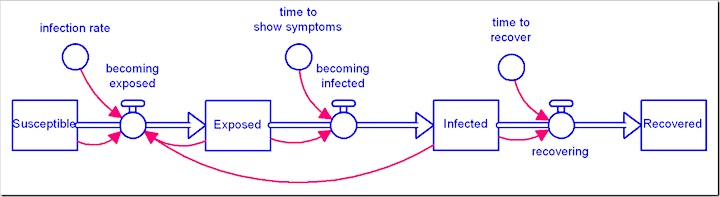
The event will briefly describe how system dynamics is suited to the modelling of an epidemic and a generic approach that will be reflected in three key contributions:

Kim Warren, Strategy Dynamics Ltd, will describe his work with Maurice Glucksman with the Pan-African Network for Rapid Research, Response & Preparedness for Infectious Diseases Epidemic (PANDORA) entitled Local outbreaks and local issues need local models.

Mark Gregson, Consultant with the Whole Systems Partnership, will outline his work in the Kent & Medway system entitled Reflections on developing a whole system demand and capacity model for an Integrated Health and Care System in the UK.

Erik Pruyt, Center for Policy Exploration Analysis and Simulation in the Netherlands, will speak on Aggregated Systems Models towards Integrated Assessment Models linking COVID19 Epidemics, Economics, Livelihood across National, Regional and Local Scales: the Cases of Namibia, the Netherlands, and Peru.

SEIR diagram source: ISEE Systems 2020 (https://blog.iseesystems.com/)

via System Dynamics meets COVID-19 Tickets, Thu 28 May 2020 at 09:30 | Eventbrite

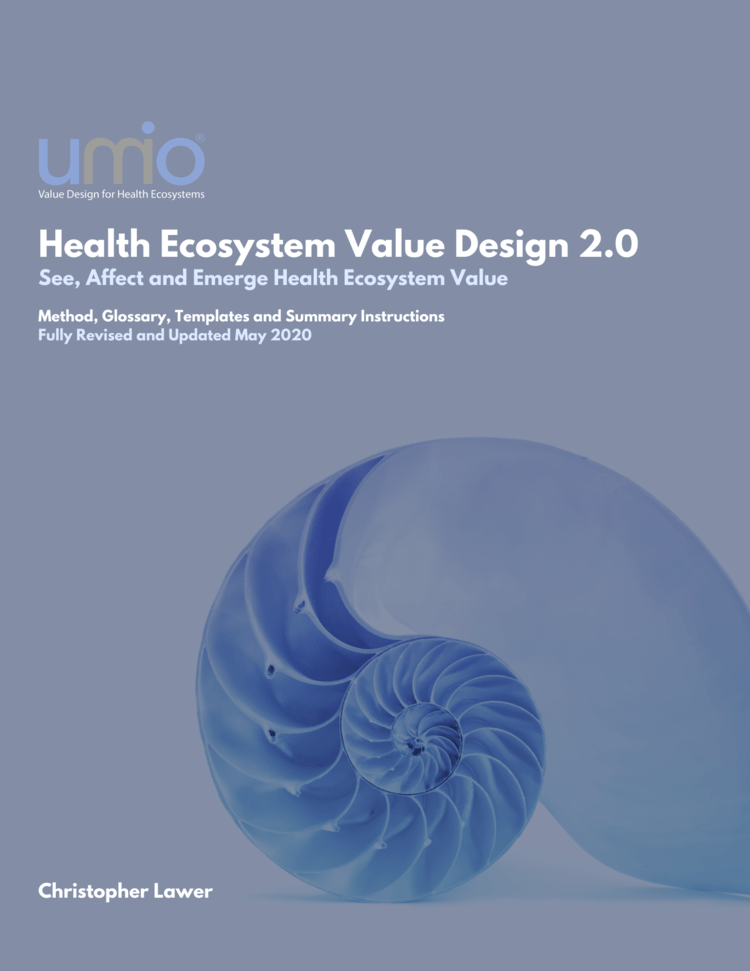
Umio – Health Ecosystem Value Design 2.0

https://www.umio.io/#homepage

Health Ecosystem Value Design 2.0

Now live

Health Ecosystem Value Design Framework 2.0

We are delighted to announce the launch of the fully revised version of Health Ecosystem Value Design® 2.0, our comprehensive health and wellbeing ecosystem design, co-production and transition framework.

Health Ecosystem Value Design 2.0 Cover.png

Version 2.0 of the Health Ecosystem Value Design® framework rises to the challenge of the “no return to normal” that Covid-19 offers us. 

It provides:

  • A revised means to study health and disease by framing health ecosystems around a particular context of human experience, disease or condition

  • A new “beyond biomedical” conception of health as individual, family, community and social group capacities or powers of acting

  • A novel approach to explore and understand the emergence (both decline and recovery) of lived health experience over a duration of time

  • A way to see and address real underlying structural forces that produce health and disease, as well as health and care system powers or ideologies, priorities, practices and outcomes

  • A dynamic relational health ecosystem value model that moves beyond narrow exchange or transactional and outcome conceptions

  • The first ever ecosystem value design method and capabilities diagnostic and development tool

Launch webinar May 5 2020
https://www.youtube.com/watch?v=s0kKD952RHA&feature=emb_logo

The “U” Health Ecosystem Value Design® Method

Health Ecosystem Value Design® follows a “U” logic, method and flow. Each step in the “U” shown below contains a template for enquiry into Real Lived Experiences with Health, assemblages, structures and forces of health and the design of Health Ecosystem Value.

Umio Health Ecosystem Value Design Simplified Model v1.png
https://www.umio.io/#homepage

Centre for Complex Systems in Transition webinar – Exploring complex interdependencies in global healthcare systems, Re-thinking resilience during COVID-19 Thursday, 7 May 2020, 13:00-14:00 (GMT+2)


From their email:

CST WEBINAR SERIES
Exploring complex interdependencies in global healthcare systems 

Re-thinking resilience during COVID-19


Thursday, May 7th from 13:00 to 14:00 (GMT+2)
This webinar will take place online
Register in advance for this webinar:
https://maties.zoom.us/webinar/register/WN_w3Tdh7PvRxiYxrVgveKoEQ
Join us for a Webinar in our new CST series of Webinars on:  Complexity & Resilience insights in a time of transition

This series brings together scientists, practitioners and societal actors who use the frameworks of complexity and resilience thinking in their daily work to make sense of the complex dynamics of change and transformative processes. There will be a special focus on how these ideas and practices are used in current times and how local and regional processes and perspectives are being shaped by applying the theoretical concepts and tools for fostering more resilient organisations, communities and decision-making strategies.

Discussants: Prof Joachim Sturmberg and Dr Bruno Kissling
Moderator: Dr Rika Preiser


Joachim P Sturmberg MBBS, DRACOG, MFM, FRACGP, PhD
A/Prof of General Practice at the Departments of General Practice The Newcastle University, Newcastle – Australia.
For over 30 years Joachim is practicing family medicine at Wamberal Surgery, Wamberal – Australia. He is the Foundation President of the International Society for Systems and Complexity Sciences for Health (ISSCSH), and he remains actively involved in the Royal Australian College of General Practitioners as well as co-leading the special interest groups in complexity in WONCA, ESPCH and NAPCRG. He has been instrumental in initiating the International Conferences for Systems and Complexity Sciences for Health. His research interests relate to the application of systems and complexity principles to health care delivery, health policy and health systems organisation. He has been invited to speak on these topics in Europe and North America, he has published extensively on these topics in peer-reviewed journals and has contributed several book chapters on these topics.
Bruno Kissling, Dr. med., is a family doctor. He worked in private practice (1982 bis 2019) in Berne, Switzerland. He was a board member of the Swiss Society of General Practice (1995-2003), Swiss delegate to the World Organization of Family Doctors WONCA (2000-2009), co-founder and co-editor-in-chief of the Swiss journal for family medicine PrimaryCare (2001-2014) and a teaching doctor at the Institute of Family Medicine, University of Berne. He published countless articles about family medicine in national and international journals. He participated in the documentary film trilogy “At the doctor’s side” by Sylviane Gindrat (2013). He co-authored three books: «Qualität in der Medizin – Briefe zwischen einem Hausarzt und einer Ethnologin» («Quality in medicine – letters between a family doctor and an anthropologist»; EMH, Muttenz, 2015), «Ich stelle mir eine Medizin vor… – Briefwechsel einer jungen Ärztin mit einem erfahrenen Hausarzt» («I imagine a medicine… – letters between a young doctor and an experienced family doctor»; rüffer & rub, Zürich, 2018) and «Die ärztliche Konsultation – systemisch -lösungsorientiert» («The medical consultation – systemic solution-oriented; Vandenhoeck & Ruprecht,Göttingen, 2019).

A very rough and partial draft systems thinking reading list

Shared for a friend of a friend

Draft systems thinking reading list

Benjamin.taylor@systemspractice.org

www.linkedin.com/in/antlerboy

www.twitter.com/antlerboy

Intro

A very partial and incomplete list!

Advice: there are *so many* flavours of systems thinking / complexity / cybernetics – do yourself a favour and don’t flog through stuff that doesn’t work for you, find things that bring your mind alive.

Start with the articles and skim through.

Many of the books can be found online for free (often pirated) – monoskop.org is good – useful for many modern management books (read the first chapter and you’ve got all the ideas) and for the old, deep stuff (read enough to see if you want to dive in) – but do buy the book if you value it.

Have a look at the core systems and the practice requirements at https://www.instituteforapprenticeships.org/apprenticeship-standards/systems-thinking-practitioner/ – you need both to be a systems practitioner

General RedQuadrant reading list (public service transformation with a flavour of systems thinking):
https://docs.google.com/document/d/19ji4L38JVVJiWj9EiSglY–q_rn_fr6a7G4MjnuDYK0/edit?usp=sharing

Groups to join:

For COVID-19, Rob Young has set up a facebook group to collate all systems-related updates – https://stream.syscoi.com/2020/04/07/please-join-and-contribute-covid-19-resources-systems-community-facebook-group/

Systems Community of Inquiry https://stream.syscoi.com/
(replaces model.report – systems thinking repository and discussion – see https://syscoi.com/model.report/model.report/newest.html for static archive)

Systems thinking network https://www.linkedin.com/groups/2639211

systems thinking facebook groups at

SCiO – Systems and Complexity in Organisation

Nick Ananin’s systems thinking events map worldwide) https://goo.gl/4PXkCg

Other key systems thinking groups:

Illuminate/SIGNAL – building the field of systems change https://mailchi.mp/cf0bdef6497a/illuminate

Systems Convening – Bev and Etienne Wenger-Trayner are writing a manual, and a good group has formed: https://groups.io/g/systems-convening / https://wenger-trayner.com/systems-convening/

Systems innovation – http://systemsinnovation.io/ and slack at http://systemsinnovationteam.slack.com

Articles

Systems One: An Introduction to Systems Thinking – Draper L. Kauffman Jr. https://drive.google.com/file/d/1btuVMWRAIg0PelXOOJ07ddq0f_nTPTP7/view?usp=sharing (short book – 48 pages)

Making Work Systems Better – Luc Hoebeke (book – 138 pages) https://drive.google.com/file/d/17btE9GsAMi2M5j418IgDLhpNoR5lK3rR/view?usp=sharing

Epistemological Crises, Dramatic Narrative, and the Philosophy of Science – Alasdair MacIntyre https://drive.google.com/file/d/1VPkr5mIn8vnBw_mMl5rCOgMYroyYCx4p/view?usp=sharing (journal publication – 20 pages)

A first lesson in meta-rationality – David Chapman https://meaningness.com/metablog/bongard-meta-rationality

Barry Oshry’s Organic Systems Framework (power+systems) – human systems.

An Overview of the Soft Systems Methodology – Stuart Burge (article – 14 pages) https://drive.google.com/file/d/1ngzFoLZScboUurv6TF47F3QkgXCh8vpG/view?usp=sharing

Leverage Points: Places to intervene in a System – Donnella Meadows (article – 21 pages) https://drive.google.com/file/d/18lO4QcbqBUhlm0EmtkjeauwDInhp1H_G/view?usp=sharing

Dancing with systems – Donnella Meadows
http://donellameadows.org/archives/dancing-with-systems/

A Systems Literacy Manifesto – Hugh Dubberly (presentation – 59 slides) https://drive.google.com/file/d/1OHQqAkwL48YM8iB4R7vJqJdLbd8SxmG7/view?usp=sharing

The Viable Systems Model

Simple Rules for a Complex World – Kathy Eisenhardt, Donald Sull (short article – 12 pages) https://hbr.org/2012/09/simple-rules-for-a-complex-world

Adaptiveness in human social organisation: some guiding principles – Michael Church (journal publication – ten pages) https://cmapspublic.ihmc.us/rid=1LLD90NQ0-N92GXZ- 29CZ/ADAPTIVENESS%20IN%20HUMAN%20SOCIAL%20ORGANISATION.htm

Chris Argyris: Theories of action, double-loop learning and organizational learning (journal publication – 23 pages) https://drive.google.com/open?id=1FMrOWbkU0BAJzbDlawwIjb6oOZkgNMSZ

Systems Approaches to Public Sector Challenges: Working with Change, OECD (free)

https://www.oecd.org/publications/systems-approaches-to-public-sector-challenges-9789264279865-en.htm

Wicked Solutions – Williams and Van ‘t Hof
https://writing.dawsoncollege.qc.ca/wp-content/uploads/2018/10/Wicked-Solutions-Second-Edition.pdf

Government

Treaty for Government – a systems thinking approach to Government – Ed Straw http://www.treatyforgovernment.com/ (book – 254 pages)

The Hidden Power of Systems Thinking – Ray Ison and Ed Straw
https://smile.amazon.co.uk/Hidden-Power-Systems-Thinking-Governance/dp/1138493996/

Stand & Deliver: A Design for Successful Government – Ed Straw (presentation – 21 slides) https://drive.google.com/file/d/1A8NTYzR78SbWci9Lcl3xLB_eMqqMD9xS/view?usp=sharing

Seeing Like a State: How Certain Schemes to Improve the Human Condition Have Failed – James Scott (long book – 460 pages)
https://smile.amazon.co.uk/Seeing-Like-State-Condition-Institution/dp/0300078153

Barry Oshry’s Organic Systems Framework (power+systems)

Navigating Complexity: The Essential Guide to Complexity Theory in Business and Management Arthur Battram (book – 270 pages)
Amazon: https://www.amazon.co.uk/Navigating-Complexity-Essential-Business- Management/dp/185835899X/ref=sr_1_3?ie=UTF8&qid=1427326475&sr=8- 3&keywords=navigating+complexity&pldnSite=1
RedQuadrant library: https://redquadrant.libib.com/#36939049X

The Fractal Organisation – Patrick Hoverstadt (book – 338 pages)
Amazon: http://smile.amazon.co.uk/Fractal-Organization-Creating-Sustainable- Organizations/dp/0470060565/ref=sr_1_1?ie=UTF8&qid=1427326460&sr=8- 1&keywords=the+fractal+organisation
RedQuadrant library: https://redquadrant.libib.com/#1029021X

Thinking in Systems: A Primer – Diana Wright, Donella H. Meadows (book – 240 pages)
Amazon: https://smile.amazon.co.uk/Thinking-Systems-Primer-Diana-Wright/dp/1844077268
RedQuadrant library: https://redquadrant.libib.com/#1031733X

Images of Organization – Gareth Morgan (long book – 520 pages)
Amazon: https://smile.amazon.co.uk/Images-Organization-Gareth-Morgan/dp/1412939798
RedQuadrant library: https://redquadrant.libib.com/#1029098X

The Little Book of Beyond Budgeting – Steve Morlidge (book – 96 pages) https://smile.amazon.co.uk/Little-Book-Beyond-Budgeting-Organisations/dp/1785899287

Unlocking Leadership Mindtraps – Jennifer Berger (article – 24 pages) https://drive.google.com/file/d/1G6SFoI5YnsATXtXXWlIwJl_zIL6ojGfb/view?usp=sharing

(book – 168 pages) Amazon: https://smile.amazon.com/Unlocking-Leadership-Mindtraps-Thrive- Complexity/dp/1503609014

The Systems Thinking Playbook – Meadows and Sweeney
https://redquadrant.libib.com/#4133211X

Complexity: The Emerging Science at the Edge of Order and Chaos – Mitchell Waldrop
https://redquadrant.libib.com/#15288900X

Out of Control – Kelly
https://redquadrant.libib.com/#21553244X

Systems Thinkers – Ramage and Shipp
https://redquadrant.libib.com/#15289113X

Systems Approaches to Management – Michael Jackson
https://smile.amazon.co.uk/gp/product/030646506X/ref=dbs_a_def_rwt_bibl_vppi_i1

Systems Approaches to Managing Change – Reynolds and Howell
https://redquadrant.libib.com/#15289094X

Systems Thinking for Social Change – Stroh
https://redquadrant.libib.com/#60844152X

The Systems Approach and Its Enemies – West Churchman
https://redquadrant.libib.com/#21553177X

The Brain of the Firm – Beer
https://smile.amazon.co.uk/Brain-Firm-2e-Classic-Beer/dp/047194839X

Safety Differently: Human Factors for a New Era, Second Edition – Dekker
https://redquadrant.libib.com/#44506149X

Strong Towns – Marohn
https://smile.amazon.co.uk/Strong-Towns-Bottom-Up-Revolution-Prosperity-ebook/dp/B07YGC4K4V


IFORS’ Operational Research Hall of Fame – C. West Churchman – Mason – 2004 – International Transactions in Operational Research – Wiley Online Library

via IFORS’ Operational Research Hall of Fame 
C. West Churchman – Mason – 2004 – International Transactions in Operational Research – Wiley Online Library

IFORS’ Operational Research Hall of Fame
C. West Churchman

First published:01 September 2004
s
search
c
compose new post
r
reply
e
edit
t
go to top
j
go to the next post or comment
k
go to the previous post or comment
o
toggle comment visibility
esc
cancel edit post or comment