A Philosophical Look at System Dynamics – Donnella Meadows – YouTube

via A Philosophical Look at System Dynamics – YouTube


Webinar: Building Capacity for Systems Change – Academy for Systems Change – 11am EDT, May 13,2020

From their newsletter:

Dear Academy Community,

During this time of disruption, we are all finding different ways to cope.
We felt that now would be a good time to reach out to some of our Academy Fellows, Board Members, Advisors and Faculty for their reflections; how are they feeling? what are they finding useful during this time? how are they navigating through this global pandemic?

This newsletter is a collection of thoughts, personal reflections and updates from several members of the Academy community. We’d love to hear from more of you – please reach out to us at anytime.

With an open heart,
Darcy, Ginger, Marta, Sarah, Kindle and LeAnne
Academy Programs Director, Marta Ceroni, has been collaborating with 30 capacity builders in the field of systems change to explore what it really takes to ‘do’ systems thinking. Their recently published report, Convening The Capacity Builders, aims to support systems leaders around the world. It covers key emerging themes in the field, including healing systems, centering equity, learning about learning and responding to disruptive change.

“Systems change is emerging as a pathway of hopeful action across the world. Governments, NGOs, and the private sector are buzzing about the need for it. But what does it take to really do it, what’s needed to realize the promise of this field, and how might we best support emerging and practicing system leaders globally?” Read the full report here

If you’re interested in connecting to reflect on key emerging themes in the field of systems change, the group is hosting a webinar on May 13. 2020, 11:00AM Eastern Time, USA. More info

Now is the time for systems thinking


via Webinar: Building Capacity for Systems Change – Academy for Systems Change

Webinar: Building Capacity for Systems Change

May 13, 2020
11:00 AM EDT
Register here

With the current pandemic amplifying existing systemic failures, the time is right to come together as facilitators of systems change and sense into what is important for us to tend to now and going forward as a collective, emerging field.

At the end of last year, the Academy came together with 29 other organizations working in the field of systems change to find ways to reinforce and complement one another’s work. We emerged from that experience with, among other things, a shared priority of centering equity and healing of systems and ourselves in our work. We feel that the current pandemic and the inequities it has exposed have only exacerbated the need for centering equity and healing and we’d love to connect with others who are interested in advancing work in these areas.

The recently published report, Convening The Capacity Builders, aims to support systems leaders around the world. It covers key emerging themes in the field, including healing systems, entering equity, learning about learning and responding to disruptive change.

This webinar will discuss the key themes highlighted in the new Convening the Capacity Builders report. It is an opportunity to connect and discuss insights that emerged from a unique convening of systems change capacity building organizations.

Click here to register for the webinar.

Adult Development and the COVID Crisis – Academy for Systems Change – with Kegan and Lahey

via Adult Development and the COVID Crisis – Academy for Systems Change

Adult Development and the COVID Crisis

Adult Development and the COVID Crisis

Leading developmental theorists, Robert Kegan and Lisa Lahey recently hosted a webinar on “Adult Development and the COVID Crisis” and have made this resource available to a wider community in the hope it may add to the healing/helping energy this extraordinary situation has unleashed.

They have made it available in several ways, and we’d like to share with our entire Academy community:

  1. It is available as a 2-hour interactive program that you can do with colleagues, friends, students, and/or clients. To view instructions for running this program, click here, and you can access the program video in its entirety by clicking this link.

Alternatively, they have divided the video into two half-hour pieces, for viewing separately or consecutively:

  1. How can we better stay connected to ourselves and to others in a time of crisis?

“All of this starts with awareness, noticing our feelings, our reactions. That is what makes it possible for us to have a relationship to those feelings. By contrast, when we are unaware of our feelings, they are in charge…Noticing our feelings, though, means we can step aside from them, to whatever degree, and we can look at them…And that move is what animates all developmental shifts, no matter how small.” – Dr. Lisa Lahey

2. How can we better realize the transformational potential of this global pandemic?

“We were a sick world before the virus. The systems which we have created — which in many ways have been an enormous advance to human evolution — those systems are clearly not able to solve our current problems. The virus has the potential to show us even more deeply that we are first of all members of one single vulnerable species just trying to make its way on one single fragile planet. The more that we come to experience that, the bigger is the transformative potential–that these systems, valuable though they may be, are just constructions.”  – Dr. Robert Kegan

Many thanks to Lisa Lahey and Bob Kegan for making these resources easily accessible for everyone. Please feel free to pass this on to whomever you think may benefit.

via Adult Development and the COVID Crisis – Academy for Systems Change

Developing my thinking about the development of thinking | Just Practicing
Shared under

Creative Commons License Attribution-NonCommercial-ShareAlike Creative Commons Attribution-NonCommercial-ShareAlike

Please go to the excellent

Just Practicing by Helen Wilding

for more

via Developing my thinking about the development of thinking | Just Practicing

Developing my thinking about the development of thinking

Print Friendly, PDF & Email

Just recently I’ve read a couple of articles.  They are both about the development of thinking in an educational context.  One is about developing critical thinking (Moon, 2005) and the other is about the teaching of systems concepts  and therefore of interest to the development of systems thinking (Salner 1986).

Both of the articles use theories of adult cognitive development or epistemological development as the foundation for their arguments.  In short, they argue that critical thinking (Moon article) and understanding of systems concepts (Salner article) are not possible until the adult has reached a certain stage of development and have integrated particular epistemological assumptions into their world views.  Both articles are written from a ‘pedagogical’ perspective so go onto discuss what educators can do to create the conditions where post-18 students can progress the development of their thinking – even if they are not consciously aware of it.

The first theory is by Kitchener (1983) and is explained in the Salner article – although I have come across it before in Bawden’s work on critical social learning systems.  Kitchener’s theory is about levels of cognitive processing.  There are three levels – level one is the cognitive task of thinking itself.  Level two is referred to as metacognition – the types of tasks used to think about and monitor the quality of thinking whilst you are doing it.  The third level is referred to as ‘epistemic cognition’ – it is about thinking epistemically – thinking about the foundations of thought.

If I think about my own experience of epistemic cognition, it isn’t something that came naturally to me.  First of all of course you don’t know you don’t know… then I came across a language to help me reflect I could understand it more.  One of the key points I remember is learning about the difference between positivist, post-positivist and post-modernist research and their different epistemological stances – so getting the language from the ‘philosophy of science’ helped me to think about and have conversations about my views and in the process develop them.

Moving onto epistemological development – the changes that occur at Kitchener’s level three whether you are conscious of it or not – the Moon article draws predominantly on the work of Magolda which identifies four domains of ‘knowing’.

  • absolute knowing – the stance that knowledge is absolute and certain.
  • transitional knowing – doubts creep in about the certainty of knowledge
  • independent knowing – recognise that knowledge is uncertain but cope with this by believing everyone has a right to their own opinions
  • contextual knowing – knowledge is no longer absolute, it is constructed and is understood according to what best fits the context

The Salner article on the other hand, predominantly draws on the work of Perry.  Perry identified nine positions through which a student moves developmentally but these can be reduced to three main stages.

  • dualism – makes a clear distinction between self and the external world where ‘knowledge’ lies.  Differences in points of view accommodated by seeing right or wrong.
  • multiplicity – the plural nature of the social context creates pressure to recognise many ‘truths’.  Differences in points of view accommodated by ‘you have your way, I have mine’
  • contextual relativism – realisation that context important in defining ‘truth’.  Knowledge is part of your relationship with the world.

There are clearly synergies between the work of Magolda and the work of Perry.  And I also found Moon’s argument about critical thinking and Salner’s argument about understanding systems concepts very similiar – that these are not possible until a student has reached contextual knowing/contextual relativism.  If a student has not developed their epistemology to recognise pluralism and relativism then it is simply not possible to appreciate and appraise multiple partial perspectives to reach a judgement or conclusion (critical thinking) or to practice epistemological and methodological pluralism and be conscious of your choices in messy situations (key competence of systems practitioner).

As I’ve been writing, I’ve realised I’ve come across another perspective related to this issue of developing thinking but this one comes under the heading of ‘wisdom’.  In TU811 People stream, we were introduced to the work of Baltes and Staudinger (2000) who have developed five criteria for wisdom.

The first two criteria are relevant to any kind of expertise – factual knowledge (know about) and procedural knowledge (know how).  The other three are more relevant to wisdom.  They are:

  • lifespan contextualism – awareness of an event’s unique context and history
  • relativism of values and life priorities – recognising and respecting different views held on this
  • recognition of and management of uncertainty – realising how little you know – but still coping!

Looking at these criteria for wisdom in the light of Magolda’s and Perry’s theories, makes me think that ‘wisdom’ too would not be possible if an adult has not developed contextual knowing/contextual relativism.

So what?

When you get a group of systems thinkers into a real or virtual room (what would be the collective known for a group of systems thinkers – an emergence, perhaps?) it isn’t long before the talk turns to “how do we get others (in our workplaces, in society) to ‘get it’?”  We talk of using systems approaches, we talk of more formal introduction of systems ideas, we talk of ‘modelling’ through what we ourselves do or say.

But what if, those who don’t ‘get it’, haven’t had the necessary experiences (in education or elsewhere) to develop contextual knowing/contextual relativism?  Salner’s observations of students operating in dualistic or multiplistic stage (symptoms include getting more stuck in systemic thinking and falling back on the non-systemic; being more likely to reduce complexity to familiar categories; and, being more likely to regard their perspective as the way it is) seem rather too familiar.  So these theories of epistemological development are important beyond the educational setting – to managers as well as educators; to all staff (including managers) as well as students; to organisational development as well as educational culture; to personal development as well as curricula development.

It all seems a bit overwhelming!

References

Moon, Jenny (2005) ‘We seek it here… a new perspective on the elusive activity of critical thinking: a theoretical and practical approach’, [online] Available from: http://escalate.ac.uk/downloads/2041.pdf.

Salner, Marcia (1986) ‘Adult cognitive and epistemological development in systems education’, Systems Research, 3(4), pp. 225–232.

Baltes, P.B. and Staudinger, U.M. (2000) ‘Wisdom: a metaheuristic (pragmatic) to orchestrate mind and virtue toward excellence’, American Psychologist, 55(1), pp 122-126

How to Make Systems Thinking a More Natural Act – Catarina von Maydell on LinkedIn

Please comment on this on the LinkedIn article (not here), where I have also commented.

via How to Make Systems Thinking a More Natural Act | LinkedIn

Systems thinking+ needs to be like entrepreneurial effectuation that includes linear approaches as well as exploratory/innovation approaches.

How to Make Systems Thinking a More Natural Act

Catarina von Maydell

Catarina von Maydell

Helping leaders & teams create strategic, sustainable innovation & change.
14 articles 

To address the many difficult challenges we face from local to organizational to global levels, we need to approach the challenges differently. This includes leveraging systems thinking, design thinking, complexity thinking, agile approaches, etc, etc. However, this “deep thinking” is not easy, and it is currently not a natural process. But we can make it easier, and we can make it something that is much more natural to business people and other people who need to solve complex problems.

This article recaps the ST-TO+ presentation and the presentation that triggered it, and then provides insights that might help us understand how we can make systems thinking+ a more ‘natural act’.

To understand “Why Deep Thinking is Not a Natural Act”, Srikanth Ramanujam used experiential exercises and a range of resources at Systems Thinking+ Toronto to show some different ways people think and how automatic cognitive processes (Daniel Kahneman’s fast thinking) can interfere with the deeper, considered, slower thinking. The presentation concluded with a discussion of:

  1. How we can leverage the processes of scientific process and iterative systems thinking steps (including mapping) to think more deeply.
  2. How the Cynefin model can help us recognize the type of thinking we probably need to do based on the situation. Cynefin recognizes situations can be:
  • ordered (situations are simple or complicated; best or good practices can address challenges), or
  •  unordered (situations are complex or chaotic; these situations require much more observation, exploration, experimentation and learn-as-you-go).

Srikanth’s presentation was triggered by Professor Ricardo Valerdi’s “Why/When Systems Thinking is Not a Natural Act” video and academic paper. Valerdi writes ST is not a natural act because

our systems “favor mechanisms tuned to dealing with immediate surface features of challenges.”

Our education and business systems’ “mechanistic/reductionist” approaches to decision-making and acting “inhibit” the development of the cognitive processes necessary for ST.

continues and with comments in source: How to Make Systems Thinking a More Natural Act | LinkedIn

Pandemic Luhman | Zenodo

via Pandemic Luhman | Zenodo

(And: Coronavirus Disease Research Community – COVID-19 

https://zenodo.org/communities/covid-19/?page=1&size=20)


Working paper Open Access 

Pandemic Luhman

Paul Marie Boulanger;  Andrea Saltelli

In the midst of the COVID-19 pandemic, important transformations are taking place while a dense veil of uncertainty clouds the way out of the present predicaments. This short, impromptu comment, based on the theories of German sociologist Niklas Luhmann, plays the game of “What would Luhmann have said”, without the ambition to predict actual outcomes, but just as an exercise of interrogating his theory. Of course, Luhmann’s own brilliance would have considerably helped.

The days after – a learning community to build back better – The Public Service Transformation Academy UK)

A new initiative I’m launching. Please join if you are interested in or produce citizen and community outcomes (UK focus).

via The days after – a learning community to build back better – PSTA

Over 50 organisations have already joined the build back better learning community, including housing associations, charities, health, police, local and central government.

We’ve been dynamic in dealing with the crisis – amazing things have been achieved.
How do we learn from these breakthroughs?

Things are still chaotic and confusing! And will be for some time as the ramifications continue.
How do we make sense of things right now and for the future?

How do we prepare for a real reboot in ‘the days after’ the crisis?

We have been working with some core organisations to start to think about these questions – and are now expanding to set up a wider learning community. There is no obligation and no charge. This is a place to share and build learning together.

The group will meet fortnightly online, 2-3.30pm on Wednesdays.

The first virtual round table will take place on 13 May, and address the question: what will we face in ‘the days after’?
This will be an active online scenario planning session – and a look at the ‘three horizons’ model for future thinking.

The second virtual round table will take place on 27 May: how can we do radical rebuilding?
This will look at application of the ‘five worlds model’ and ‘five key leadership practices’ applied not to organisations, but to creating place-based, emergent, learning systems.

Further dates to be planned. A core group will meet on the ‘off weeks’ to plan and input, and materials from each session will be shared with all participants. The community is supported with free groups on WhatsApp and groups.io

To join, email benjamin.taylor@publicservicetransformation.org

via The days after – a learning community to build back better – PSTA

Three Horizons – Collective Leadership for Scotland

Looks like a great initiative, and I highly recommend the Three Horizons model at this time.

We are using it in https://www.publicservicetransformation.org/2020/04/the-days-after-a-learning-community-to-build-back-better/, too

via Week 1-2: Three Horizons – Collective Leadership for Scotland


Week 1-2: Three Horizons

Introduction to Week 1-2

We are launching the first of our themed “One thing at a time” weeks. We will be taking some time to reflect and focus on a theory or approach that is central to the Collective Leadership work. For the next couple of weeks we’ll be focusing particularly on Three Horizons. This work has been produced in collaboration with Graham Leicester from International Futures Forum.

The idea is that you can take this at your own pace and delve as deeply as you wish. You might simply want to read up a bit more, watch some YouTube clips to help you to get to grips with Three Horizons framework; you might want to take a bit more time and get involved in practising using Three Horizons and you may wish to participate in the offer of the 2 online live workshops; you might want to share a virtual dialogue walk with someone to talk it through in a bit more detail one to one. The level of involvement is up to you.

You can access all materials down below. Please do complete if you can the short scanning survey which we hope will provide a useful picture of how Scotland is changing now and might change in the future under the influence of the pandemic. You can sign up for the survey and for the follow-up online workshops below.

Video 1: Introduction to The Three Horizons

A short introduction by Kate Raworth (author of Doughnut Economics) on how to use Three Horizons thinking to frame the transition to a regenerative and distributive economy, including suggestions for workshop questions (video: August 2018)

Blog by Graham Leicester: Scanning the Covid-19 Landscape of Change

These are powerful times.  We face immediate and acute challenges alongside the inevitability of long-term shifts in patterns of living.  Systems, all systems it seems, are in transition.  When they come through this experience many will be radically changed.  We are embarked on an extraordinary learning journey.

Three Horizons (see below) is a simple framework for reading this landscape and keeping track of how it might evolve over time.

There is a flavour of Three Horizons already in the tendency to describe the journey through the pandemic in three phases:  from response, through recovery to renewal, for example.  Or, as others have it, ‘now, next, beyond’. Most of these three phase descriptions might just as easily be represented as three time horizons – short, medium and long term.  That is how the original Three Horizons framework made popular by McKinsey’s in the early 2000s was intended to be understood.

The framework becomes much more powerful, however, and more useful for anyone involved in the conscious pursuit of social change, if the three horizons are understood not as time horizons but as three qualities of the future in the present. The framework then provides a space to appreciate:  the unstable patterns of the past and the strains they are now coming under (H1), a sense of the opportunities for innovation and change that are accelerating all around us (H2), and also the potential for the present moment to act as a portal (to use Arundhati Roy’s language) to a very different future, founded on different values (H3).

There is always a dominant pattern.  This is the first horizon (H1), ‘business as usual’.  Its quality is managerial.  We rely on H1 systems being stable and reliable.  But as the world changes, or is disrupted for example by a pandemic, so aspects of business as usual begin to feel out of place or no longer fit for purpose.  Eventually ‘business as usual’ will always be superseded by new ways of doing things.

The third horizon – H3 – emerges as the long-term successor to business as usual.  It grows from fringe activity in the present that introduces completely new ways of doing things but which turn out to be much better fitted to the world that is emerging than the dominant H1 systems.  Its quality is hopeful – full of hope.

The second horizon – H2 – is a pattern of transition activities and innovations, people trying things out in response to the ways in which the landscape is changing.  Its quality is entrepreneurial.  Some of these innovations will be absorbed into the H1 systems to improve them and to prolong their life (we call this ‘sustaining innovation’ or ‘H2 minus’) while some will pave the way for the emergence of the radically different H3 systems (this is ‘transformative innovation’ or ‘H2 plus’).

The future emerges from the playing out of these three patterns of activity, the three horizons, over time.

IFF has been using Three Horizons as a scanning framework to capture how these three patterns and the interaction between them is changing week by week during the pandemic in a number of sectors, capturing learning as we go. What are those at the forefront of the action noticing about the frailties and failings of H1?  What are the innovations springing up in H2?  What are the signs of hope that out of this crisis a better world – H3 – is possible?

Many assume that there will come a time, after the immediate response phase and as we enter ‘recovery’, when we will get to take a look around at what has happened and decide which changes to keep, which to discontinue, what to retrieve from the past that we need to revive and so on. The default set of assumptions underpinning those decisions will come from the past.  We may keep something because ‘it works’ – but all we know is that it might have worked in the past and did work in the pressure cooker environment of the crisis.  Will it work in the future?  Is it an aspect of the future we aspire to create?  Those are different questions.

In other words, without a sense of where we want to go, our own third horizon, we will inevitably – and largely unconsciously – privilege sustaining over transformative innovation.  We will not realise the full potential of this moment for significant change.

That is why it is important to notice the H3 activity already manifest in the present.  These are the actions that inspire and encourage us, give us hope, demonstrate that there are rich human values that can be expressed in heart-warming action.  These are the seeds of the future to which we aspire.  Bill Sharpe, in his book Three Horizons, calls H3 ‘the patterning of hope’.

Scanning using the Three Horizons framework will give us a good picture of our starting position:  Where are we?  What is the nature of the landscape we are in and that we might encounter ahead?  And also, in the form of these glimpses of H3 in the present, a good sense of our direction of travel:  Where do we want to go?  What are the values we want to privilege through the transition?  What is the third horizon pattern we aspire to realise in the future?

IFF has developed a set of resources for guiding us through this journey of system transition in a time of great uncertainty and change.  It includes taking notice of some of the archetypal dynamics we are likely to encounter along the way, ways in which the three horizons often interact with each other over time.

The Smooth Transition is a managed and gradual process, without significant shocks, discontinuities or resistance.  More common are the other variants, all of which we can see in play just now.

Collapse and Renewal is characterised by increasing resources poured into an unsustainable H1 pattern, which eventually fails and gives way to a new H3.  We see this dynamic at present, for example, in the huge investment in keeping the existing economy on life support in the hope of ‘recovering’ it.

Capture and Extension involves the H1 pattern absorbing innovation in order to extend its life, without any significant change in the underlying system.  This might be seen at present in moving the existing school curriculum online without questioning its continuing relevance.

Investment Bubble occurs when investors (of time, money, attention, other resources) act as a herd in deciding that ‘this is the next thing’.  This leads to over-investment in a single idea that cannot in the end satisfy all its backers.  The recent paper Exit Through the App Store about our investment in the idea of a tracking app to get us out of lockdown points to an H2 bubble likely to burst.

There is a useful table exploring what the wise H1 manager and the determined H3 visionary should do if they become aware of these dynamics.  It turns out that in all cases the watchword for the H1 manager is to maintain diversity (always have options), and for the H3 visionary to maintain integrity (hold to the vision, don’t compromise it).

To return to the beginning, the first step is to get a sense of our starting position – to map the new landscape appearing around us.  A simple way to get started is to distribute a short online sampling survey, ideally repeated at intervals, to tap into what people are noticing and how they are feeling as the patterns shift around them. If you want an example, please try the survey we have set up below.

By mapping the landscape in this way, when the time comes to take stock, to decide what to keep, what to stop, how to move into recovery and renewal, those decisions will be informed by an explicit view of the future, the values we wish it to embody, and the evidence from the present that such a world is indeed possible.


How a Landmark Physics Paper from the 1970s Uncannily Describes the COVID-19 Pandemic

cxdig's avatarComplexity Digest

Phil Anderson’s article “More Is Different” describes how different levels of complexity require new ways of thinking. And as the virus multiplies and spreads, that’s just what the human race desperately needs

Source: blogs.scientificamerican.com

View original post

Impact of External Systems | Management Blog

This is a good blog for a clear and cogent introduction to Elliot Jacques’ Requisite Organisation and its systemicity or otherwise…


via Impact of External Systems | Management Blog

Impact of External Systems

By the time an organization reaches S-III maturity, its core system is maturing and provides for eventual profitability. At S-IV, the organization sees the emergence of multiple systems and sub-systems (marketing, sales, account management, operations, quality control, research and development, HR, accounting).

At S-V, with maturing multiple systems and sub-systems, the organization has to look outward, to external systems. No matter how well the company is organized internally, it is external systems that impact success (or failure).

Market (External System)
Markets organically shift related to demographics, trends, economic growth or contraction. These organic shifts are sometimes subtle and relatively slow. The relative slow speed allows companies to respond (market response).

Regulation (External System)
Most companies are financially regulated (taxes), some are subject to stringent environmental regulation. During COVID-19, regulation dramatically clamped market demand, by defining essential vs non-essential companies.

Labor (External System)
The US went from record low unemployment to depression level unemployment in a matter of 60 days. Labor is an external system that impacts the way we internally organize.

Finance (External System)
Finance includes institutional debt, credit lines, owner investment, private equity investment. The company believes it should be able to borrow as much money as it has the ability to repay. Banks, on the other hand have these concepts called covenants which require certain internal ratios. Finance, as an external system has an impact on the way we internally organize. COVID-19 shifted credit in some cases to forgivable debt guaranteed by government.

Most of these external systems stand alone, but COVID-19 has brought together a not-so-subtle interplay. The organizations who survive are those who are mature in their internal systems, but also understand the interplay and impact of external systems. Those companies funded in the first tranche of stimulus were those who kicked in applications immediately. Most smaller companies, with immature systems, without awareness of external systems were brushed to the second tranche or left in the cold.

It is the role of the CEO at S-V to ensure both, maturity of internal systems and skilled experience in external systems.


via Impact of External Systems | Management Blog

This Danish Municipality Changed Its Management Model Inspired By Buurtzorg – Corporate Rebels

via This Danish Municipality Changed Its Management Model Inspired By Buurtzorg

I like this. It recalls Jane Searles’ Circles of Need model which was implemented in Chorley District Council (under the leadership of Donna Hall, who went on to Wigan and The Wigan Deal):

https://link.springer.com/chapter/10.1007/978-1-4614-1972-3_30

Click to access NI14-Nov-08-K-Boardman-10.pdf

Click to access chorley-borough-council-m-f00.pdf

Click to access blackburn-darwen-borough–6c2.pdf

And it recalls other thinking about ‘zones of time and space’, e.g.

https://stream.syscoi.com/2020/04/13/border-zones-of-ecology-and-systems-theory-becker-2011/

https://stream.syscoi.com/2020/03/31/permaculture-zones/

There seems to be a core systems principle hidden here… and notably lacking from most relevant thinking in the real world!

Systems Thinking for Global Problems – course at Toronto University

Professor Steve Easterbook has a blog (which I’m unlikely to pick up because there’s no email signup) at http://www.easterbrook.ca/steve/


via Systems Thinking for Global Problems


CSC2720H Systems Thinking for Global Problems

Winter Term, 2020

Note:

  • Course Seminars are scheduled for Tuesday afternoons, 1pm – 4pm, starting on January 7th, 2020.
  • Location: Room FE328 326, 371 Bloor Street West, Toronto. (Note switch of room, across the corridor from the original room!)
  • Instructor: Prof Steve Easterbrook, Dept of Computer Science.
  • For computer science grad students, this course fulfills breadth requirements in:
    • Methodology 4 (Human-Centered and Interdisciplinary Computing) *and*
    • Research Area 15 (Emerging areas in interdisciplinary computer science)
  • Note: You cannot take this course for credit if you previously took my course CSC2602 in Winter 2013, nor if you took any instance of DGC2003.

About the Course

This course is unlike any other graduate course you have taken. You will play games, solve puzzles, and tell stories. Each activity will create a system around you, with its own dynamics. Sometimes you will try to beat the system and discover you cannot. Other times you will discover you can change a system by changing your perspective of it. In the process, you will discover how complex patterns of behaviour can arise from simple structures and simple rules. You will draw on such insights to develop a deeper understanding of how the world works. You will start to see the systems around you in a whole new light, and you will develop a new mental toolkit for analyzing complex global issues, modeling their structure and behaviour, and understanding how and why change happens.

Along the way, you will read about the theory and practice of systems thinking, trace the history of the key ideas, and discover how they have been applied. You will explore how systems thinking provides new ways of studying the relationships between the most important global challenges of the twenty-first century, including globalization, climate change, conflict, democracy, energy, health & wellbeing, and food security.

Key topics will include:

  • General Systems Theory, developed by Bertalanffy for understanding biological systems;
  • Cybernetics: the study of feedback and control in living organisms, machines, and organizations;
  • Systems Dynamics approaches for modelling and analyzing non-linear feedback mechanisms in complex systems;
  • Complexity science and complex adaptive systems;
  • The role of computational modelling and simulation as a central tool for understanding systems
  • Philosophical roots of systems thinking as a counterpoint to the reductionism used widely across the natural sciences;
  • Emergent concepts from systems thinking, such as limits to growth, planetary boundaries, tipping points, sustainability, resilience, and chaos;
  • Soft Systems Methodology and Critical System Theory for engaging multiple stakeholders in processes of change;
  • Use of systems thinking to explore competing perspectives, trans-disciplinary synthesis, and modeling of global dynamics.

Course Requirements:

  • Class participation: Show up, do stuff, get credit.
  • Oral presentation: Research and present a 5 minute talk on a topic to be determined. Bonus marks if you do it as a Pecha Kucha. You must negotiate you choice beforehand, so we don’t have duplicates.
  • Term paper: Topic is negotiable. Suggestion: A case study applying ideas from the course to your own research work – preferably something that could be published, although there’s no requirement to seek publication. (Due by the end of the term; length & style should be typical for the journal you would publish it in).

Note: This is the sixth incarnation of this course. It was originally developed in the summer of 2012 as part of the Dynamics of Global Change Collaborative Program, and taught again in the summer of 2013. It then migrated to the Computer Science department in the winter terms 2014 and 2016. The previous course pages are archived at:

Some similar courses at other Universities exist, and may have useful material relevant to this course:

If you’re looking for more opportunities to meet systems thinkers and discuss how we can apply systems thinking to solve important societal problems, you might be interested in the Systems Thinking Ontario group, which meets in Toronto every month.

Course Outline (Draft – may change!)

Note: Some of this page still refers to the version of the course taught in the winter of 2018. I’ll update the outline and readings list as we go through the course.

Seminar Topic & Notes Notes and Background Readings
(1)
Tues
Jan 7, 2020
Introduction & Basics
  • Course objectives
  • Parts vs. Wholes
  • Open and Closed Systems
  • Holism and reductionism
  • Seeing systems
  • Frames of reference
Notes:
  1. Here are the slides I used this week
  2. Here are a couple of relevant blog posts about the ideas we talked about: Systems Thinking for Climate Systems, and The Principle of Complementarity.
  3. We talked a little bit about how this course started, and where it might fit within the university. Here’s a couple of relevant blog posts: Why Systems Thinking? and Why universities are bad at inter-disciplinary work, although the latter ends up being a bit of a rant…
  4. Activities this week included: Avalanche and Frames
  5. Three good introductory books:
    • Meadows (which we’ll be using as an initial text);
    • Weinberg (which provides a good entry into systems thinking for people in the natural sciences);
    • Walker and Salt (who provide a set of case studies showing how hard it is to understand and manage complex ecosystems)

For next seminar:

  1. Read: Chapters 1 & 2 of Meadows “Thinking in Systems”. (Note: Readings for this course are only available from the U of T campus network. If you need access from off campus, please email me!)
(2)
Tues
Jan 14, 2020
Feedback Loops
  • How feedback loops work
  • Balancing and Reinforcing Loops
  • Systems Dynamics Models
Notes:
  1. Here are the slides I used this week.
  2. We talked a little about the relative merits of stock and flow diagrams versus causal loop diagrams. For a detailed analysis of the weaknesses of causal loop diagrams, see Richardson 1986.
  3. We ended with a case study of the Earth’s climate as a stock and flow diagram, and identified three places to intervene to combat global warming:
    • Solar Radiation Management – reduce the flow of heat from the Sun to the Earth. See Alan Robock’s essay for why this is probably a very bad idea.
    • Carbon Dioxide Removal – increase the flow of carbon out of the atmosphere. See this article from Columbia for an overview of proposed technologies and their feasibility. TL;DR: We cannot yet do this cheaply enough at scale, but might eventually.
    • Stop Burning Fossil Fuels – stop the flow of carbon into the atmosphere. As long as this flow is non-zero, the problem gets worse. But we’ve been avoiding doing this for 30 years.

    Note that we’ll probably need to use all three approaches eventually, because we’ve been too slow to reduce emissions.

  4. Activities this week included Living Loops and Postcard Stories

For next seminar:

  1. Read: Randers, J. (2008). Global collapse—Fact or fiction? Futures, 40(10), 853–864. (access via UofT library)
(3)
Tues
Jan 21, 2020
Flows and Limits
  • Stock and flow models
  • Exponential Curves
  • Limits to Growth
  • Population Dynamics
  • Understanding accumulation
  • Climate change as an accumulation problem
Notes:
  1. Here are the slides I used this week.
  2. We talked about the original Limits to Growth study, published in 1972. There have been several updates:
  3. And a couple of recent papers comparing the original study with what happened, by Graham Turner: A comparison of The Limits to Growth with 30 years of reality and On the Cusp of Global Collapse?.
  4. You can play with the World3 model used in Limits to Growth online here.
  5. I didn’t have time to show this, but for an amusing take on exponential growth, you might want to join the Impossible Hamster Club
  6. I used Moore’s Law as an example of exponential growth. For more details on whether (and how long) Moore’s Law might continue, here’s a wonderfully thoughtful essay by Rodney Brooks.
  7. I showed lots of graphs of exponential growth, taken from Steffen et al’s paper on the Anthropocene.
  8. I briefly talked about economic growth in the context of the anthropocene, and mentioned that it’s principal measure, GDP is a flow measure, rather than a stock. Here’s quick overview of what GDP means, and here’s a short discussion of why GDP (a flow) cannot really assess wealth (a stock). For a critical look at whether economic growth is even necessary, see Tim Jackson’s book Prosperity Without Growth.
  9. Understanding flow and accumulation problems. The cognitive barriers have been studied in detail by John Sterman and colleagues. See for example, the papers Cronin et al “Why don’t well-educated adults understand accumulation?” and Sterman & Sweeney “Understanding public complacency about climate change: adults’ mental models of climate change violate conservation of matter“
  10. Activity: Paper Fold and the Accumulation exercises from Cronin et al. (2009).

For next seminar:

  1. Read: Bai et al, 2016 Plausible and desirable futures in the Anthropocene: A new research agenda.
(4)
Tues
Jan 28, 2020
Delay and Inertia
  • Effect of delated information
  • Pilot Induced Oscillations
  • Supply Chain Management!
Notes:
  1. We played the beer game!
  2. Here’s a short article discussing the beer game and some of the lessons it demonstrates.
  3. For a longer analysis of what the Beer Game reveals about mental models and decision-making in complex dynamical systems, read Sterman, J. D. (1989). Modeling Managerial Behavior: Misperceptions of Feedback in a Dynamic Decision Making Experiment. Management Science, 35(3), 321–339. doi:10.1287/mnsc.35.3.321
  4. For a more theoretical account of the effects of delay in a dynamical system, dive into how engineers deal with this problem in Control Theory, with this classic paper from Brown & Coombs: Notes on Control with Delay

For next seminar:

  1. Read: No reading this week
(5)
Tues
Feb 4, 2020
Resilience and Collapse
  • The Whiplash Effect
  • Feedbacks in the Climate System
  • The effect of delay on climate policy
  • Tragedy of the Commons
Notes:
  1. Here are the slides I used this week.
  2. We talked about the results from the beer game, and other systems where delay causes a problem, and looked at the “fixes that fail” pattern. The example for how road building nearly always fails to solve traffic congestion is discussed in this blog post on the Cobra Effect.
  3. And we talked about delays in responding to the challenge of climate change. Here’s an explanation of the diagram I showed that explores the delays.
  4. I presented a case study of the climate system as a set of feedback loops.
  5. We talked a little about the idea of geo-engineering the artificially cool the planet. The modeling study I mentioned is Berdahl et al. 2014, and the paper on reasons why its a really bad idea is Robock, 2008. For more on geoengineering see here and here.
  6. Games this week were: Warped Juggle and Harvest.

For next seminar:

  1. Read: Kim, D. H. (1992). System Archetypes I: Diagnosing Systemic Issues and Designing High-Leverage Interventions. Toolbox Reprint Series. Pegasus Communications Inc.
  2. And read: Kim, D. H. (2000). Systems Archetypes III: Understanding Patterns of Behaviour and Delay. Pegasus Communications Inc.
(6)
Tues
Feb 11, 2020
Systems Analysis
  • Mid-course review
  • Practice analysing systems
  • A trip to the systems zoo
Notes:
  1. Here are the slides I used this week.
  2. We explored a number of System Archetypes.
  3. We spent some time practicing drawing Causal Loop Diagrams. So it’s a good time to revisit tips on constructing these diagrams in Guidelines for Drawing Causal Loop Diagrams
  4. Today’s game was Group Juggle. Here’s one version of a causal loop diagram (drawn by Linda Booth Sweeney) to explain the behaviour seen during the game.

For next seminar:

  1. Read: Stauffer, M. (2018). An Introduction to Complexity Science for Social Sciences.
Tues
Feb 18, 2020
No Seminar – Reading Week
(7)
Tues
Feb 25, 2020
Chaos and Complexity
  • Chaos Theory
  • Difference between Chaos and Randomness
  • Complex Adaptive Systems
Notes:
  1. Here are the slides I used this week.
  2. We started by playing with the Shodor fire models Fire and the slightly more sophisticated A Better Fire. If you want to explore more of these models, take a look at:
  3. We spent some time analyzing the Logistic Equation. Here’s the spreadsheet we used to explore it: The Logistic Equation Spreadsheet
  4. We talked about how sensitivity to initial conditions affects weather forecasting. For a great overview of this, and where the current state-of-the-art is in weather forecasting, read Bauer et al, The Quiet Revolution of Numerical Weather Prediction.
  5. We talked about Rossby Waves and the Gulf stream as an example of a chaotic system with a recognisable attractor. You can see the current state of the gulf stream on this visualization, and compare it with a comparable simulation in a rotating tank of water.
  6. A very brief introduction to chaos theory
  7. Brief introduction to complex adaptive systems theory
  8. The classic long read on chaos theory is James Gleick’s book Chaos
  9. For a fascinating read on the early development of Complexity Science at the Santa Fe Institute, read Waldrup’s book “Complexity“

For next seminar:

  1. Read: Manson’s paper Simplifying Complexity: A review of complexity theory, and for a second perspective on Manson’s use of terminology, read Reitsma’s response
(8)
Tues
March 3, 2020
Complex Adaptive Systems
  • System Structure and Change
  • Self-Organised Criticality
  • Power Laws
Notes:
  1. I didn’t use many slides this week, but here they are anyway.
  2. We talked some more about chaos theory and how it relates to climate and weather. If you want to read more on this, I highly recommend Ed Lorenz’s book, The Essence of Chaos, which also includes an an appendix the text of his original “Butterfly” talk.
  3. We explored how stock market data also exhibit some self similarity (aka self-affinity). The diagrams were from an article by Mandelbrot in Scientific American. Note that Mandelbrot is not claiming that stock market data forms a fractal pattern, just that it shares some of the statistical properties of fractals, notably that volatility in the stock market follows a power law, so that you see the same kinds of oscillation at all timescales.
  4. The idea is picked up by economist Frank Ackerman, who explores its relevance to extreme risk and climate change in his new book, Worst Case Economics: Extreme Events in Climate and Finance.
  5. We explored a number of videos/demos of the kinds of stability and cascades of change that you get in self-organised criticality:
  6. The Wikipedia entry on self-organised criticality is also a pretty good introduction.
  7. The game we played this week is called “Triangles”.

For next seminar:

  1. Read the chapter on Leverage Points from Meadows’ book (also available here)
(9)
Tues
Mar 10, 2020
Pandemics and Systems Change
  • Global Pandemics
  • Multi-layered systems
  • Leverage Points
Notes:
  1. Here are the slides I used this week.
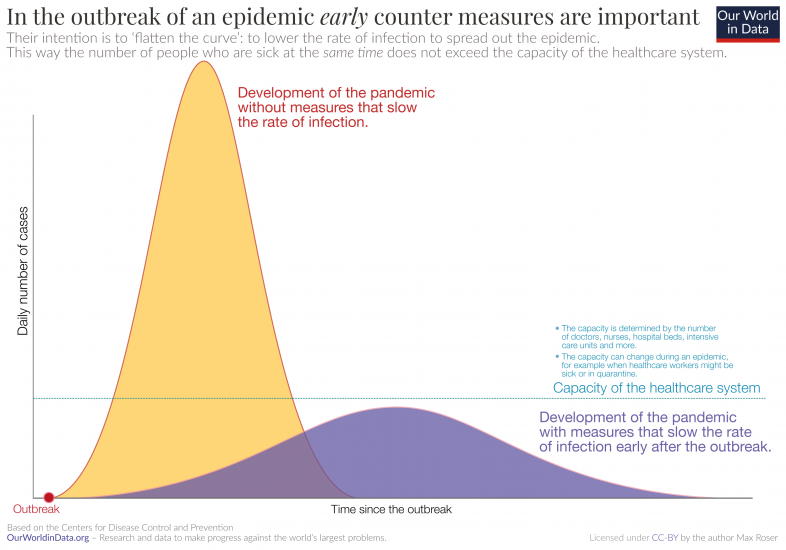
  2. We talked a lot about the COVID-19 virus and global pandemics. During class I noted the World Health Organisations (WHO) had not yet declared it a pandemic. The next day (March 11), they did. Here’s the chart I showed on flattening the curve, and the animated version that shows how the “carrying capacity” of the healthcare system is affected.
  3. There’s a lot more information about COVID-19 at the Our world in data site.
  4. Robert Rohde at Berkeley has been charting the daily data. His latest chart is here. See his twitter feed for more.
  5. And here’s the video I showed on epidemics and exponential growth.
  6. We talked about Leverage Points and the Parisian Shower. Here’s the original article that example is from.
  7. The game we played this week is called “Space for Living”.

For next seminar:

  1. Read: Holling Understanding the Complexity of Economic, Ecological, and Social Systems
(10)
Tues
Mar 17, 2020
No Seminar – A pause while we figure out how to take the course online due to COVID-19 pandemic
Tues
Mar 24, 2020
Pandemics
  • How pandemics work
  • Links between the pandemic and climate change
Notes:
  1. Class will be online. Check your email for the zoom link
  2. I only showed four slides today and they were all about the pandemic.
  3. First, updates on the pandemic:
  4. And some links between the pandemic and climate change:

For next seminar:

  1. Read: Checkland’s Soft Systems Methodology: A Thirty Year Retrospective
(11)
Tues
Mar 31, 2020
Interpretive Systems Thinking
  • The Adaptive Cycle
  • Panarchy Theory
  • Principle of Complementarity
  • Soft Systems Analysis
Notes:
  1. Class will be online again. Same link as last week.
  2. Here are the slides I showed this week
  3. We spent some time discussing the Adaptive Cycle. The original book on panarchy is Gunderson & Hollings “Panarchy: Understanding transformations in Human and Natural Systems
  4. For more on resilience, I highly recommend Walker & Salt’s book, “Resilience Thinking“, which also, I think, offers a clearer introduction to the panarchy model too.
  5. See also, Fath et al, 2015, Navigating the adaptive cycle: an approach to managing the resilience of social systems
  6. See also Stirling’s paper “Keep it Complex“, where he points out that there’s a tendency to over-simplify policy prescriptions when we look for science-based policymaking, and that a more pluralistic approach that is needed, one that takes the complexity seriously
  7. And I used an example of panarchy applied to the energy transition in the face of climate change, from this paper by Dangerman and Schellnhuber.

For next seminar:

  1. Read: Midgely et al, The Theory and Practice of Boundary Critique
(12)
Tues
April 7, 2020
Critical Systems Thinking
  • Critical Systems Heuristics
  • Boundary Critique
  • Intellectual history of Systems Thinking
  • Course Summary
Notes:
  1. Here are the slides I used this week.
  2. The idea of a Wicked Problem was identifed in a classic paper by Rittel and Webber, Dilemmas in a General Theory of Planning
  3. By way of introduction to Critical Systems Thinking, I talked about Stephen Toulmin‘s work on the structure of arguments. Here’s a blog post from Ulrich tracing the philosophical roots of his thinking to Toulmin and Habermas.
  4. The most readable introduction to critical systems heuristics is Ulrich’s A Brief Introduction to Critical Systems Heuristics (CSH).
  5. We used a mindmap of “Solving Global Warming” (from this site) as a warm-up exercise for boundary critique. The mindmap on its own is a good summary of the messages we typically hear about what we ought to do to address climate change. But an examination of what has been left out and why is interesting: this kind of message completely lets governments and corporations off the hook, and suggests it’s up to us as individuals to change what we do. Which means inevitably, action on climate change is seen as a voluntary lifestyle choice, rather than a deeper systemic dilemma.
  6. I used two examples of to illustrate boundary critique, where people draw boundaries in different places. The first was on protests about genetically modified food; and the second, a very recent post on expert responses to the COVID-19 pandemic.
  7. We also met Ulrich’s observation that researchers ought to trangress a boundary at least once a week. Here’s a blog post in which he expands on this idea.
  8. I mentioned Michael Jackson’s book, Systems Thinking: Creative Holism for Managers. Don’t let the “for managers” in the title put you off. It’s a surprisingly good overview of the main strands of systems thinking over the past half century or so. The book is expensive to buy from major online retailers, but Abe Books has plenty of used copies.
  9. I skimmed over the intellectual history of Systems Thinking, but you might want to explore further using this map of the history of systems thinking and complexity science. There’s also the ASC timeline for cybernetics, and Robert Horn’s mural(although I can only find a sketch of it online).
  10. Finally, we talked about the systemic nature of pandemic responses, and in particular, the dynamics of lifting the lockdown restrictions. We explored this brand new (unpublished) study by Tuite et al on Ontario’s pandemic response, and a new report on a modeling study in the Netherlands (auto-translated from Dutch).

Useful Material

Books

Meadows DH. Thinking in systems: A primer. Chelsea Green Publishing; 2008.
Meadows is the main text we’ll use for the first half of the course. Its a book I thorooughly recommend buying (as you’ll want to re-read it every few years). It’s a very readable introduction to the basics of systems dynamics.
Weinberg GM. An Introduction to General Systems Theory. Dorset House; 2001.
Weinberg is an interesting alternative to Meadows, especially appropriate for those with a background in the physical sciences, because he spends a lot of time contrasting systems thinking with the traditional reductionism used in science. For a review of Weinberg’s book, see here
Jackson MC. Systems Approaches to Management. Springer; 2000.
A very detailed account of the history and philosophical roots of different strands of systems thinking. It’s comprehensive, but that makes it a little heavy going to read.
Ramage M, Shipp K. Systems Thinkers. Springer; 2009.
This book is about 30 of the most prominent people in the development of the field. For each person, it provides a brief biography, and an excerpt from their writings (so they speak in their own words). This will be very useful as a source book for your presentations.
Walker BH, Salt D. Resilience thinking: sustaining ecosystems and people in a changing world. Island Press; 2006.
Applies systems thinking to explore how to make socio-ecological systems more resilient to future shocks. Resilience is an important systems concept – it refers to the ability of a system to withstand sudden changes. The book includes five major case studies, interleaved with the conceptual chapters. Excellent reading!
Garvey J. The ethics of climate change: right and wrong in a warming world. Continuum International Publishing; 2008.
Excellent book on the overall idea of what an ethical response to the challenge of climate change even means. It’s not specifically about systems thinking, but Garvey is certainly a systems thinker. He demonstrates that climate change is unusual as an ethical problem,because the causes and consequences are smeared out across time and space. He then frames the central question as how we divide up a shared limited resource: the atmosphere as a carbon sink. I reviewed the book here.
Booth Sweeney L. The systems thinking playbook: Exercises to Stretch and Build Learning and Systems Thinking Capabilities. Chelsea Green Publishing; 2010.
This is the book from which most of the activities on the course are taken. I suggest *not* reading this until after the end of the course – the exercises will work better if you experience them before reading about them.
Downey AB. Think Complexity. Green Tea Press; 2011.
For anyone who likes programming (in Python), this book covers many of the key ideas on complexity science, chaos, and self-organising systems, with a whole series of programming examples so you can build your own simulations models. And the book is free online – just click the link!
Gundersson L, Holling CS. Panarchy: Understanding Transformations In Human And Natural Systems. Island Press; 2002.
This book extends some of the ideas of systems dynamics to talk about why systems change and why collapse occurs.

Media

Papers

Introductory Papers

Modeling

Applications

The Global Problematique

a response by Rockstrom

Limits to Growth

Climate Change

Peak Oil

Agriculture

Advanced Topics

On Teaching Systems Thinking

Other Sources


via Systems Thinking for Global Problems

RSD9 Symposium « Systemic Design Association – 12-17 October 2020, online, hosted by the National Institute of Design, Ahmedabad, India

Now online, October 12-17 2020 via http://rsd9.org/

]via RSD9 Symposium « Systemic Design Association

RSD9 Symposium

National Institute of Design, Ahmedabad, India

In our myopic race towards progress humans have forgotten the interdependent web of life, putting the entire planet and its living beings deeper into issues of climate change, food scarcity, financial instability, energy shortages and resource unavailability. It is only through the lens of systemic thinking, with an understanding of the relational nature of action on any scale being resonated at all levels, can resolving of these issues be meaningful. We can with shifting our focus to a holistic human service approach and revisiting our ‘ways of understanding’ synchronise nature’s dynamic balance and our well-being.

See the Call for Participation – open now through May 10.

National Institute of Design is located in Ahmedabad, India.

The Relating Systems Thinking and Design Symposium series started at AHO in Oslo in 2012.  The series has the intention to promote and foster the emerging practices and theory development for systemic design for service systems, social systems, policy development and complex contexts. RSD has been held in Europe and North America, in Oslo, Banff, Toronto, Torino, and Chicago. In 2020, RSD will be held at the National Institute of Design, Ahmedabad, India.

The RSD conferences are organized by the local hosts with the sanction, guidance and assistance of the Systemic Design Association (SDA) a democratic membership organisation registered in Norway. Become a member of the SDA on the same site today.

We will soon communicate any plans for contingencies and virtual alternatives. Look for registartion to open in June, as well as the conference program, travel and accommodation updates.

Join us at the 9th RSD in India!

Source RSD9 Symposium « Systemic Design Association

oftwominds-Charles Hugh Smith: Our Inevitable Collapse: We Can’t Save a Fragile Economy With Bailouts That Increase Fragility

via oftwominds-Charles Hugh Smith: Our Inevitable Collapse: We Can’t Save a Fragile Economy With Bailouts That Increase Fragility

FRIDAY, MAY 01, 2020

Our Inevitable Collapse: We Can’t Save a Fragile Economy With Bailouts That Increase Fragility

By bailing out the sources of systemic fragility with trillions of dollars, the Fed has shifted the risk to the entire financial system and the nation’s currency.
That the global economy is fragile is painfully obvious to all. What is less obvious is the bailouts intended to “save” the fragile economy actively increase its fragility, setting up an inevitable collapse of the entire precarious system.
Systems that are highly centralized, i.e. dependent on a handful of nodes that are each points of failure–are intrinsically fragile and prone to collapse. Put another way, systems in which all the critical nodes are tightly bound are prone to domino-like cascades of failure as any one point of failure quickly disrupts every other critical node that is bound to it.
Ours is an economy in which capital, wealth, power and control are concentrated in a few nodes of the network/ecosystem we call “the economy.” A handful of corporations own the vast majority of the media, a handful of banks control most of the lending and capital, a handful of hospital chains, pharmaceutical companies and insurers control healthcare, and so on.
Control of digital technologies is even more concentrated, in virtual monopolies: Google for search and Youtube, etc. and Facebook / Instagram and Twitter for social media, Microsoft and Apple for operating systems and services derived from OS, and so on.
The vast majority of participants in the economy are tightly bound to these concentrated nodes of capital and power, and these top-down, hierarchical dependencies generate fragility.
When unexpectedly severe variability and volatility occur, the disruption of a few nodes brings down the entire system. Thus the disruption of the subprime mortgage subsystem–a relatively small part of the total mortgage market and a tiny slice of the global financial system–nearly brought down the entire global financial system in 2008 because the GFS is a tightly bound system of centralized concentrations of capital, power and control.
Currently, we’re seeing the fragility of a meat production system that has concentrated ownership and production of meatpacking into a relatively few nodes on which the entire food supply chain is totally dependent.
And so what’s the status quo “fix” when this intrinsically fragile system comes apart? Increase its fragility by bailing out the most tightly bound, dominant nodes. This is what the monopoly on creating currency, the Federal Reserve, is doing on a vast scale.
Rather than reducing the fragility of the system, the Federal Reserve is increasing the fragility, guaranteeing a collapse of not just the financial system but the currency as well.

Philosophy of alternative stable states: teleonomy meets teleology – Systems Changes – Open Learning Commons – David Ing


via Philosophy of alternative stable states: teleonomy meets teleology – Systems Changes – Open Learning Commons

Apr 29, Apr 30

Underlying many of the approaches to “systems change” is teleology – “a reason or explanation for something as a function of its end, purpose, or goal”. Moving beyond social systems into other domains (e.g. biology, ecology) raises questions about whether nature has an end or purpose.

An alternative philosophy is based on teleonomy – “the quality of apparent purposefulness and of goal-directedness of structures and functions in living organisms”. This came up in a recent meeting. I then had some online communications with @Zemina .

The philosophy of science that I’ve taken on is not teleology – goal-directed behavior – but teleonomy https://en.wikipedia.org/wiki/Teleonomy – that essentially means that you don’t work from the future-backwards, but that you are able to program options for your future.

See more in source.

via Philosophy of alternative stable states: teleonomy meets teleology – Systems Changes – Open Learning Commons

I note with interest that in David’s Open Innovation Learning book (a section of the post signposts to a section of this for more), he points to Aristotle’s four causes:

Aristotle offered four explanations of why in four causes:

(i) material cause (that out of which)

(ii) the formal cause (the account of what it-is-to-be)

(iii) the efficient cause (the primary source of change or rest)

(iv) the final cause (the end, that for the sake of which a thing is done

This is pretty powerful stuff to play around with, and reminds me of my distinction, for organisations, between

(1) espoused purpose – the mission statement

(2) de facto purpose or POSIWID – the actual behaviour and outcomes which the organisation is producing (see forthcoming podcast interview with Allenna Leonard for more on this) an

(3) deep, meaningful purpose – the empowering purpose to which the organisation could aspire (usually neither of the above)


s
search
c
compose new post
r
reply
e
edit
t
go to top
j
go to the next post or comment
k
go to the previous post or comment
o
toggle comment visibility
esc
cancel edit post or comment